
CWS TRIPOD
DISCIPLE 2
INTO THE WORD, INTO THE WORLD


 Word of God
|
DISCIPLE 2 INTO THE WORD, INTO THE WORLD
|
||||||
| L1 | L2 | L3 | L4 | L5 | L6 | L7 |
| L8 | L9 | L10 | L11 | L12 | L13 | L14 |
| L15 | L16 | L17 | L18 | L19 | L20 | L21 |
| L22 | L23 | L24 | L25 | L26 | L27 | L28 |
| L29 | L30 | L31 | L32 | |||
|
The Discipleship and Nurture (D&N) Ministry provides focus and attention to:
Every believer matters to Christ and a disciple of Christ is a lifelong learner. Discipleship is a relationship where we stand in Christ and take on His character. We learn from Him, how to live life as He would. It is the intention of our Church to help each believer to grow spiritually as a child of God. Courses at different levels are planned and conducted to build our foundation in the word of God and help us to engage in various spiritual disciplines. We are not just looking at being informed, but to be transformed as we discipline ourselves to become true Disciples of Christ.
|
|
DISCIPLE 2: INTO THE WORD, INTO THE WORLD We understand that as a growing Christian under discipline in community and in ministry to the world, approaching all experiences of life as opportunities for faithful witness and service, run over 32 weeks. This study concentrates on four books: Genesis, Exodus, Luke, and Acts (eight lessons on each book). Appropriate connections are made to other parts of Scripture both through reading and study assignments and through commentary in the study manual. Participants will read familiar passages, see them in fresh ways, and anticipate that God will speak through them.
|

 |
||
 |
 |
DISCIPLE 2: INTO THE WORD, INTO THE WORLD
D2 CLASS
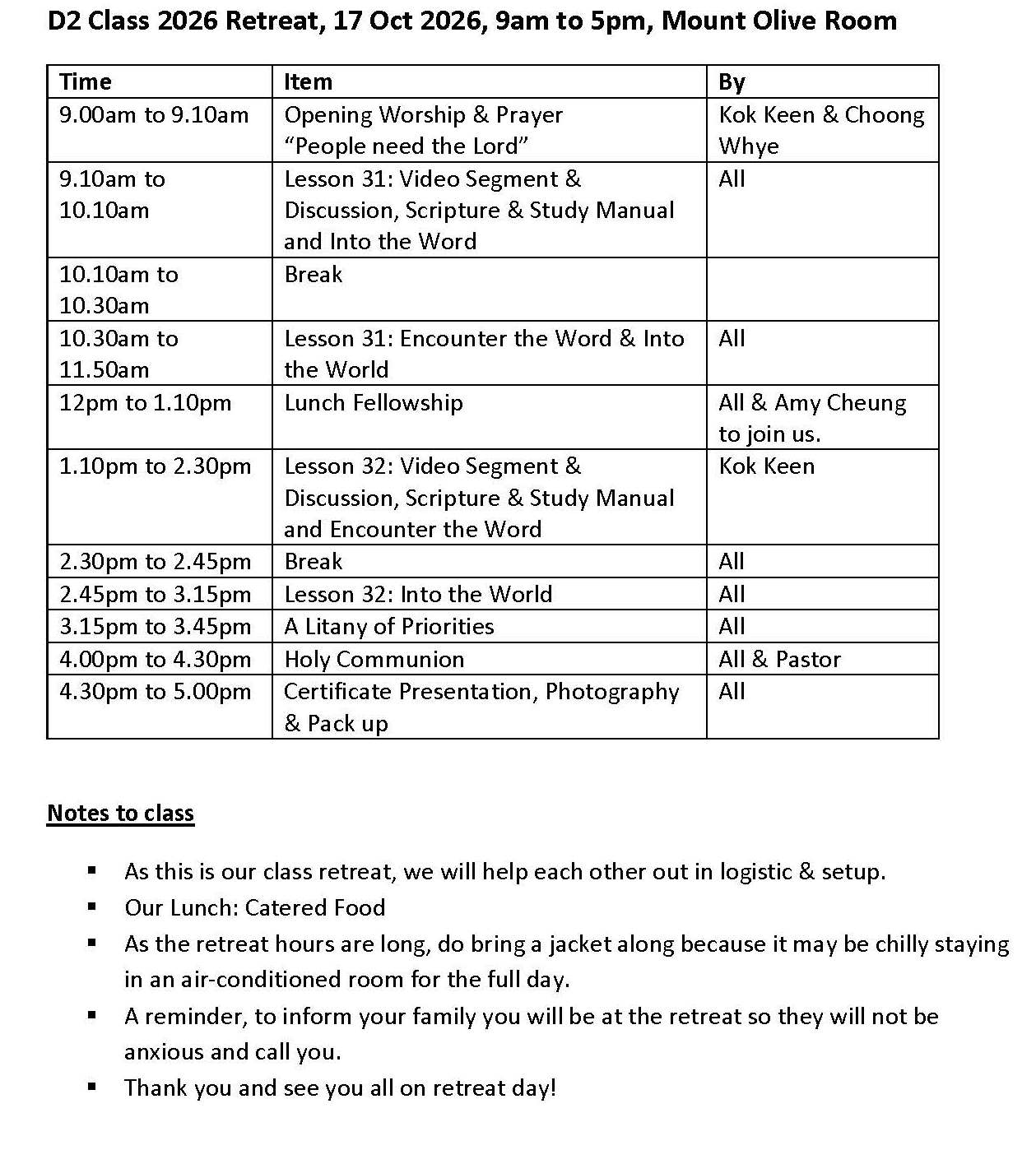
2026, every Wednesday, 7.30pm to 10pm Closing Retreat on 17 October, Sat,
9am to 5pm
|
S/N |
TOPIC |
DATE |
FOCUS |
REMARKS |
|
|
OLD TESTAMENT |
|
|
|
|
1 |
God Speaks |
25 February |
Celebration |
L1 |
|
2 |
God Scatters the Proud |
4 March |
Confession |
L2 |
|
3 |
God Welcomes |
11 March |
Service |
|
|
4 |
Carrying the Covenant |
18 March |
Submission |
L4 |
|
5 |
Conflict Within the Family |
25 March |
Worship |
|
|
6 |
Wrestling With God |
1 April |
Prayer |
L6 |
|
7 |
In God's Time |
8 April |
Solitude |
|
|
8 |
God Works for Good |
15 April |
Celebration |
L8 |
|
9 |
The Bonds of Slavery |
22 April |
Submission |
L9 |
|
10 |
God in the Fire |
29 April |
Meditation |
L10 |
|
11 |
God Opens the Sea |
6 May |
Guidance |
L11 |
|
12 |
Amid the Struggle God Provides |
13 May |
Fasting |
L12 |
|
13 |
God's Commands |
20 May |
Study |
L13 |
|
14 |
The Just Laws of God |
3 June |
Simplicity |
L14 |
|
15 |
Protector of the Powerless |
l0June |
Generosity |
L15 |
|
16 |
God's Dwelling Place |
1 July |
Worship |
L16 |
|
|
NEW TESTAMENT |
|
|
|
|
17 |
Good News for the Whole World |
8 July |
Study |
L17 |
|
18 |
Our Savior Has Come |
15 July |
Solitude |
L18 |
|
19 |
Teach Us to Pray |
22 July |
Prayer |
L19 |
|
20 |
Despising His Goodness |
29 July |
Confessing |
L20 |
|
21 |
Teach Us How to Live |
5 August |
Service |
L21 |
|
22 |
Signs of God's Rule |
12 August |
Submission |
L22 |
|
23 |
Learning to Follow |
19 August |
Simplicity |
L23 |
|
24 |
Sent as Witnesses |
26 August |
Prayer |
L24 |
|
25 |
Acts of the Holy Spirit |
2 September |
Guidance |
L25 |
|
26 |
Community in Jerusalem |
9 September |
Service |
L26 |
|
27 |
Missionary Zeal |
16 September |
Fasting |
|
|
28 |
Count it Joy |
23 September |
Celebration |
L28 |
|
29 |
Fellowship of Courage |
30 September |
Generosity |
L29 |
|
30 |
Temples, Politics & Business |
7 October |
Service |
L30 |
|
31 |
Boldness for the Gospel |
Class Retreat - 17 Oct (Sat) (9am to 5pm) |
Guidance Commitment |
|
|
32 |
Ordering Our Lives |
1 God Speaks RESPECT
"Then God said, 'Let there be light'; and there was light. And God saw that the
light was good."
-Genesis 1:3-4
OUR HUMAN CONDITION
The world and all that is in it was created for human beings. So I make the most
of it, enjoy life, and use everything available to me.
ASSIGNMENT
This week you will be opening Torah. Turn
Through these first five books of the Bible; noticing headings and major themes.
Get acquainted with the study aids provided in your Bible.
In Genesis we stand in awe before a wonderful and bewildering universe. Read
Genesis 1-2 slow-ly, looking for new meanings. Read the psalms and the Isaiah
passage as though you were look-ing at a painting.
Day 1 Introductory articles in your Bible on the Old Testament, the Pentateuch,
Genesis, and Exodus.
Day 2 Genesis 1:1-2:3 (a priestly Creation ac-count, sabbath). Learn what God is
like.
Day 3 Genesis 2:4-25 (an early, earthy Creation story). Learn what humankind is
like.
Day 4 Psalms 104; 145 (praise to the Creator) Day 5 Psalm 147 (God cares and
provides);
Isaiah 40:12-31 (God the Creator) Day 6 Study Manual
Day 7 Rest
Making Connections: Come to your study of Scripture with an open mind and an
open heart ready to receive what God will reveal to you.
BASIC RESOURCE LIBRARY
Assignment: _
SPIRITUAL DISCIPLINES
Celebration. As we learn to trust God to pro-vide, we begin to see ourselves in
proper relation-ship to God's total creation, which frees us for obedience
experienced as joy.
PRAYER
Pray daily before study:
"I will praise you, LoRD, with all my heart;
I will tell of all the wonderful things you have done.
I will sing with joy because of you.
I will sing praise to you, Almighty God" (Psalm 9:1-2, TEV).
Prayer concerns for this week:
Day 1 Introductory material in the Bible, Torah
Day 4 Psalms 104; 145 (praise to the Creator)
Day 2 Genesis 1:1-2:3 (a priestly Creation ac-count, sabbath)
Day 5 Psalm 147 (God cares and provides); Isaiah 40:12-31 (God the Creator)
Day 3 Genesis 2:4-25 (an early, earthy Crea-tion story)
Day 6 Study Manual
INTO THE WORD
We enter, not only the powerful Creation stories nor even just the mighty Book of
Genesis. We are opening the pages of
Torah, that vast unified narrative that reaches from the first stirrings of
creation to that moment when the Hebrew tribes stood on Jordan's banks, ready to
cross over into the land of promise.
The first five books of the Bible have long been seen as a spiritual and
literary unit. Sometimes called the Pentateuch, penta meaning "five," teuch
meaning "book" or "scroll," hence the "Five Scrolls," it includes the first five
books of the Bible: Genesis, Exodus, Leviticus, Numbers, and Deuteronomy. These
books are called Torah, a word hat is often translated "law" but is more
accurately understood as "instruction" or "teaching." Traditionally Torah has been attributed to Moses, because his laws and his
powerful person-hood stand at its center. Torah provides the foundation for
Jewish thought and practice. An
ancient rabbi might quote the prophets or the psalms; but if he really wanted to
be authorita-tive, he would quote from Torah, the instruction of Moses. Torah is
bedrock, the heartbeat of Judaism, the authority for all that follows. Some
Jewish scholars would say that the remainder of the Old Testament and all other
written material and all oral tradition are simply elaborations of Torah.
The basic theme of Torah is this: God, the Creator of the world, called the
patriarchs and matriarchs to be a blessing to the nations and promised them the
land of Canaan. When Israel became enslaved in Egypt and numerous, God freed
them from bondage and led them through the wilderness with wonderful
demonstrations of grace. God continually taught them how to live as a covenant
community. Then after their lengthy wanderings, God gave them, under Joshua, the
land of promise.
This theme is not always easy to perceive, because the Bible uses a variety of
literary forms.
But to the reader whose spiritual eye is open, the ysterious thread of God's
gracious work runs
through it all.
Genesis: Creation
Two Creation stories swing wide the door to Torah. The first is a sophisticated,
thoughtful, majestic account laced with theological insight. The second is a
story-earthy, primitive, playful,
hinting at truths yet to be explored. Each interacts with the other to give us a
rich creational and caring faith.
The beginning words could be translated as "When God began creating the heavens
and the earth." The first note struck is God. God was. God spoke. "God said... "
and it was done. The universe takes form and the Bible begins when God speaks
(see John 1:1-4).
Other cultures told their own creation stories. The Babylonians had a dualism, a
power struggle between good and evil. But the Hebrew faith declares that God
created everything. God spoke. The power, the authority, is in God's Word.
Later religions and philosophers defined matter as evil, human flesh as corrupt,
the physical side of life as sinful. But in Genesis God announced each day that
the created order was good. God's Word called it into being and made it so.
Notice that God made the sun. In Egypt, peo-ple worshiped Ra, the sun god. The
sun is no god, says Genesis, but is a part of the created order. In Mesopotamia
people worshiped Nanna, the moon god. The moon is no god, says the Bible, but
was placed in space by the Word of the Lord. "And the stars" (Genesis 1:16),
those ma-terial things that some people believe control their destiny, God's
Word added them to the sky.
Why the detail on plants, fish, and animals? Because pantheism, that is, the
notion that God exists in and through the created order, is reject-ed. The
universe is not God; God is the Creator and Sustainer, not simply the life force
within.
Animism, that primitive religion that sees a god in every tree, every mountain,
even the wind, that kind of religion is dismissed by Genesis.
Polytheism, the notion of many gods, is also demolished, for the one holy and
almighty God, who was before all time, created everything that is. Even the
great sea monsters, so feared by ancient peoples, are mere playthings for God
and under God's control.
A priestly influence shows in 1:14. The sun and moon and stars are created, in
part, so that we can know when to celebrate religious festivals and holy days.
What about humankind? God created human beings after the plants and the animals
in the created order. They were made in God's image on the sixth day, given
authority, pronounced very good. The term image of God (imago dei) has caused
all thoughtful people to ponder. What does it mean?
Some say that to be in the image of God is to have the ability to decide, to
think, to choose. That which separates us from the birds and the animals, the
rocks and the trees is the will.
Others suggest that image of God means to be able to relate, to love. That it is
not good for human beings to live alone jumps out at us from both Creation
stories and becomes a biblical theme. When people are alone, as Jacob or Joseph
was alone, they are in trouble.
Another interesting way to explain image of God is to focus not on ourselves but
on others. Other people are made in the image of God. Our neighbor reflects the
being of the divine. Confronted by you, I am reminded of who God is. Therefore,
we should treat other people with respect because they represent the Holy One.
My neighbor has intrinsic worth because he or she is the image of God. So I also
have intrinsic worth, as well as considerable respo"nsibility, because I too am
the image of God.
What is your understanding of the responsibility that
comes with bearing the image of God?
Careful study will show that the first Creation story should end with Genesis
2:3. The priestly em2hasis on sabbath clearly flows out of the account of the
six days of Creation. God acted on the seventh day too; God rested.
Now here is a point pondered across the centuries. What is the climax, the apex
of Creation? The creation of humankind or the creation of sabbath? Which is more
important, the image of God to have dominion over the earth, to live in love
relationship both with God and with neighbor? Or sabbath rest that proclaims God
as Creator and gives all creatures and creation a time to rest, knowing that
everything that exists has its being in the graceful hands of God? What is life
without perspective?
What does each of these spiritual truths say to you?
The second Creation story is older, down to earth, whimsical. God seems to start
with a piece of dried-up desert. When God acts, life springs forth: Water begins
to flow over "the whole face of the ground" (2:6).
The root meaning of the Hebrew word for formed (2:7), sometimes translated
"molded," may be seen in a potter at a potter's wheel. The Lord took dirt from
the ground-re-member the relationship between humankind and earth-
functioned as a potter, and then breathed into the clay
The Talmud is the basis of religious authority for Judaism. Consisting of two
parts, the Mishnah (code of law) and the Gemara (record of rabbinic discussions
and interpretations of the law), the Talmud was the most important factor in
unifying Judaism after the destruction of the Temple in A.D. 70. Much of the
oral tradition debated about at Jesus' time was later recorded in the
Talmud.There are two versions of the Talmud. The largest and most authoritative
one is the Babylonian Talmud, produced by the academies in Babylon between A.D.
400-500; and the other is called the Jerusalem or Palestinian Talmud, produced
by the acade-mies of Palestine about a hundred years earlier.
Four strands or sources have been identi-fied as woven together in the text of
the Pentateuch.
They are commonly identified by scholars by the letters J, E, P,
and D.
• J is identified from its use of Jehovah (more accurately Yahweh), as the name
of God and is associated with the Southern Kingdom, Judah. It dates from 950-850
B.C.
• E is identified from its use of Elohim as the name of God. The writer or
editor, called the Elohist, may have been a priest at Bethel; so E is associated
with the Northern Kingdom, sometimes called Ephraim. It dates from about 750 B.c.
• P is called the Priestly Document and was written in Jerusalem about 450 e.c.
It in-cludes most of the liturgical, genealogical, and technical writings and
has very little narrative.
• D is identified as the work of the Deu-teronomist, a priest in Jerusalem. This
strand is the Deuteronomic Code found in the Temple and read to the Judeans by
King Josiah in 621 e.c. It contains the second version of the Ten Commandments
and much of the special laws.
In figure "the breath of life." In Hebrew the word is ruach, and in Greek
the word is pnuema; both words mean wind, air, breath, and Spirit. "And the man
became a living • being" (2:7), literally, "a bundle of needs and desires."
"The tree of the knowledge o good and evil" (2:9, 17) refers more to experience
than to head knowledge. The Hebrew word for good can mean nice, pleasant,
beautiful, as well as morally right. The word for evil can mean bad, vicious,
wicked, as well as wrong. So to eat from this tree of knowledge would mean to
open oneself to knowing a whole range of experiences, some desirable, some
distor-tions of life.
What does this tree symbolize? Boundaries; Always in life boundaries, limits,
exist. But the tree attracts our attention in yet another way. Right and wrong,
good and evil stand also at the doorway of Scripture. God's holiness looms large
in the strange tree. Human tendency to want more, to think, If only I could get
... , if only I could have ... , then I would be happy, is overshadowed. God's
holy boundaries are symbolically perceived in this strange tree.
The word helper (2:20) is most often used of God. "God is my helper" (Psalm
54:4). In English, helper can mean one who serves or waits on another. But here
helper is' one who comes to my aid, one who is my strong companion.
The man falls into a deep slee-p, a trance. Implied is a religious experience,
muo like Jacob had when he slept at Betfie (Genesis 28:10-22). The rib
symbolizes a "side by side" arrangement, "bone of my bones and flesh of my
flesh" (2:23). That, says the Bible, is why young men leave home. Woman and man
were made to help each other.
Naked, but experiencing no guilt, no shame, not afraid-such was the original
vision of innocence.
The Testimony of the Universe
Creation is a witness to God. How can anyone ever deny the reality of God, with
the mountains, the trees, and particularly the skies giving witness?
"The heavens are telling [telling about] the glory of God; and the firmament
proclaims [shouts about] his
handiwork.
Day to day pours forth speech [like a daily newspaper],
and night to night declares knowledge [like an encyclo-pedia]" (Psalm 19:1-2).
The sun's rays are silent. So are the moonbeams. "Yet their voice goes out
through all the earth" (19:4).
No wonder Paul in the New Testament argued that every person ought to know that
a Creator God exists. "Ever since the creation of the world his eternal power
and divine nature, invisible though they are; have been understood and seen
through the things he has made. So they [humqn beings] are without excuse"
(Romans 1:20).
Reread Psalm 104; take time to savor, to wonder, to The early Hebrews' Idea of
the universe Is reflected In many Old Testament Scriptures. Compare the drawing
with Genesis 1:14-17; 7:11; 8:2; Numbers 16:30-32; Psalms 18:15;
30:3; Job 38:22-26.
appreciate the diversity and glorious array of beauty in God's creation. Look
for evidences of order in the creation.
What aspects of creation draw you especially near to God and cause you to praise
the Creator?
Connectedness
Both Creation stories convey connectedness. Humankind stands not in isolation
from the rest of created order but in mutual rel_ationship with it. From the
very dust of the earth humans were made. The same chemicals are in human bodies
that are in soil and rocks. Without water, air, plants, and animals, men and
women have no home. Just as plants and animals replenish each other in a
mysterious rhythm, so humankind exists and survives in a structure of
interdepen-dency built into creation.
The Character of God
Notice the parentlike feelings you sense in the God of Creation. No impersonal
"first cause," God builds a garden as a mother bird builds a nest. Like a
thoughtful artist, God fashions a being of clay. Nothing is left to chance.
Water, food, air, beauty-all are provided by the God of grace.
Even loneliness concerns God, so God creates a helper or companion for the man.
Right away, the Bible teaches us to make way for a God of compassion and for
human beings who are a part of created order yet somehow standing above it and
responsible for it, and strangely able to relate to the Creator.
Respect for Creation
Sin will strike us down in Genesis 3. We will spend the rest of the Bible and
the remainder of human history trying to recover. But Genesis 1-2 gives us the
original intent of creation. From the opening moments, men and women had
J their responsibilities. God created a garden, put people in
it, and then put a hoe in their hands. Work was not
invented with sin. Unfruitful, unfulfilling work was. But with the garden came
cultivation and caretaking obligations. "The LoRD God took the man and put him
in the garden of Eden to till it and keep it" (2:15). Not just "till it" but
also "keep it."
Human beings "have dominion" over everything (1:26). Human say-so would exercise
authority. Not as cocreators but as stewards, we are called upon to guard and
protect all that God has created.
Naming the animals and birds provided an opportunity for human authority. The
act of naming carries with it a certain power over what we name. And we do have
power,awesome power, over plants and animals, rocks and trees,fish and birds,
even air and water. We will be held accountable for our trusteeship. For
creation is not ours to own but ours to care for and to use for God's glory.
What feeling do you have after reading Genesis 1-2 and the Creation psalms? Is
it not respect for God and for the universe? Do not the words cry out, "be
thoughtful," "be considerate," "show reverence for everything God has made"?
Where in Genesis 1 do you hear testimony to an orderly creation, instituted and
sustained by God?
INTO THE WORLD
The Creation accounts call us from indifference to pas-sionate care for the
earth, from an attitude of using whatever is available to an attitude of
protecting earth's resources for future generations.
Never before have we had so much power to affect the created world. Now we can
clear millions of acres of forest. We can destroy the .ozone layer with
automobile exhaust.
We can pollute the earth with waste and the atmosphere with worn-out satellites.
What are your main environmental concerns?
What could you do as a steward of God's creation to link arms with other
concerned people?
What is your church or community doing to recycle aluminum cans, bottles,
newspapers, plastics?
Automobile exhaust is a life-threatening pollutant in most
•parts of the world. What steps can you take toward controlling it?
Sensitize yourself, even with tiny gestures: Use paper rather than plastic bags.
Carry your own coffee mug instead of using plastic cups. Buy only those fast
foods wrapped in paper. Car pool. Encourage retailers to reduce packaging
and then to use only packaging that can be recycled. The power of the consumer
is awesome. What will you do?
The warning signs that acid rain kills forests, animals, and marine life are
growing. Check to discover major pollutants in your region. What can you do?
Plant flowers, shrubs, and trees around your community, church, and home. Some
consumer items such as disposable diapers and plastic garbage bags put severe
stress on the land. Encourage alternatives.
Water, the symbol of our baptism and source of life, must be kept plentiful and
clean. Are there lakes and streams or oceans where you live? What could you do
to keep them clean and clear?
God's Word in My World
This message from God's Word will shape my ministry this week:
I will respond in these ways:
SABBATH
God created the world and then declared sabbath time, time set apart for rest.
God rested; so we rest and celebrate the grandeur and mystery of creation. If
you can, go
outside and look around. Take the created world in through all your senses and
remember you are a part of it. You belong to God your Creator. Read Psalm 8.
IF YOU WANT TO KNOW MORE
Few Christians understand the power of Torah in Jewish faith and culture. Few
understand its influence on the ministry of Jesus Christ and the Scriptures of
the early church. Learn more about Torah by looking up Torah in a Bible
dictionary or handbook.
2 God Scatters the Proud
PRIDE
"Then they said, 'Come, let us build ourselves a city, and a tower with its top
in the heavens, and let us make a name for ourselves; otherwise we shall be
scattered abroad upon the face of the whole earth.' "-Genesis 11:4
OUR HUMAN CONDITION
We want to feel important, to be in charge, to make a name for ourselves. We
don't need any-one else. We'll create our own meaning and take credit for it. We
cannot understand why we feel alienated from others.
ASSIGNMENT
Why read Genesis 11 before Genesis 3? To shake up your thinking; to help you
understand sin in new ways; to think about destructive behav-ior as well as
disobedient actions.
Babel sets the stage for creation of a covenant people through Sarai and Abram.
Solomon is an illustration of pride and deterioration.
Day 1 Genesis 11 (tower of Babel, Shem's de-scendants)
Day 2 Genesis 3 (Adam and Eve)
Day 3 Genesis 4-5 (Cain and Abel, descendants of Adam)
Day 4 Genesis 6-10 (Noah and the Flood) Day 5 1 Kings 6:37-7:12 (King Solomon);
10:1�11:40 (pride and destruction)
Day 6 Study Manual Day 7 Rest
Making Connections: Discover the historical setting for the book: Who wrote it,
when was it written, who was the intended audience, what is the main message?
Look in your Bible for an introduction to each book.
BASIC RESOURCE LIBRARY
Assignment: _
SPIRITUAL DISCIPLINES
Confession. When we face ourselves and give up our pretenses, we recognize that
our sin hurts others as well as us and we experience confession as forgiveness
an.d healing.
PRAYER
Pray daily before study: "Why am I so sad?
Why am I so troubled?
I will put my hope in God,
and once again I will praise him, my savior and my God" (Psalm
42:5, TEV).
Prayer concerns for this week:
INTO THE WORD
he tower of Babel story seems innocent enough. Inserted into a long listing of
Noah's descendants, the story tells us about folks over
in Babylonia who wanted to build a mountain out of mud.
In the story, the people seem happy, like chil-dren at play, all speaking the
same language, zestfully piling one brick on top of another.
What is happening here? Why did God react so strongly? Something sinister must
be lurking in the shadows. Is there a snake somehow sliding through the
symbolism?
For the Jews hearing this story, each word dripped with meaning. The Babylonians
built on a plain. The mountains of Jerusalem were already higher than any
edifice that could be built on a river bottom. They built out of mud! They
shout-ed, "Come on! Let's make bricks and bake them hard" (Genesis 11:3, TEV). A
mud tower that would touch the sky? With tar for mortar? People listening to the
story are smiling; the enterprise is ludicrous.
"Let us build ourselves a city, and a tower with its top in the heavens, and let
us make a name for ourselves" (11:4, italics added). Suddenly we're not talking
about a tower; we're speculating about sin. Looming before our eyes is our own
human-ity, presumptuous, conceited, boasting that we will build right up to
heaven, the habitat of God.
Smug in self-sufficiency, wrapped up in their own bravado, these bricklayers,
symbolic of an arrogant humanity, proudly declare that they with their little
mud house have no need of God.
All humankind is represented by this tribe. After they tired of wandering
aimlessly, they decided to guarantee their own security. With this brick tower,
they would reach beyond themselves to the heavens. They would build a city that
would establish a permanent name for themselves.
For the Bible, pride confronts the will of the sovereign God. "You shall have no
other gods before me" is the first commandment (Exodus 20:3). The divine
holiness that the Bible calls Gocf's "jealousy" will not tolerate human pride
and false assumptions.
So God comes down from heaven to see what is going on. That little speck on the
earth's surface near Babylon, God can't even see it. God has to get off the
throne of heaven, come down and
have a look around, like a parent getting up from a chair and going out to the
back yard to look at
the mud pies the four-year-olds are making with spatulas and teaspoons.
The Hebrew word for dirt or earth is adamah; the Hebrew word for humankind is
adam. We will see, over and over, that Hebrew play on words that reminds us that
humankind is earth with a spirit blown into it. Our sin affects the earth, and
back to the dirt we shall return.
Uninvited, unsolicited, the Almighty came down. God did the same thing in the
cool of the evening, looking for Adam and Eve who were hiding in the bushes
(Genesis 3:8). God also came down and demanded of Cain, "Where is your brother
Abel?" (4:9).
When we disdain God and assume an air of self-sufficiency, pretending that the
creature is in
control, the result is always the same. Remember, "Pride goes before
destruction" (Proverbs 16:18).
"Come, let us go down, and confuse their language there, so that they will not
understand one another's speech" (Genesis 11:7). The play on words continues;
for the noun Babel means "gate of God," and the verb fotm halal means "to
confuse."
God confuses their language so that they fail to communicate. The punishment is
severe. They can't understand one another. They speak at the same time, and
nobody listens. Husband cannot communicate with wife, teenage son with father,
daughter-in-law with mother-in-law, employer with employee, alien with resident,
easterner with wes-terner.
The Lord scatters them abroad; they lose touch.
Babel becomes the word to describe a meaningless confusion of words and voices.
In English, we use the word babble. Don't miss the irony here.
Those tower builders who set out to create their own meaning in life ended up
with meaningless confusion. And their ruin lies in dust.
The foolhardy, pompous enterprise was destined to fail. Empires collapse and are
forgotten. Great buildings eventually disintegrate. "And the dust returns to the
earth as it was, and the breath returns to God who gave it" (Ecclesiastes 12:7).
Just as Adam was formed from clay, so the bricks were made of clay. And pride
takes humankind back to that same clay.
Innocence Is Lost
The word Eden means "plain," "steppe," or "flat region." The image of the garden
in Eden is of peace and happy innocence where all needs are met as a gift of
God's gracious care. Even in Eden, man and woman tended the garden with the
sturdy simplicity of labor.
But "of the tree of the knowledge of good and evil you shall not eat, for in the
day that you eat of it you shall die" (Genesis 2:17). God's prohibition was in
no way oppressive. Yet man and woman asserted themselves precisely at this
point! They broke the one rule. Obedience was the issue, obedience and trust.
Freedom has limits.
The snake talks fast (3:1-5). Even in this primitive story, the human mind was
aware of a temptation that seems to come from outside ourselves. Yet the guilt
of disobedience belongs to man and woman and to them alone. God had given woman
and man all they needed, but they went beyond that to decide for themselves!
After they boldly ate, they found out what "the knowl-edge of good and evil"
means-the full experience of good and evil. They became ashamed, saw that they
were naked, felt guilty, and covered themselves with scratchy, hard-to-wear fig
leaves. Humankind's efforts to deal with guilt are never very successful.
God found them hiding in the garden. They began to make excuses. Pride,
self-centeredness, the haughty spirit, leads to disobedience. Not so different
from the tower of Babel:
Brother Against Brother
Cain probably means "metalworker"; Abel means
"breath," suggesting the fragility of life. Already a tragedy is suggested. Why
God looked with favor on Abel's offering and not on Cain's is not clear. God is
free to be pleased or not pleased. The account does indicate that Abel was a
herdsman and Cain, the elder, was a farmer. Historically conflict has existed
between those two cultures.
Perhaps the issue is the quality of the gifts, or the attitude with which one
chooses one's offering to God-or to a brother. But in the end, the nature of the
offering is not what matters most in this narrative. What matters most
j is the attitude of God. Even if God did not accept Cain's offering, God did
not reject Cain. But Cain was still
responsible for his attitude and his action.
Blood, for the Hebrews, was life. Abel's blood cried out from the earth (Genesis
4:10). Cain, cursed from the ground! Cain, the second-generation farmer,
estranged from the soil!
What is the relation between Adam and Eve's disobedi-ence and Cain's murder of
his brother Abel? Was it not their reaching for what belongs to God-the
knowledge of good and evil, the giving and taking of life? Are not the sins of
the father and mother visited on the children "to the third and fourth
generation" (Deuteronomy 5:9)? Remem-ber in King David's life how his lust and
violence are continued by his sons and daughters (2 Samuel 13).
Remember that Jesus said the two greatest commandments are love of God and love
of neighbor. Surely disobedience toward God (Adam and Eve) inevitably leads to
violation of neighbor (Cain and Abel).
When Evil Is Rampant
Nothing is untouched. No one is unaffected. All human-kind is marked by evil.
"The LoRb saw that the wickedness of humankind was great in the earth, and that
every inclination of the thoughts of their hearts was only evil continually"
(Genesis 6:5).
Now God nearly gives up on the human race. They are determined to choose their
way rather than God's way.
What is God to do now? One option is to close down the whole affair, and God is
tempted to do so.
But God, in mercy and gracious optimism, tries again. God instructs Noah. The
ark is built, pairs of animals are saved, and punishment is again mediated by
God. Although the Flood destroys the world, a remnant has been rescued.
But how quickly sin begins again. Even the casual reader is astonished by Noah's
drunkenness (9:20-21) (wine from the earth, for Noah was a tiller of the soil).
Noah and his ark did not save the world from sin.
God Offers Grace
Look at each of the four stories about sin and punish-ment. Then ask, Where does
grace appear?
Adam and Eve were thrust from the garden; but God extends grace, comfort, and
fresh beginnings, even amid punishment. Yes, the woman will bear pain in
childbirth; yes, the man will toil for food; yes, they both are sent from the
garden, losing their innocence, for something died within them as God had
warned.
Yet God continued to talk with his disobedient children.
And those scratchy fig leaves of human design God re-placed•. "The LoRD God made
garments of skins for the man and for his wife, and clothed them" (Genesis
3:21). God gave them children to bless their marriage. Further-more, God was
willing to try again.
Cain was punished, for the land became increasingly unproductive. (Our sins
against our neighbor corrupt the earth.) "When you till the ground, it will no
longer yield to you its strength; you will be a fugitive and a wanderer on the
earth" (4:12). A terrible punishment. There is always a price to be paid for our
sins. Cain said it was too much. "My punishment is greater than I can bear!"
(4:13). He thought he would never feel God's care again and would be killed even
as he had killed his brother.
"Not so!" says God with amazing grace. God continues in communication, marks
Cain for protection, lets him dwell in the land of Nod (which means
"Wandering"), east of Eden, and allows him to marry and have children.
Humanity was destroyed by the Flood, but Noah and the animals were saved in
God's ark to begin again. Once more God gives life a chance. In fact, God now
establishes a covenant with the earth, promising never to destroy it by flood
again. "I have set my bow [rainbow] in the clouds, and it shall be a sign of the
covenant between me and the earth.... When the bow is in the clouds, I will see
it and remember the everlasting covenant" (9:13, 16).
Still another chance.
But what about the tower of Babel? People are scattered, confused, unable to
communicate with one another. Is God willing to try again? Is there any hope?
Where does the tower story appear? It does not stand alone as the other stories
do. The tower account sits right in the middle of the genealogy of Abraham. It
seems an intrusion. Omit it, and Genesis 11 reads smoothly.
What is God saying? For the scattered sinful people of the world, groping before
a thousand false idols, unable to communicate with the Lord of the universe, God
is at work! God has yet another plan for the salvation of human beings.
Now God will call forth a man and a woman, and God will try again.
"Now the LoRD said to Abram, 'Go from your coun-
try . . . to the land that I will show you. I will make of you a great nation,
and I will bless you, and make your name great.... and in you all the families
of the earth shall be blessed' " (12:1-3).
Once again God will enter human history in a saving way. God again will attempt
to gather the sinful, scattere_d, lonely, guilt-ridden, and confused people of
the world into a fellowship of love and trust.
An Example of Pride
Perhaps the most striking example of tower of Babel mentality in Hebrew history
is King Solomon.
Solomon started well, praying for wisdom (1 Kings 3:3-14) and building the
Temple as God and King David had requested (1 Kings 6). But wealth led to
grandiosity
(10:14-22). His household expenses burdened the entire kingdom.
Solomon spent seven years building the Temple; but he worked thirteen years
building his own palace, which was twice as big. Then he built another palace
just like it for one of his wives, an Egyptian, daughter of Pharaoh.
Solomon's desire to put on a display thrust the people of Canaan into slave
labor, forced Israelites into the army and conscripted labor, and laid a heavy
burden on the nation.
But in the eyes of the Bible, Solomon's growing arro-gance focused on his
idolatry. In the process of taking seven hundred wives and three hundred
concubines, mostly for political purposes, he began to worship the various gods
they brought to his court and even built t�mples for those gods. "So Solomon did
what was evil in the sight of the LoRD." And "the LoRD was angry with Solomon,
because
Genesis 10 lists the.descendants of
Noah's sons-Shem, Ham, Japheth-and the areas populated by them after the Flood.
"From these the nations spread abroad on the earth" (10:32). The three areas of
people, languages, and land are conjoined
by Canaan.
his heart had turned away from the LoRD" (11:6, 9).
The seeds of destruction lay in Solomon,s self-glorifica-tion and vanity. Upon
his death, resentment exploded.
The Northern Kingdom broke away into Israel, the
Southern Kingdom into Judah; and the scattering of the Israelites began
(11:26-40).
Solomon,s sin seems so gradual, so quietly pervasive.
When did it happen? No one can really tell. Try to spot some early signs. .
What signs of pride leading to destruction are common to the stories of Adam and
Eve, Cain and Abel, the Flood, the tower of Babel, and Solomon?
Each story-Babel, Eden, Cain and Abel, Noah and the Flood-probes the mystery of
human alienation from God. Each account recalls human willingness to make chaos
out of order. Each picturesque portrayal reminds us of God's effort to save us
from self-destruction.
INTO THE WORLD
Any security we have rests in God, the author of creation, and not in the work
of our hands.
As you observe life around you, where do you see examples of pride that say, "I
can take care of myself; I don't need God"?
What evidence do you see that God has stepped in to confuse and scatter?
What does the modern-day prideful search for meaning apart from God look like?
What are its outcomes?
Look at your own life to see if you detect a pride that treats God as a back-up:
"I'll manage my own life; when I need help, God, I'll let you know."
NOTES, REFLECTIONS, AND QUESTIONS
How might I minister to others in a society that is fragmented? As I think of
scattered people who cannot communiate, what can I do to build bridges? How might
I reach across the barriers where I live?
God's Word in My World
This message from God's Word will shape my ministry this week:
I will respond in these ways:
SABBATH
Sabbath teaches us that our only real security is in our relationship with God.
On sabbath we let go of our efforts to build monuments so that we will be
remembered. We laugh at our struggles to be important. We put our trust in
J God. Read Matthew 6:25-34 or Ecclesiastes 3:1-15.
IF YOU WANT TO KNOW MORE
l A fascinating account of pride is found in 2 Chronicles 26, the story of King
Uzziah. A boy king at sixteen, Uzziah's authority was characterized by humility
and quiet strength. Open to counsel, he ruled well for nearly forty years. "But
when he had become strong be grew proud, to his destruction'' (26:16). Uzziah,
not satisfied just to be king, swaggered into the Temple, to bum incense as
though he were. a priest. Pride. Communication broke down. Au-thority was
undermined. Sickness swallowed him up. Read the account and its footnotes.
3 God Welcomes
HOSPITALITY
"I have chosen him [Abraham], that he may charge his children and his household
after him to keep the way of the LoRo by doing righteousness and justice; so
that the LoRo may bring about for Abraham what he has promised him."
-Genesis 18:19
OUR HUMAN CONDITION
The invitation comes, but it is scary. It comes as promise without guarantee. We
are on guard, afraid to accept hospitality because it puts us in someone else's
hands. We are afraid to extend hospitality for fear they might accept.
ASSIGNMENT
You know the Abraham and Sarah story fairly well. So read slowly, concentrating
on detail.
Remember that you are watching the inception of whole nations. You are taking
hold of the thread of salvation history that runs through the entire Bible. The
issue is hospitality.
Day 1 Genesis 12-13 (God calls Abram and Sarai, Abram and Lot)
Day 2 Genesis 14-16 (Abram meets Melchizedek, promise of heirs and land, birth
of Ishmael); Malachi 3:1-10 (the tithe)
Day 3 Genesis 17-19 (an everlasting covenant, Abraham and Sarah entertain
strangers); Psalm 16 (song of trust)
Day 4 Genesis 20-21 (Isaac, a child of laughter) Day 5 Jonah (invitation to the
whole earth) Day 6 Study Manual
Day 7 Rest
Making Connections: Clarify the context or setting of the passage. Look at the
verses and the chapters that precede and follow the passage to gain a
perspective for understanding it.
BASIC RESOURCE LIBRARY
Assignment: _
SPIRITUAL DISCIPLINES
Service. At the prompting of the Holy Spirit,
we choose to live as servant,
carrying out our ministry in quiet, ordinary ways, whoever the needy, whatever
the need:
PRAYER
Pray daily before study:
"You have kept your promise, LoRo, and you are good to me, your servant.
Give m� wisdom and knowledge, because I trust in your commands"
(Psalm 119:65-66, TEV).
Prayer concerns for this week:
INTO THE WORD
he initial call of God (Genesis 12:1-9) was essential. The birth of Isaac as fulfillment of promise (21:1-7) was conclusive. But when God visited Abraham and Sarah to eat with them, to activate the promised pregnancy, that surely was the event that linked the promise to reality.
Hospitality to Strangers
Abraham, having trusted and waited for nearly a quarter century since he left
Haran, rested outside his tent. Three men arrived. Who were they? They were God,
incognito. Abraham ran to meet them, offering hospitality and courtesy.
Where had Abraham and Sarah learned hospitality? From their culture, of course.
Hospitality was a duty in their culture. But in a sense we might say they had
learned hospitality at the feet of God. God offered them a place, a homeland, a
blessing, a family, for no apparent reason other than the generous opening of
grace. Why should we give hospitality? Because God has invited us. Because we
may be entertaining angels "without knowing it" (Hebrews 13:2). In the story,
the voices of the three men turn into the voice of God. Why give hospitality?
After the Exodus, the answer was because once you were strangers in Egypt.
Hospitality to the stranger is an act of grace and compassion. In the New
Testament we learn that by offering hospitality we will be recei-ing Christ
himself (Matthew 25:31-40).
Abraham was ninety-nine years old, just circumcised, resting in the heat of the
day. Yet he hurried to meet them (Genesis 18:2). He acted as
if it would be a favor to him to be allowed to serve them (18:3-4). He provided
water, a com-mon courtesy, so that they could wash their feet (18:4). Abraham
killed a fatted calf (Genesis 18:7). You will recall this hospitality when you
study the parable of the lost son (Luke 15:11-32). The bread broken symbolizes
table fellowship, reconciliation, shalom. This meal gives us a model for
biblical hospitality.
The messengers gave a specific time for Sarah's pregnancy and for Isaac's birth.
Her laughter rippled with disbelief. Sarah lied about laughing (Genesis 18:15);
but God, who looked for Adam and Eve in the garden, insists on openness in
relationship. "Oh yes, you did laugh," said the Lord (18:15).
God reaffirmed the covenant with Abraham
(18:16-19). Then the messengers went on to Sodom.
The story of Abraham's bartering with God over Sodom's destruction strikes some
people as strange. Too earthy. Too naive. Abraham and God bargain like merchants
in a Near Eastern marketplace. But that primitive story holds bed-rock biblical
truth.
Abraham and God had eaten together. They understood that sharing a meal was an
act of covenant. They had committed themselves to each other in friendship and
obligation. So now they could argue as trusted friends.
When have you been able to argue with God?
Abraham's compassion pleaded for the innocent of Sodom. Could God's compassion
be less than Abraham's? The grace to save the city, the same grace that put
clothing on Adam and Eve, was still operating.
How many righteous people does it take to save a town? a state? a country? a
world from destruction?
Ten would have sufficed for Sodom, but they were not
available.
Lot
Lot's father Haran died young, so Uncle Abram raised Lot. When their combined
flocks became too large to manage, Abram, in a high-minded act, stood with his
nephew and offered him an abundantly fair choice. Standing at Bethel, they
looked toward Jericho and the rich Jordan Valley extending all the way to the
Dead Sea. Looking in the other direction they saw the rugged terrain of Canaan.
Lot always leaned toward the easy way. He chose the lowlands, the fruited
plains, city life, and proximity to other people (Genesis 13:2-12). Abram's
magnanimous gesture handed Lot an option of hospitality.
In Genesis 19, the angels visited Sodom, a town near the Dead Sea, 1300 feet
below sea level, known for its corruption and wickedness. Lot gravitated to
Sodom. Even then the names of Sodom and Gomorrah were synonymous with evil. In
Genesis 19 the evil is portrayed as a violent rejection of gracious hospitality
coupled with mob rage, homosexual aggression, and attempted gang rape. As
Ezekiel said, Sodom had become a byword for abominations (Ezekiel 16:46-47, 56).
Isaiah calls Judah "Sodom" because the people were offer-ing religious
sacrifices with their hands covered with blood, forgetting to care for the widow
and the orphan (Isaiah 1:10-17). They were substituting ritual for compassion.
Lot was saved because he practiced hospitality to the strangers, even offering
(though it seems abhorrent to us) his daughters to the mob in protection of his
guests (Genesis 19:8). God pleaded with Lot's family to leave; but the
sons-in-law laughed. "Do not look back" was the divine command (19:17). But
Lot's wife hesitated, wistfully
glanced over her shoulder, and was turned into a pillar of salt (19:26). The
image of Lot's wife comes to mind when we hear Jesus urging his followers not to
look back but to follow him without flinching (Luke 9:62).
Notice again the graciousness of God even while dealing with Lot. Lot pleads, "I
cannot flee to the hills Look,
that city is near enough to flee to, and it is a little one. Let me escape
there" (Genesis 19:19-20). God agrees. The stench of sulfur and salt was in
their nostrils, but God still
l provided for them a place.
The Invitation
Now look back to the beginning of the story. Watch God graciously give the invitation to an elderly Semitic couple living in
Mesopotamia.
The Lord invited Abram and Sarai, saying, "Go from your country and your kindred
and your father's house to the land that I will show you. I will make of you a
great nation" (Genesis 12:1-2).
God welcomed a peculiar pair to conceive a family of nations. Abram and Sarai
were a poor risk for a baby. The miracle is that they obeyed. They trusted, even
if they sometimes shook their heads or giggled in puzzlement.
They accepted the invitation.
When did your faith ever take you into the unknown?
A Land
What kind of place was Canaan? Right away we recognize that it was already inhabited. Established cities existed, particularly
in the fertile areas. Other nomads kept flocks
on the hillsides. Altars to Canaanite fertility gods dotted the landscape. Abram
and Sarai did not walk into virgin territory. Their faith in the one God of the
universe would be lived out amid faith in many gods.
Abram built his.first altar near Shechem,
an old Canaanite city with a pagan
cultic center, located between Mount Ebal and Mount Gerizim. Later Shechem was a
key center for the Northern Kingdom, Israel, and in the fourth century
B.c. became the place of worship for the Samaritans.
The area from the Tigris-Euphrates Valley to the coastal strip of Canaan is
called the Fertile Crescent. Areas to the north and south were barren and
uninhabitable during the time of the patriarchs. Early civilizations flourished
in the well-watered Fertile Crescent.
The land of promise was not highly receptive. Hardly had
Abram and Sarai pitched their tents when the rains failed and "there was a
famine in the land" (Genesis 12:10). The semi-arid land of promise could
scarcely provide enough grass for their herds! The land was not a peaceful land
either. In Genesis 14, with the account of the war among the cities around the
Dead Sea, we discover how Abram and Lot were drawn into a war not of their
making. Notice how often the promise of God seemed futile.
In what way does your "land of promise" (physical or spiritual) seem dry,
barren, or hostile?
A Tenth
As the war ends, Melchizedek, king of Salem (often identified with Jerusalem)
and priest of God, steps on stage, bringing bread and wine and giving blessing
(Genesis 14:18-20). Abram in response gives to him "one tenth of everything."
The tithe was less a gift than a sovereign obligation, recognition of a
proprietary claim. So the tithe as a symbol of participation in God's covenant
people began and continues to this day. The tenth as basic faithful-ness runs
through the laws of Moses and continues in the prophet Malachi's plea for
obedience (Malachi 3:1-10).
What do tithing and your tithe mean to you?
What relationship do you see between the tithe and an attitude of hospitality?
In Egypt, Abram was afraid, afraid for his life, so he told the Egyptians that
Sarai was his sister (Genesis 12:10-20).
A half-lie, half-truth, to be sure, for Sarai was the daughter of his father
Terah. Why did he lie? To save his own life. Whom did he jeopardize? His wife
Sarai, the woman of promise, the one without whom the promise could not be
fulfilled. God reprimanded Abram, freed Sarai, and set the covenant couple on
their feet again. As we will see again and again, God will use the covenant
people in spite of their weaknesses and failures. Why? Because God has chosen
them to be a blessing to the nations, and God remains faithful to the covenant.
A Human Solution
When fulfillment of God's promises seems unlikely, we seek our own solutions.
Abram was growing older, and Sarai's. barrenness contin-ued. Sarai took matters
into her own hands. Ten years had passed, Abram was eighty-five, and the divine
program had not come to fruition. If God would not act, they would.
Bent on achieving their own desires, they, in effect, put the promise to one
side. The custom of the day allowed a barren woman to give her slave to her
husband so that the slave might bear a child, as it were, upon the woman's
knees. The child would be considered a legal heir. Hagar named her son Ishmael,
a "wild ass of a man." This human attempt to establish the promised inheritance
did not work. Nevertheless, God with grace and compassion protected both mother
and son.
Names
Names are important in the Bible. A person's character can be determined by his
or her name. Historical circum-stances are often remembered in a name. Sometimes
a life change is symbolized by a name change. Genesis 17 is a dramatic chapter
in which God changes Abram's name to Abraham, affirming once again that Abraham
will become the father of a multitude of nations. Sarai becomes Sarah, who will
be the mother of nations.
Abraham was now ninety-nine years old. To seal the covenant, the old man was
circumcised. So was Ishmael, now age thirteen, and so were all the men of the
house. Circumcision became the outward sign of the covenant and is practiced
among Jews to this day. Notice that circumci-sion of the male organ of progeny
confirmed the promise of life and legacy. God promised life; circumcision
connoted faithfulness. It was a visible sign of the covenant.
Later the prophet Jeremiah pleaded for circumcision of the heart and not merely
circumcision of the flesh (Jere-miah 4:4; 9:25-26). But for Abraham the matter
was not divided. Faithfulness and symbol were the same.
The Promise Fulfilled
The material leading up to the birth of Isaac seems on first glance to be rather
unimportant. Lot continued his deterioration. He had lived in ambiguity all his
life. He simply could never really trust the God of the covenant. "He was afraid
to stay in Zoar; so he lived in a cave with his two daughters" (Genesis 19:30).
He left the village that God had provided and hid in a cave, fearful and alone
with his daughters. They got him drunk and slept with him. Sons were born. Why
bother to record this material? Look at the babies' names: Moab, for whom the
Moabites were named, and Ben-ammi, after whom the Ammonites were named.
These two nations were to become bitter enemies of Abraham's descendants.
The birth of Isaac gave occasion for Sarah to throw her Egyptian maid Hagar and
son Ishmael by Abraham out of the tent. A special verse is this: "God heard the
boy crying" (Genesis 21:17, TEV). God's care and compassion continued for Hagar
and Ishmael even though the covenant would not be carried by Ishmael.
The conflict with Abirnelech continued over a water well dispute. He and Abraham
made a treaty, swore an oath, and avoided bloodshed. Abraham planted a tree in
Beer-sheba, "Well of the oath," and worshiped God.
What has the Bible been telling us? Isaac is coming into a troubled world,
filled with conflict, blood enemies, and historic strife. As we study the Near
East today, after nearly four thousand years, those historic tensions still
exist.
A Message to the Nations
Sometimes people of faith forget the purpose of the invitation. The Hebrews were
blessed to be a blessing, given life so that they could extend life to a dying
world. God's holiness and grace were meant for the whole earth. The seeking
nature of God's saving power and love is designed to bring the whole universe
into shalom and unity.
That's why Abraham was called. "I will make of you a great nation, and I will
bless you, and make your name great, so that you will be a blessing. I will
bless those who bless you, and the one who curses you I will curse; and in you
all the families of the earth shall be blessed" (Genesis 12:2-3).
God repeated the theme of blessing in the angel visitation experience. "Shall I
hide from Abraham what I am about to do, seeing that ... all the nations of the
earth shall be blessed in him?" (18:17-18).
The prophet Isaiah, after the destruction of Jerusalem, when God was returning
the Jews to their homeland, wrote,
"I have given you as a covenant to the people, a light to the nations,
to open the eyes that are blind" (Isaiah 42:6-7).
Again, Isaiah reminded Israel of her holy mission to the world:
"It is too light a thing that you should be my servant to raise up the tribes of
Jacob
and to restore the survivors of Israel; I will give you as a light to the
nations,
that my salvation may reach to the end of the earth" (49:6).
Whoever wrote about Jonah and his call to be a missionary knew that Israel had
forgotten its calling. Jonah means dove; Jonah's father's name, Amittai, means
truth and righteous-ness. It is no accident that the Book of Jonah, probably
written after the Exile, appeared when Israel was withdraw-ing, looking inward,
refusing to associate with foreigners.
Jonah symbolized Israel-the people of Abraham-and Isra-el's call to be light and
life to the whole world.
INTO THE WORLD
Hospitality is an attitude, a posture, a willingness to let others enter your
life. It is Abraham and Sarah welcoming the angels with an unexpected happy
meal.
Hospitality is the willingness to share time and space with another person. It
is Eli taking Samuel into his care. It is Jesus talking with the woman at the
well. It is a father reading a story to his daughter, a boss laughing with an
employee at the water fountain, a prayer group welcoming a newcomer. How are you
developing that attitude, that posture of hospitality?
NOTES, REFLECTIONS, AND QUESTIONS
What kind of risk are you willing to take to offer hospitality?
God's Word in My World
This message from God's Word will shape my ministry this week:
I will respond in these ways:
SABBATH
Sabbath offers time for those God brings into our life.
1 Hospitality is an important part of sabbath. It is an horror to share a
sabbath meal with a guest. The point is simply to include a lonely or needy
person to break bread at your table, someone who cannot pay you back. Share your
sabbath this week with someone who needs a welcome.
IF YOU WANT TO KNOW MORE
Reread the Book of Jonah with the help of a commen-tary. Remember that the
Ninevites to whom Jonah was to preach were Assyrians, who had earlier conquered
the Northern Kingdom, Israel. Why was Jonah so disappointed and angry when
Nineveh repented? Ask yourself why Israel kept forgetting its mission. Ask
yourself why the church of Jesus Christ keeps forgetting its mission.
4 Carrying the Covenant
CONTINUITY
"That very night the LoRD appeared to him [Isaac] and said, 'I am the God of
your father Abraham; do not be afraid, for I am with you and will bless you and
make your offspring numerous for my servant Abraham� sake.' ''
-Genesis 26:24
OUR HUMAN CONDITION
Things go well for a time. Then comes a crisis when we seem trapped. Everything
we've dreamed of, worked for, even prayed for, falls apart. How are we to keep
going?
ASSIGNMENT
The readings are poignant and profound. Each word heavy with emotion. Ponder the
mystery of the near-sacrifice of Isaac. Weep with Abraham as he buries his
partner in faith.. Think how crucial it is to carry on family values, the faith
community. You might enjoy reading each chapter aloud so that you feel it more
intensely.
Day 1 Genesis 22 (God tests Abraham)
pay 2 Genesis 23 (death and burial of Sarah) Day 3 Genesis 24 (search for
Rebekah)
Day 4 Genesis 25-26 (death of Abraham, birth of two nations, covenant reaffirmed
to Isaac, conflict over wells)
Day 5 Deuteronomy 6 (teach the children); Psalm 105 (God's faithfulness)
Day 6 Study Manual Day 7 Rest
Making Connectums: Study Scripture for its power to provide us a memory that
ca11t sustain us-that tells us who we are, where we have come from, and where we
are going.
BASIC RESOURCE LIBRARY
Assignment: _
SPIRITUAL DISCIPLINES
Submission. We find our true identity-an iden-tity born of obedience-when we
give up our need to have our own way and when we turn our attention away from
self and toward others.
PRAYER
Pray daily before study: "Listen, LoRo, to my prayer;
hear my cries for help.
I call to you in times of trouble,
because you answer my prayers" (Psalm 86:6-7, TEV).
Prayer concerns for this week:
INTO THE WORD
With some vacillation, Abraham and Sarah have been people of faith, trusting in
God's promise. They did leave kindred and home, departing on an unknown journey
of faith. Abra-ham did believe the Lord so that "the LoRO reckoned it to him as
righteousness" (Genesis 15:6). He did present the tithe and affirm the covenant
with circumcision. In spite of her laugh-ter of disbelief, Sarah did help offer
hospitality to the strangers and receive the promised "laughter" child.
God's salvation history has begun, but will it self-destruct?
The Test
A crucial test comes in Genesis 22. Now we discover how serious and how
anguishing faith can be. Most readers recoil at the story: "God wouldn't command
a father to sacrifice his son!" "Abraham just must have imagined it." Some
scholars have thought that the story was Israel's way of rejecting infant
sacrifice in Canaan where the practice of offering one's first-born son was
commonplace in cultic worship. But the biblical account insists, "God tested
Abraham" (Genesis 22:1). The instruction was exceptionally clear: "Take your
son, your only son Isaac, whom you love, and go to the land of Moriah, and offer
him there as a burnt offering" (22:2).
Clearly the covenant is at stake. The child of promise is specifically required.
Abraham had surrendered his past when he left Mesopotamia; now he yields up his
future as he walks slowly toward Moriah.
Why did God test Abraham? The Bible gives no explanation. Divine inscrutability
commands. God is the tester.
The story makes a new disclosure about God.
God is the tester. The promise of God is that through Isaac Abraham's
descendants will be named (21:12). The command of God is that Isaac must be
killed. No descendants, no future. Back to barrenness. The pilgrimage has
exhausted itself in emptiness. Can God be trusted completely, totally?
Tests come in the Bible just as they come in life. Job was tested by Satan with
God's permission (Job 1:12; 2:6). Jesus was tempted in the wilderness (Luke
4:1-13) and tested in the garden (Matthew 26:39-46). Can one be tested by
Almighty God even to the point of death? Do we have to drink the cup of
obedience?
Jesus told the disciples that they would be beaten, brought to trial, and hated.
But he pro-mised that •the one who endures to the end will be saved" (Mark
13:13). Early Christians, faced with life-and-death choices, spoke of trials and
temptations.
Recall an experience when you and your faith were tested.
What helped or hindered you?
Often we are ill prepared when testing comes. A trial hits us when we are
recovering from the last crisis. We are easily sent off balance. How can we
prepare spiritually for such crises?
"God himself will provide the lamb for a burnt offering," Abraham said to his
son in a tender moment of highest trust (Genesis 22:8). If salva-tion history
were to continue, if the life-giving legacy were not to disintegrate, God must
pro-vide. Which is harder for us modems to believe, that God would test or that
God will provide? The level of faith is equally intense. When the ram appears in
a thicket, Abraham calls the place "The LoRD will provide ' (22:14).
Suddenly faith stands tall, asserting that God, only God and none other, is the
source of life. God resolves the test with benevolent care. According to
Scripture, the ram does not appear by accident, by nature, or by good fortune.
God, who tested Abraham in scandalous mystery, now provides in equally perplexing graciousness.
In Latin pro video means "to see before," "to
see to," "to see about." Have you sometimes felt uncomfortable when the church
sang hymns like "God Will Take Care of You"? How do you feel about the notion
that God will "see to" all your needs?
Not only is the son Isaac preserved by the providence of God; so also is the
covenant. Abraham's faith is strength-ened by the test. Isaac, "laughter,"
lives; and continuity of the called people clearly depends upon the acts of God.
Christians have always seen the dramatic parallel between Abraham's being
prepared to offer Isaac and God's offering the sacrificial Son Jesus upon the
cross. Is it possible that Jesus was tested even to the point of death to lay
himself fully on the providence of God? Is there a hint of crucifix-ion and
resurrection in the Abraham and Isaac experience? Could it be that the ultimate
act of trust required that Jesus drink the cup to the dregs and that his words
"Father, into your hands I commend my spirit" (Luke 23:46) are his response to
the ultimate test? Is it possible that resurrection is the ultimate conviction
and experience that God will provide?
The Purchase of a Cemetery Lot
Sarah was 127 years old when she died (Genesis 23:1).
Abraham was even older when their bond of bed and board was broken. What does a
man do when his wife, his friend in faith, his fellow pilgrim, dies? Think of
the prayers, the wars, the famines, and the days of wind and sun they had seen
together. Now Abraham weeps, weeps as an old man weeps. He prepares to place her
in the ground (23:2). But whose ground? Father Abraham owned not one fistful of
Canaanite soil. The promise of land was still only a promise.
Sarah "died in faith," as the writer of Hebrews puts it,
"without having received the promises, but from a distance they saw and greeted
them. They confessed that they were
) strangers and foreigners on the earth" (Hebrews 11:13).
She died at Hebron, among the oak trees she loved, where
she and her husband had often pitched their tents. Earlier they had built an
altar near Hebron when nephew Lot had gone bis own way (Genesis 13:18). They
knew well, as friends and enemies, the Hittites, those earlier settlers from
Mesopotamia who owned the land. .
If any place was home, it was Hebron, where the desert
begins to stretch to the south and the hills and mountains reach to the north,
where the Dead Sea leans to the east and the ocean to the west. Besides, it was
the time and place for burial. Later, in the Joseph saga, we will observe
Egyptian funeral manners and customs. But now in Hebron we see Hittite and
Hebrew customs.
Picture in your mind the bartering that takes place in a Near Eastern bazaar.
The words are not what they seem. Watch carefully as Abraham, vulnerable, yet
with great dignity, asks for a place to bury his dead.
"You are a mighty prince," affirm his Hittite friends (23:6), but the words
smack of flattery, for the price is going to be high.
Abraham already has a choice cave in mind. Why does
he ask someone to intercede on his behalf with Ephron, the owner? Perhaps he
knew some of the Hittites better than he knew Ephron. Perhaps he too was showing
honor in not speaking to Ephron without an introduction. The men gathered at the
city gate would be witnesses. In a society without coinage or documentation, a
remembered ritual was their method for recording the deed. (You may want to read
in Ruth 4:1-10 how Boaz bought Naomi's field among the men at the city gate.)
"I give it to you; it's nothing" is the beginning offer.
Abraham insists that he pay, but he asks only for the cave. Ephron says to take
the whole field. Common law made the original owner pay taxes on the whole
property if only a portion were sold. The new owner was responsible if he bought
the entire property. Here was a chance for Ephron
to sell the land at top dollar. Abraham asks for a price, and Ephron responds in
effect, "Among men like us, in our position, what is a little piece of land
worth four hundred shekels of silver? Don't worry about it." That was an arm and
a leg!
Then the old man, in the presence of witnesses, without objection, weigl)ed out
the full asking price. Men would talk of the transaction around campfires at
night. Compare, for example, the price King David paid centuries later to
purchase the threshing floor in Jerusalem for a royal sacrifice (2 Samuel
24:18-25). The amount was fifty shekels of silver.
Had the wise old businessman gone soft in his grief?
Surely Ephron the son of Zohar left laughing. But Abra-ham also walked away with
a sense of satisfaction. Why? The promise of God was begun; Abraham owned a
piece of land. He could bury his beloved with dignity and honor.
The adjoining field, the gnarled old trees, and the cavern reaching deep into
the hillside would be there for his own tomb and the tombs of his children and
his grandclrildren. A Muslim mosque covers the site of the cave of Machpelah
today. The burial site of Abraham and Sarah, Isaac and Rebekah, Jacob and Leah
is a sacred shrine for Jewish, Muslim, and Christian pilgrims.
The Search for a Wife
Isaac was an adolescent when he made that trip to Mount Moriah. Now he is forty
years old. Abraham sensed the beginning of his own declining years and the need
for continuity of the family. It was time for Isaac to marry.
Abraham made careful preparations.
Abraham entrusted a servant (chief steward would be a better term) with the
task. Notice that the steward took his vow by placing his hand near Abraham's
genital organs. (The word testis, meaning "witness," is the root word for both
testicle and testimony.) What are we dealing with here? Life, are we not? Where
did we modems lose the awesome sense of life and death that surrounds
commitment, integrity, and trust? Why do so many people think they can lie, break obligations,
betray. trusts, and still live and have their families continue? And have their
salvation history main-tained? The continuity of many families is ripped asunder
by e1testimony" betrayed and life-force trust denied.
Recall when integrity maintained a family or a lie destroyed one.
In one sense the plans for a bride search and the betrothal negotiations are
very human, and customary for the times. The customs are Mesopotamian. The
caravan is large (ten camels). The exchange of dowry is magnanimous and the
conversations appropriate. God does not intervene in any dramatic or miraculous
way. Yet continuity of the covenant is at work here, even in the most human
circum-stances. The bride must be family, lest the covenant be diluted by
Canaanites. Trust in the one true God is essential. The steward prays for a girl
who will give water to him and his camels. Imagine his excitement as Rebekah
draws from the well and carries water for ten thirsty camels! How much water can
ten camels drink?
The steward even has the temerity to ignore traditional hospitality by insisting
on immediate departure. For him, it was a matter of commitment to the One who
provides.
There was no need to linger. Sometimes, when we are clearly executing God's
purposes, we do well to look neither to the left nor to the right, but to
proceed with dispatch.
Redigging Old Wells
A startling text in Scripture is this: "Isaac dug again the wells of water that
had been dug in the days of his father Abraham" (Genesis 26:18).
Literally, the wells of water clogged up in Canaan.
Warring nomads polluted them. Wind and sand covered them. They caved in from
disuse. Isaac, the son of Abra-ham, could have looked at the loss, considered
the awe-some task of restoration amid hostile neighbors, and moved on. He could
have refused the covenant, taken his father's flocks, and gone back to Haran.
Instead, he redug the wells. He made the covenant with God his very own.
The Bible records that Isaac dug four wells (26:17-33).
The first was called "Contention," because the local herds-men quarreled with
Isaac's herdsmen. The second well was called "Enmity," because the herdsmen
disputed again. The third well was called "Room" or "Broad places." The fourth
well was brand new. Isaac's servants dug it, and
• Isaac called it the "Well of the oath/'
Reread Genesis 26:23-33. Contemplate Beer-sheba, "Well of the oath." Amid the
conflict with Abimelech, God
speaks to Isaac. Now, finally, covenant becomes personal,immediate, firsthand. Isaac now hears the promise directly from God, just as
Abraham had heard it. "Do not be afraid, for I am with you and will bless you
and make your offspring numerous" (26:24).
Notice that the peace agreement coincides with the reli-gious experience. The
well not only symbolizes fresh, clear, ''new well" water; the well becomes a
shrine of peace •and promise.
Teaching Our Children
Remember is a: key biblical word. The stories we are studying were told and
retold long before they were written down. The reality of covenant and the
lessons of history must be passed down within the community of faith.
Our salvation story is a part of the continuum. So the stones that were pil�d up
at the Jordan River (Joshua 4:1-9) focus our collective memory today.
Notice in Deuteronomy 6 the constant and intense involve-ment required to teach
children the faith. The word Shema means "hear." "Hear, 0 Israel: The LoRD is
our God, the LoRD alone" is Judaism's central statement of faith. "Sberna"
emphasizes the first commandment (Exodus 20:2-3). Amid peoples of many gods,
Abraham and Sarah and their descendants teach•the world the truth of monotheism.
Jesus' response to the lawyer's question about eternal life was to remind the
lawyer of the words of the Shema (Luke 10:25-28).
"Keep these words. . . . Recite them to your children and talk about them....
Bind them ... , fix them . . . , and write them" (Deuteronomy 6:6-9).
INTO THE WORLD
We have much to learn from the Bible about ways to maintain continuity-stories,
genealogies, recitations, holi-days, rituals, monuments, explanations. So many
of our children have meager knowledge, and therefore memory, of our Jewish and
Christian history and heritage.
One mark of maturing faith is caring for those who are younger. Generativity is
concern for and acting on behalf of the rising generation. What are some ways
you are convey-ing the covenant to the younger generation, to children,
grandchildren, children in your church?
What one spiritual event in your life would you like to pass on to someone
younger than you?
NOTES, REFLECTIONS, AND QUESTIONS
Phylacteries (Hebrew tejillin) are small boxes that Jewish men wear on their
fore-head and left arm during morning prayers every day except sabbath and holy
days to comply with the instruction in Deuteronomy 6:8. lnsid.e the boxes are
copies of Old Testament ve.rses about the law regarding phylacteries.
A meruzah, meaning doorpost, is a small decorated container placed by doors of
Jew-ish homes to comply with the instruction "write them on the doorposts of
your house" (Deuteronomy 6:9). Within them are copies of Deuteronomy. 6:4-9 and
11:13-21. They are marked on the outside with the Hebrew word Shaddai,
"Almighty."
How could you best convey it?
What can the church do to pass on the biblical truths of God to our children and
the children of the world?
God's Word in My World
This message from God's Word will shape my ministry this week:
I will respond in these ways:
SABBATH
Sabbath helps us be spiritually ready for tomorrow. We take with us into the
days ahead, the peace and perspective of sabbath renewal. On sabbath, we lay the
past to rest, quietly placing yesterday in the hands of God. Then for a few
hours we let go, allowing body, mind, and spirit" to be renewed.
IF YOU WANT TO KNOW MORE
For some people, genealogies are rather boring, just lists of names. But they do
provide continuity and history. As we come to recognize the names so that they
trigger memory, they become more interesting. Glance through the genealogy of
Jesus in Matthew 1:1-16. Underline the names you know. Spot persons made
especially interesting to you by their inclusion.
NOTES, REFLECTIONS, AND QUESTIONS
ALIENATION
"Isaac loved Esau, ... but Rebekah loved Jacob."
-Genesis 25:28
5 Conflict Within the Family-
ALIENATION
OUR HUMAN CONDITION
Alienation within the family seems almost uni-versal, even among the people of
God. Estrange-ment between husband and wife, rebellion by daughter or son,
fierce rivalry between children are as old as humankind.
ASSIGNMENT
This week focus falls on family estrangements. Read between the lines to spot
relatives in tension with one another.
Watch God carefully guard Jacob's steps to maintain the covenant even amid
deception. Read 2 Samuel 15:1-19:8 quickly as a powerful illustration of family
alienation.
Day 1 Reread Genesis 25:19-34 (birth of two nations); 27 (the brothers struggle)
Day 2 Genesis 28 (Jacob's dream); Psalm 52 (lament)
Day 3 Genesis 29 (deceiver is deceived); Psalm 53 (folly of evil)
Day 4 Genesis 30; Proverbs 15:17; 18:19 (woman against woman, man against man);
Psalm 36 (wickedness and goodness contrasted)
Day 5 2 Samuel 15:1-19:8 (family alienation) Day 6 Study Manual
Day 7 Rest
Making Connections: Build a list of people, places, events, terms, and concepts
as you meet them in Scripture. Look them up in a Bible dictionary.
BASIC RESOURCE LIBRARY
Assignment: _
SPIRITUAL DISCIPLINES
Worship. When confronted by the seeking, lov-ing God, we worship, are changed,
and made ready for guidance.
PRAYER
Pray daily before study:
"I am worn out with grief;
every night my bed is damp from my weeping;
my pillow is soaked with tears.
I can hardly see;
my eyes are so swollen
from the weeping caused by my enemies" (Psalm 6:6-7, TEV).
Prayer concerns for this week:
INTO THE WORD
The signs of family dissension appeared early. They wrestled in the womb, those
twin boys who were as different as daylight and dark.
That struggle predicted a lifelong rivalry.
They named the firstbom Esau, "Hairy," later nicknaming him Edom, "Red." Father
Isaac e.n-joyed this rough, easygoing son who was a skillful hunter, a man of
the fields. They named the younger son Jacob, "Grabber," because he grabbed his
brother's heel as he came from the womb. Mother Rebekah adored her quiet,
serious son Jacob, who was a shepherd, dwelling in tents. Hunter and shepherd
portray t�o different ways of living on the land, inevitably in conflict. But
the attitude of the parents must have inflamed the sibling rivalry. Consider
these sad words of Scrip-ture: "Isaac loved Esau, ... but Rebekah loved Jacob"
(Genesis 25:28).
Birthright
Jacob was smart; be was smooth. One day Esau showed up at Jacob's campfire tired
and hungry. The grabber blindsided his hairy brother by with-holding the bean
soup. The small lentils, when boiled in the pod, turn a reddish brown, are high
in protein, and mak-ea healthy nutritious por-ridge. Esau asked for a bowl.
"Sell me your birthright'•.' demanded the conniver. Laws of pri-mogeniture gave
a double portion of the i.nherit-ance to the oldest son. Jacob was demanding
Esau's firstbom rights.
Was Esau really about to die? The Bible sug-
gests that he was "famished," like an exhausted young man after a hard day's
work, not starving like a person who has gone days without food. Jacob made him
swear a verbal oath that made the transaction legal. "Thus Esau despised his
birthright" (Genesis 25:34), which meant in a spiritual sense that he was
turning his back on the covenant promise as well. Esau claimed later that he had
been cheated, for his twin surely took advantage of him. Jacob, for his part,
launched into a career of manipulation that made his name synonymous with
deception.
The Father's Blessing
How long Rebekah plotted we do not know, but when Isaac thought he was about to
die, she was ready. The father's blessing had almost mysti-cal properties. It
possessed a kind of divine power to determine the future.
Rebekah's scheme was based on Isaac's blind-ness. She dressed her favorite in
Esau's clothes, put a goat skin across his smooth arms, prepared a meal using
the herbs and spices Esau would have used on his game, and sent "Grabber" in to
receive the blessing.
Notice the suspicion in the old man's mind. He felt Jacob, smelled him, talked
to him. The smell of the woods and fields on Esau's clothes made ironic the
blessing giving Jacob rule over those fields and woods. His nose helped him
convey the covenant.
"Ah, the smell of my son
is like the smell of a field that the LoRD has blessed.
May God give you of the dew of heaven, and of the fatness of the earth,
and plenty of grain and wine" (Genesis 27:27-28).
The scheme was so shameful, so risky, even Jacob was hesitant. Jacob argued with
his mother, not so much over the mor_ality of the deception. but because he
doubted they could get away with it (27:11-12). But she insisted and he obeyed.
Like mother, like son.
Jacob violated principles already contained in the religious codes of
Mesopotamia and in the ethical beliefs of his family. Later Moses would clearly
define those principles:
"You shall not steal.
"You shall not bear false witness . . . "You shall not covet ... " (Exodus
20:15).
We cannot help but be fascinated by the Bible's inclusion of the sin of the
father of the twelve tribes whose very name was to personify Israel.
Isaac, at Esau's pleading, tried to give another blessing. It was weak, yet the
grace of God and a father's love were in it (Genesis 27:39-40). God never
completely abandons even those who sell their birthright.
Separation
"Grabber" packed quickly and left in a hurry, leaving behind an enraged brother,
a bewildered father, and a lonely mother. As Esau noted, Jacob had pilfered it
all-the promise of Abra-ham, the blessing of Isaac, the inheritance of Esau.
Rebekah, knowing that she had lost the love of Esau, hurried Jacob off with
these words: "Why should I lose both of you in one day?" (Genesis 27:45).
Neither mother nor son realized the enormity of the family breach. She
underestimated the full
range of her mischief, for she would go to her grave without ever seeing her
beloved son again. "Let your curse be upon me, my son" were her words (27:13).
Little did Jacob dream that the lie would exile him for twenty years.
Bethel
Jacob headed for his mother's people, back to the family roots neai,: Haran in
Paddan-aram (Mesopotamia). But on the way, God �et him in a dream at Bethel and
claimed him as the conveyor of covenant (Genesis 28:13-15). God graciously
affirmed the covenant made with Abraham and Isaac. Once again, God blessed the
covenant people so that they in turn might bless the whole earth. So, in a world
of many gods and goddesses, monotheism was confirmed and God's presence and
power restated. The fugitive hears holy words: "I am with you and will keep you
wherever you go, and will bring you back to this land; for I will not leave you
until I have done what I have promised you" (28:15).
Jacob was so moved that he turned his stone pillow into an altar, poured oil on
top of it, pledged his loyalty to the God of Abraham and Isaac, and pledged the
tithe as Abraham had done (28:18-22; see 14:18-20).
Two themes appear to be emerging. One is Jacob's deceit, his treachery, and
self-serving style. The other is God's divine grace operating on an undeserving
life.
Manipulation
It began romantically enough. Jacob met Rachel at a water well, just as
Abraham's servant had found Rebekah at a well, perhaps the same well. This time
he watered the flocks.
Sister Rebekah manipulated her sons; brother Laban manipulated his daughters.
After working seven years to marry Rachel, Jacob woke up from his wedding night
married to the wrong woman. The young trickster had met his match.
So after Jacob married Leah, he married Rachel too and
j then worked seven more years to pay for her. That hurried departure from home
had left him without gifts or money to pay for a wife. He was, in effect, an
indentured servant.
So, with that sullied begin.Ding, he married sisters, and the tension never
abated, for "he loved Rachel more than Leah" (Genesis 29:30). The rivalry
between the sisters affected their sex life, the names of their children, even
relationships within the family later on. In this society, as in most
traditional Near Eastern cultures, the highest honor
_j for a woman was to bear a child, especially a son. The desire for children
was foremost in a woman's thoughts, an
obsession at times. Through children she received her status in the community,
her sense of worth, her authority in the home, her consolation and support in
old age.
Leah, feeling second-class because Rachel was prettier
The customs of primogeniture (position of being firstbom) gave the oldest son of
an ancient Hebrew family certain rights and responsibilities. He helped the
father make family decisions and served as the father's representative. At the
father's death he received a double share of the inheritance (Deuteronomy
21:15-17), because as head of the family he had the primary responsi-bility for
the welfare and support of other family members and because through him the
family line would continue.
These customs underlie the biblical account of Jacob's tricking Esau out of his
birthright, many aspects of the Joseph story, and Jesus' parable of the prodigal
son.
and favored by their husband, tried harder to please. Can . you imagine the
pathos of a woman naming her firstborn
son "Surely now my husband will love me"? Or a second son, "Because the LoRo has
heard that I am hated"? Or a third son, "Now this time my husband will be joined
to me"? Finally a fourth son brought a positive response: "This time I will
praise the LoRD" (29:31-35).
Contention
"Give me children, or I shall die" cried Rachel (Genesis 30:1). The time had
come for extreme measures. Under Mesoeotamian custom, inheritance could be
maintained by adoption. A woman could place her servant in her hus-band's bed
and then allow the servant to bear the child in her own lap. Emotionally
satisfying, legally binding, the custom allowed the best Rachel could do. Dan
and Naph-tali were born to Rachel's maid Bilhah: "God has judged me, and has
also heard my voice" and "I have wrestled with my sister, and have prevailed"
(30:5-8). •
But Leah countered with her own handmaiden, who gave birth to "Good Fortune" and
"Happy am I." The competi-tion intensified.
Rachel was desperate. When she saw Reuben with man-drake roots, she was
inspired. She bought the mandrake roots with her bed. She let Leah sleep with
Jacob for a night while she prepared. Leah conceived; Rachel did not. Only some
years later, "God remembered Rachel ... and opened her womb" (30:22). Joseph was
born, not because of an aphrodisiac but because God remembered and acted.
Jacob's contention with Laban continued. What should Jacob receive as wages?
They agreed on a division of the flocks. The story is confusing. Perhaps two
stories are comingled, but also Laban kept changing the rules.
The details are not so important. What we are observing is a domestic
one-upmanship that went on for years. Two connivers pitted their wits against
each other. Duplicity and sharp dealings marked their business relationships.
Jacob prevailed, for his herds continued to prosper. But the seeds of bitterness
were growing into a serious family dispute.
Even the daughters were angry at their father's deceit.
What are your thoughts about business within the family?
How can alienation be avoided?
INTO THE WORLD
The mandrake, a nightshade plant with large spinach-shaped leaves, has purplish
flowers and small yellow fruit that resem-bles a tomato. The flowers have a
distinc-tive odor (Song of Solomon 7:13). The fruit has a good flavor and was
used medicinaUy as a mild narcotic. But the forked root was thought to enhance
fertility.
Focus now on your extended family. Contemplate the tensions across the years.
Try to relate specifically to Isaac and Rebekah, Jacob and Esau, Laban and his
daughters. When did someone
practice deception or trickery in your family? How was that deception exposed
and made right? When have sharp deal-ings over property or money alienated
persons? What rivalry is still going on between sisters and brothers? How
healthy or destructive a competition is it?
What could you do to strengthen your family ties and relationships?
God's Word in My World
This message from God's Word will shape my ministry this week:
I will respond in these ways:
NOTES, REFLECTIONS, AND QUESTIONS
SABBATH
Sabbath has power to create a way of life in which family experiences
tenderness, intimacy, and peace. What could you do to bring joy or good will
within your family? Is there someone with whom you need to make contact?
Could you pray a family prayer together, praying by name for members of your
extended family?
IF YOU WANT TO KNOW MORE
Isaac was the child of promise, but the Bible does not say much about him as a
person. He was not a strong character in the stories of the patriarchs, yet God
chose him to carry the covenant. Look through Genesis 12-35 and trace Isaac's
life through the Scripture. Use a concordance or commen-tary to find out where
he is mentioned in other parts of the Bible. Find out as much as you can about
who Isaac was, what his life was like, how he fit into God's plan for the
covenant people, and what influence he had on Israel.
RECONCILIATION
"Jacob was left alone; and a man wrestled with him until daybreak."
-Genesis 32:24
6 Wrestling With God-
RECONCILIATION
OUR HUMAN CONDITION
We do not want to accept responsibility or blame for discord•. We find it
painful to acknowl-edge our own guilt. We postpone, wait for some-one else to
make the first move, or pray the discord will go away.
ASSIGNMENT
Read slowly, thinking on three levels: Focus on the story itself; then reflect
on Israel's faith that across history God had comforted her in adversity and
chastised her in arrogance. Finally, remember your own efforts to give and to
receive reconcilia-tion in your family.
BASIC RESOURCE LIBRARY
Assignment: _
SPIRITUAL DISCIPLINES
Prayer. As we hold on to God in prayer, we tap and work with God's healing,
strengthening, and directing power.
PRAYER
Pray daily before study: "Hear my cry, 0 Lord;
listen to my call for help!
If you kept a record of our sins,
Day 1
Day 2
Day 3
Day 4
Day 5
Day 6
Day 7
Genesis 31 (Mizpah: covenant between Jacob and Laban); Psalm 34 (praise for
deliverance)
Genesis 32 (Jacob wrestles with God); Psalm 51 (prayer for forgiveness) Genesis
33 (Esau extends grace)
Genesis 34-36 (Jacob and Esau bury their father)
Matthew 5:21-48 (Jesus teaches reconcilia-tion)
who could escape being condemned?
But you forgive us,
so that we should stand in awe of you" (Psalm 130:2-4, TEV).
Prayer concerns for this week:
Making Connections: At each mention of a place or a geographical area, locate it
on a map in your Bible or in a Bible atlas. Fix the location in your mind in
relation to other places or areas.
INTO THE WORD
It was time to go home. Signs, both human and divine, pointed that way. Jacob's
flocks had grown. Sons and servants made his campground
look like a community. Jacob's brothers-in-law were jealous and angry. Laban
treated him with distrust. Leah and Rachel felt sold out by their father and
were ready to leave.
God played a role. In a dream Jacob heard the divine voice tell him to pack up
and move out.
After a continual family tug-of-war, it was time to separate. So Jacob fled
during the spring sheep-shearing time. Laban and sons would be frantical-ly at
work, so they would not miss him for a few days.
Rachel almost aborted the escape with her foolish theft of the family household
gods. What were they, those household gods called teraphim? They were small
figurines or images, sometimes in human or animal form and used on altars in
homes. Sometimes people consulted them for ora-cles or for blessings, especially
blessings of hearth and home. Sometimes they were made of silver and
intrinsically valuable. Quite likely the gods were so powerful a symbol of
family, ancestry, and household blessings, including fertility of home and
fields, that Laban felt his very self had been victimized. The gods may have
carried legal power of inheritance of the family possessions.
Leah and Rachel, as females, had been cut out of any inheritance. Perhaps
grabbing the household gods was Rachel's last grasp at family fairness.
How the listeners of the story of Jacob's flight must have snickered when they
pictured the household gods hidden in the camel saddle, sat upon by a woman
during her menstruation. The humiliated gods were not even able to cry out for
rescue.
A Parting of the Ways
For twenty years Laban and Jacob had been trying to outwit each other. Their
various schemes and tricks resulted in hostility and alienation. Now they
confronted each other in a moment potential with violence. The covenant of God
again faced human peril.
God, in a dream, cautioned Laban. The house-hold gods were not found. After
angry accusa-tions, the men softened their words. They agreed to go in opposite
directions. We might wish that Laban and Jacob could become friends, but in this
world sometimes peace and separateness are as much as are humanly possible.
They built a pile of stones: Galeed, a "heap of witness," a boundary marker to
symbolize a hand-shake (Genesis 31:44-49). You stay on your side, I'll stay on
mine, and no one will get hurt. We cannot help but remember Abraham's generous
offer to Lot-you go one way and I'll go the other (13:9). We may also anticipate
Jacob's wis-dom in camping apart from Esau, even after their reconciliation
(33:12-14).
But the agreement between Jacob and Laban was even more inclusive. Jacob
promised never to hurt Laban's daughters (his wives) or take other wives.
Responsibility of family protection and family integrity was being transferred
from father to son-in-law. The rocks later came to be known as Mizpah, "Watchpost,"
with the Mizpah Bene-diction now being precious to people of faith: "The LoRo
watch between you and me, when we are absent one from the other" (31:49). When
we say this benediction, we mean, "The Lord watch over and protect us all." But
Jacob and Laban meant, "The Lord keep an eye on you and me when we can't keep an
eye on each other, to make sure each is keeping his part of the bar-gain."
A common meal was a sacred meal. The hospi-tality of the Near East holds that a
person will not harm another with whom he has broken bread, with whom he has
"shared salt." It was a
ritual of relationship, cementing the reconciliation. God was mystically present
as they ate bread together.
Jacob then swore by his father Isaac, the rela-tives kissed all around, and they
gave final bless-ings to one another. The two family units separat-ed amicably:
Jacob was going home. The covenant had been guarded again.
Recall a time when you reached an understand-ing, shook hands, and agreed with
someone to go separate ways in peace.
What was the impact on your life?
Wrestling With God
God said very little to Jacob during the twenty years in Haran. But now as Jacob
approached the land of covenant, God began to speak again. A vision of God's
army, "Mahanaim" (Genesis 32:1-2), reminded Jacob of the army of angels
descending and ascending on the ladder of his dreams at Bethel. What had the
promise been? "Know
that I a� with you and will keep you wherever you go,
and will bring you back to this land" (28:15). God had kept the promise.
But now "Grabber" is coming home to the red and hairy Esau. Across his life,
Jacob has operated on the principle that no problem was so big or so complicated
that it could not be solved by running away. Older now, with two wives, eleven
children, flocks and herds, he has nowhere to go but straight toward Esau. No
longer is there a way to run.
Messengers, gifts, division of family-all the ploys in the world are futile.
Esau is waiting with four hundred men.
The Jabbok River, a narrow rugged stream that cuts through the cliffs and hills,
runs into the Jordan River from the East. Jacob, like the Jabbok, was coming
home.to Canaan from the hills of Gilead. But he had run out of solutions. The
Bible says, "Jacob was left alone" (32:24).
At night he wrestled, seemingly with a powerful man, but obviously with God. He
was totally alone and without a plan of escape. All night long he wrestled as
God sought to birth him again.
"I will not let you go, unless you bless me" (32:26). "Who are you? What manner
of man are you? What is
your name?" said God.
The word came slow and hard to Jacob's lips. "I am Grabber" (32:27). Nothing is
more painful, yet more heal-ing, than for a person to acknowledge honestly who
he or she really is.
Now, says God, you have a new name, "Israel, for you have striven with God and
with humans, and have pre-vailed" (32:28). We think God will kill us when we
face truth squarely and openly, but God does not. God may wound us, humble us,
strip us of money or fame, but God
does not kill us when we confess and seek mercy.
The new name is of utmost significance. Jacob, the grabber, the conniver, the
one who steals and runs, is gone. He now becomes the father of the twelve tribes
of Israel, laying the foundation of the Hebrew people. The Hebrews, in looking
back over their history, particularly after the Babylonian exile, saw in Jacob
the symbol of Israel limping home, chastised, humbled, but returning by God's
grace nonetheless.God touched Jacob's thigh, the place where vows are made, testimonies authenticated, life given. The new man, Israel, would limp; but he would never forget his night with
God, and he would never be the same again. Explain a time when you were anxious, afraid, alone.
Sons of Jacob
By Leah
Reuben (Genesis 29:32)
Simeon (29:33)
Levi (29:34)
Judah (29:35) Issachar(30:17-18) Zebulun (30:19-20)
By Zilpah (Leah's maid) Gad (30:10)
Asher (30:12-13)
By Rachel
Joseph (30:22-24)
Benjamin (35:16-18)
By Bilhah (Rachel's maid) Dan (30:5-6)
Naphtali (30:8)
Were you driven to your knees? Did God shine a spotlight of truth into your
inner being, asking who you were? What happened to you?
When Brothers Embrace
Limping up the hill after a sleepless night, Jacob offered himself in
vulnerability to his brother.
"Esau ran to meet him, and embraced him, and fell on his neck and kissed him,
and they wept" (Genesis 33:4). The one who was wronged ran down the slope as an
act of grace. The one in power yielded to the powerless. The one with rights of
punishment and revenge hurried to hug his brother.
Isn't it interesting how often the mercies of God are conveyed not by the chosen
ones but by those who some-how stand outside the covenam.t?
Jacob (Israel) was straightforward and totally honest when he looked his brother
in the eye and said, "Truly to
see your face is like seeing the face of God-since you have received me with
such favor" (33:10).
Later Jesus surely pointed to this truth: "Whatever you bind on earth will be
bound in heaven, and whatever you loose on earth will be loosed in heaven"
(Matthew 16:19). To see one's sister or brother in reconciliation is to unveil
the face of God.
Describe a time in your life when you went humbly to someone, open and
vulnerable, or when someone came limping to you.
Keeping On
We might wish for this story to conclude with a holy and merciful hug between
two brothers. But life goes on. It always does.
Sbechem, a young man of the Canaanite tribe of Hivites, forced Jacob's only
daughter Dinah to have sex with him, violating her virginity. He fell in love
with her and wanted to marry her (Genesis 34:1-4).
The issue was twofold: Dinah's honor and intermarriage with Canaanite people.
Esau had married Canaanite women; Jacob had not. Absorption into other peoples
was a constant threat to the people of God. How could they avoid idol worship,
covenant confusion, and loss of family identity if they intermarried? On the
other hand, living in the same villages, pasturing flocks in the same fields,
trading and socializing, how could they avoid it? How could they avoid pollution
of their faithfulness to God?
Shechem's father was straightforward, offering marriage for Dinah and urging intermarriage between the tribes.
Two of Jacob's sons, Simeon and Levi, seemed to take over.Their deceit and trickery were the sort of thing Jacob might have done in earlier years, although the slaughter was not his style. By this act, Simeon and Levi lost stature in the family. As we will see in the story of Joseph, Judah rises in leadership. Simeon and Levi showed no mercy, whereas God continually showed mercy to them.Jacob said simply, "You have brought trouble" (34:30), and they moved on. Simeon and Levi, with self-justification, smartly commented, "Should our sister be treated like a whore?" (34:31). The Bible lets the ambiguity of sin and sin's consequences just lie there for our contemplation.
From your life experiences, reflect on the ways you deal with moral ambiguity,
family shame, or revenge for being hurt.
Jacob moved back to Bethel, "House of God," where God had first declared him
carrier of the covenant. Here he discarded all household and foreign gods,
presumedly in-cluding the teraphim that R_achel had stolen (35:-2-4).
Monotheism and unique separatism of the covenant people were growing stronger.
Some years later, Joshua gathered all the tribes together at Shechem to purify
themselves.
Read the story in Joshua 24.
Note some poignant moments in Genesis 35. Deborah, after long years of
faithful service as nurse to Rebekah, died and was buried like family under the
oak at Bethel (35:8). For Jacob, it was a way of honoring his mother.
God reaffirmed Jacob's new name, Israel, and reestab-lished the covenant
(35:10-12).
The section ends with a careful description of Hebrew worship, important for
what it is does not say more than for what it says. No Canaanite fertility
rites, sexual orgies, drunken prayers, or infant sacrifice. Rather a simple
stone pillar, a chaste offering of wine and healing oil (35:14).
If you go to Bethlehem today, you may visit the tomb of Rachel along the way.
She had given birth to Joseph earlier; now she died in childbirth, giving life
to Benjamin, the twelfth of Jacob's sons. Remember that Jacob fell in love with
Rachel the moment he set eyes on her and worked for fourteen years for her. Her
death broke his heart.
All the other patriarchs and their wives are buried at Hebron. The lonely
solitary tomb of Rachel is near Bethlehem, forever linked to birth and death
and children.
Many centuries later, Herod's killing of the boy babies in Bethlehem brought to
mind an earlier picture (Jeremiah
31:15) of Rachel as a mother of Israel weeping for her slaughtered children
(Matthew 2:17-18).
Rachel the beloved died; Benjamin the baby lived. The tears then were for
Rachel. Later in the Joseph story we see how Jacob favored Joseph and Benjamin,
his sons by his sweetheart Rachel.
Where had the old man Isaac been all these later years? After the death of
Rebekah, he seems to have stayed near the tomb of his father Abraham and his
mother Sarah at Hebron, there in the field his father had bought from the
Hittites.
When the Bible says a person "died and was gathered to his people, old and full
of days," it means more than biography. The acceptance of death as a part of
life, as a part"of God's blessed providence, is implied..There in Genesis 35:29,
like a jewel tucked away, is one of the most precious phrases of reconciliation
in the Bible: "And Isaac breathed his last; ... and his sons Esau and Jacob
buried him."
So Jacob's reconciliation was complete. He had wrestled with God and prevailed,
embraced his red and hairy broth-er Esau, buried his father Isaac at Hebron,
placed his mother's nurse in the ground, and fulfilled his Mizpah promise to
Laban to look after Leah and Rachel kindly until their death.
Living in Harmony
Reread Matthew 5:21-48 (a portion of the Sermon on the Mount) and ask yourself
in what ways the teachings of Jesus will help you avoid alienation,
in what ways experience reconciliation.
INTO THE WORLD
Breaches are everywhere; God is trying to heal them. "In Christ God was
reconciling the world to himself'' (2 Co-rinthians 5:19), Racial barriers,
economic rifts, and political enmity abound. Hunters like Esau still conflict
with ranch-ers like Jacob. Employers like Laban vie with employees like Jacob.
People in one country like Mesopotamia strug-gle against people from another
country like Canaan.
Read what Jesus said about offering a gift at the altar when you are at enmity
with a family member or a neighbor (Matthew 5:23-24). If you took that
instruction literally, whom would you go and see to make it right?
Reconciliation is bigger than family. It can involve the church. Offer tokens of
reconciliation this week in your family, in the church family, in the
neighborhood, or at work. Record the results here.
God's Word in My World
This message from God's Word will shape my ministry this week
I will respond in these ways:
SABBATH
Sabbath can take us from alienation and meaninglessness to wholeness, from
estrangement to reconciliation. Ask yourself if there is anyone with whom you
need to be reconciled. Might you go see that person and make things right? Offer
a prayer of repentance and forgiveness.
IF YOU WANT TO KNOW MORE
Some people enjoy relating modern geography to the geography of biblical places.
Take a map of the present-day Middle East that includes Turkey, Iran, Iraq,
Syria, Leba-non, Saudi Arabia, Jordan, Israel, and Egypt. Locate as many places
of biblical interest as you can. Notice key rivers and mountains, highways and
major trade routes, key ports and major cities.
If you can, secure a topographic map. It will help you understand economics,
politics, trade patterns. Check rain-fall and weather conditions. Notice the
vast deserts, the significant mountain ranges. Reflect on the logic of national
boundaries.
PATIENCE
"Pharaoh sent for Joseph, and he was hurriedly brought out of the dungeon. When
he had shaved himself and changed his clothes, he came in before Pharaoh."
-Genesis 41:14
7. In God's Time-PATIENCE
OUR HUMAN CONDITION
We eat fast foods, consume computer informa-tion, and honk our horns angrily,
urging others to hurry up. We are rudely impat�ent. To speak of "kairos," God's
time, bewilders us.
ASSIGNMENT
You are not just reading about Joseph. You are watching Jacob and his sons go to
Egypt and into slavery. You are preparing for a four-hundred-year wait while God
builds up a mighty people.
You are setting the stage for Moses and the Exodus, and you are pondering
patience.
BASIC RESOURCE LIBRARY
Assignment: _
SPIRITUAL DISCIPLINES
Solitude. By turning our times of aloneness into times of listening to God in
silence and solitude, we grow in ability to be present and attentive to others.
PRAYER
Pray daily before study:
"Sovereign Lord, I put my hope in you;
Day 1
Day 2
Day 3
Day 4
Day 5
Day 6
Day 7
Genesis 37 (sold into slavery); Psalm 130 (prayer for help)
Genesis 38 (Tamar and Judah); Psalm 40 (waiting patiently)
Genesis 39 (Joseph learns patience in prison); Psalm 37 (do not fret)
Genesis 40 (interpreter of dreams); Isaiah 40 (wait for the Lord)
Genesis 41 (preparations for famine); Psalm 25 (prayer for deliverance) Study
Manual
Rest
I have trusted in you since I was young.
I have relied on you all my life;
you have protected me since the day I was born.
I will always praise you" (Psalm 71:5-6, TEV).
Prayer concerns for this week:
Makng Connections: Try to identify the literary style of the passage. Is it
poetry, parable, story, teaching? Literary style influences the way the passage
is to be heard. Your Bible may have an article on literary style.
INTO THE WORD
hy was he so spoiled, this seventeen-year-old lad named Joseph? Why did his
brothers hate to have him around?
We know he was handsome, like his mother Rachel, and smart as a whip. His father
Jacob lavished attention on him, loving him "more than any other of his
children, because he was the son of his old age" (Genesis 37:3). Who was to
discipline him with his mother gone and his father turning mellow? To his
jealous brothers, Joseph's ornamental coat with the long sleeves was salt in the
wound. How could a man work in the fields, shearing sheep or cutting grain, in a
long-sleeved robe? It was more suitable for strutting than for sheepherding.
The roots of the family tension went way back.
Remember the jealousy between Leah and Ra-chel? The race for the most sons
caused them to use their maids as concubines to acquire sons and gain favor with
Jacob. But Rachel was always Number One; and no doubt Joseph, her firstborn, was
aware of his favored position. Notice that Joseph tattled on the sons of Bilhah
and Zilpah (37:2). Joseph could feel their hatred. They couldn't even say
"Shalom," that is "speak peace-ably to him" (37:4).
Dreams
Joseph's adolesce.nt dreams appeared especially arrogant and added fuel to the
fires of hostility. Dreams were thought to be revelations from God, normally
told to others and pondered as divine revelations. Joseph's dreams made even his
father angry. "What kind of dream is this that you have had?" (Genesis 37:10).
It was a strong rebuke.
Was the anger directed at the teenager for daring to have the dreams, then
bragging about them?
Or was the anger also directed at the possibility that God might in fact be
ordaining an unwanted future?
Joseph was usually safe in the tents under his father's protection. But when he
went into the distant open fields, he was vulnerable. The story sounds like a
set-up. The shepherd brothers had departed from the familiar and sacred ground
around Shechem and moved thirteen miles further to the Canaanite village of
Dothan. The brothers spotted his swagger while he was still at a distance and
plotted to kill him.
Notice who tried to protect Joseph from death: two of Leah's sons, Reuben and
Judah. Reuben, the oldest, represented his father's protection in
his absence. Also, he had once slept with his father's concubine (35:22), an act
of political re-bellion that threatened Jacob's authority. If he saved Joseph,
could he regain his father's favor?
Judah, who later became the spiritual leader of the clan, also argued against
murder. It is a long step between hatred against a brother and actual bloodshed.
As an alternative, Judah rather crassly suggested that they make some easy money
by selling their brother into slavery (37:26-27).
Thoughtlessness and cruelty are evident. The brothers ripped off Joseph's
long-sleeved robe, the symbol of their hatred and of his arrogance, and threw
him into the pit. We learn in 42:21 that Joseph pleaded for mercy. But there is
no men-tion here of entreaty, deliberate emphasis that the brothers were
insensitive to his pain and pleas.
Then they calmly sat down and ate their meal.
The seeming confusion about Midianite or Ishmaelite traders possibly indicates
a blend of two oral traditions. Yet there might have been a tangle of
traders•,for Dothan was on the central caravan route between Damascus in the
north and Egypt to the south. The Ishmaelite traders were loaded with
medicines-balm from Gilead just east of the Sea of Galilee, gum, and resin.
Joseph was sold for twenty shekels of silver, by weight, later to become the
accepted price for a male slave from five to twenty years of age (Leviticus
27:5).
The brothers dipped Joseph's robe in goat's blood and presented it to their
father as a kind of proof of his death and of their official release from any
further responsibility for him. They used a goat to deceive their father as he
had used a goat to deceive his father long before. They used his clothes to
carry a lie just as Jacob had used Esau's clothes to conceal his lie.
Everyone was taken aback by the depth of Jacob's grief. Years later, the
brothers would recall Jacob's heart-rending agony when Benja-min's life was
threatened (Genesis 42:38). They didn't want to see it happen again. "Jacob tore
his garments, and put sackcloth on his loins, and mourned for his son many days"
(37:34). "He refused to be comforted, and said, 'No, I shall go down to Sheol
[the place of the dead] to my son, mourning [stilij.' Thus his father bewailed
him" (37:35). Joseph was special, and Jacob knew it.The old man could never get the prophetic
dreams or the dreamer out of his head. He said he would wear mourning clothes
until his dying day.
The wild animal trick worked, but the grief was inconsol-able. The brothers got
rid of Joseph, but things would never be the same. The peace of the family was
shattered. Shalom was gone.
As you contemplate this tragic episode, think first of adolescence: In order to
mature, a person usually must face some humbling trial. What experience have you
had or observed to verify this idea?
• Grief can be destructive. Some people never recover. What has been the deepest
grief of your life?
What brought you help and healing?
Taking Risks for Right
A casual reader might skip Genesis 38 as an interruption in the Joseph story,
but it plays a powerful role in salvation history. Who is the man? Judah, from
whom David and Jesus are descended and after whom the entire Southern Kingdom
came to be called. Who is the woman? Tamar, whose twin son Perez by Judah became
a critical link in the genealogy of the covenant (Luke 3:33; Matthew 1:3).
This chapter helps us understand sexual practices and family customs. Judah
married a Canaanite woman, and they had three sons, Er, Onan, and Shelah. When
Er was of age, Judah arranged for him to marry Tamar. But soon Er died.
Now there was already a common law or custom that later was formalized into the
law of Moses called the law of levirate marriage (Deuteronomy 25:5-10). The law
stated that if a man died without heirs, losing both his name and his property,
his brother should marry the widow and have children for his brother. The law
was even expanded to include next of kin. Look at the levirate law context for a
question asked of Jesus (Luke 20:27-33).
So Judah gave Tamar in .marriage to his second son, Onan; but two things
happened. First, when Onan had sexual intercourse with Tamar, he "spilled his
semen on the ground . . . so that he would not give offspring to his brother"
(Genesis 38:9). Why did he do that? Because his inheritance would be
compromised. Children of the oldest brother would receive double inheritance
ahead of him. No children, no division of the property.
But then Onan died, leaving Tamar a widow again. The third son, Shelah, was
young; so Judah told Tamar to stay in her father's house until Shelah grew up.
After a while Judah's wife, the mother of the three boys, died, so Judah became
a widower.
Jacob was living near Hebron when he sent Joseph to Shechem to find his
brothers, but they had gone on to Dothan, which was a stopping point on the main
caravan route from Damascus to Egypt.
Judah had promised Tamar his third son, Shelah, so she was sort of engaged. But
the years went by, and Judah did nothing. It became obvious he was going to do
nothing.
Why? Perhaps he thought Tamar was somehow responsible for the two sons' deaths
and feared for the third.
Tamar now risked everything in a courageous gamble of faith and daring. She
pretended to be a shrine prostitute, dressing appropriately, and Judah slept
with her, promising a kid for payment. He gave, at her demand, his staff, his
cylinder seal for official documents, and the cord that he wore around his neck
to carry it.
Three months later the family learned Tamar was preg-nant, and Judah condemned
her to die by burning. That was his right, if she were family, although the
punishment was extremely severe. But the deeper issue was whether she was family
or not. If Judah had authority over her life, he also had responsibility for her
marriage.
When she produced the seal, cord, and staff, Judah was dumbfounded. "She is more
in the right than I," he said (38:26). Yet there is a certain dignity, a
squaring of the shoulders as Judah now assumes his family responsibilities.
Tamar knew what was right, what the family law and tradition declared. She knew
she was being mistreated. She knew that her husband's name and property would be
lost. So, risking everything, even her own life, she courageously did the only
thing she knew to do.
The pregnancy resulted in twin boys. The strange delivery reminds us of Esau and
Jacob. The first fist, tied with a scarlet thread, was officially firstbom, but
Perez actually came first from the womb. Once again God chose the "second son,"
bending custom to achieve divine purposes.
Judah, by his actions, almost cost the covenant community the line God needed.
Tamar, by birthing Perez, maintained the line of descendants that would lead to
the birth of Jesus Christ.
Isn't it strange how God can work through human frailty and courage, deception
and determination?
Resisting Temptation
Something significant happened in Joseph's life. Instead of turning bitter and
belligerent, Joseph matured. He was being tempered. "The LoRD was with Joseph"
(Genesis 39:2). Arrogance diminished. Humility and self-discipline grew in its
place. Impatience to be in charge slackened; patience to be an effective
administrator emerged.
But Joseph's testing was not finished. Potiphar's wife made passes at him, but
he refused her overtures. Why? Adultery among peoples everywhere is a grievous
impropri-ety. Among the Israelites it was a grievous sin against God. In the Ten
Commandments, ahead of prohibitions against stealing and lying, is boldly
written, 'You shall not commit adultery" (Exodus 20:14). To sleep with a man's
wife was a capital offense, but more, it was a sin against God, this
God who has been with him. Although Joseph said he •did not want to betray his
master, he also cried out, "How then could I do this great wickedness, and sin
against God?" (Genesis 39:9).
Joseph, unwilling to sacrifice integrity for available sexual
gratification, was growing in strength. He was learning patience.
Wronged again, Joseph was imprisoned, innocent, but humbled even more than
before. Surely the pit in Canaan must have flashed through his mind as he was
thrown into the prison cell.
Still, the Lord was with Joseph. Potiphar could have taken more severe action.
Surely lie could have put to death a servant who attacked his wife, or certainly
he could have put Joseph in a worse prison than the one in which the king's
officials were held. One wonders what was in Potiphar's mind regarding this
entire incident.For now all Joseph could do was wait and pray. And try to be helpful. Quickly he
became a "trusty" for the jailer who put the prisoners under Joseph's care.
Learning Patience
Formerly a dreamer, Joseph now became an interpreter of dreams. The ancient
world had many professional dream analysts. For them, dream interpretation was a
learned skill. Joseph insisted to the servants and later before Pharaoh that
dream interpretation is a gift from God. If God is giving a revelation, God will
interpret the message.
The cupbearer and baker had dreams about their heads (Genesis 40:1-15). With a
play on words, Joseph told each of them that his head would be lifted up. The
baker's head would be lifted up and off. The cupbearer's head would be lifted by
his being put back in his honorable positi�n. "But remember me," said Joseph.
"Please do me the kindness to make mention of me to Pharaoh" (40:14). But sad
words follow. How many times we forget our promises. How many times others
forget. "Yet the chief cupbearer did not remember Joseph, but forgot him"
(40:23) for two long years. More time for Joseph to learn patience.
But Joseph was ready when the call came. When he interpreted Pharaoh's dreams,
he went right to the heart of the matter, not trivializing with detail. He
insisted that the interpretation, like the dreams, came from God. Seven years of
plenty, seven years of famine (Genesis 41:25-27).
Pharaoh was king of Egypt, god of the Nile, provider for the people. It was no
accident that the cows came up out of the Nile. They stood there in hot weather.
No accident either that the grain, probably heads of wheat, were dream symbols.
Pharaoh's power was linked to his ability to give life, to govern, and to
provide. ff, as the people believed, Pharaoh were a divine being, controlling
water and sun, animals and crops, the dreams threatened Pharaoh's power to govern.
Now watch the splendid combination of presence and preparedness, of
self-disciplined patience and aggressive proposal that Joseph exhibited. God had
been at work in his heart. "God has shown to Pharaoh what he is about to do....
Now therefore let Pharaoh select a man who is discerning and wise, and set him
over the land of Egypt" (41:28, 33).
How wisely Joseph positioned himself. Yet he did it without rudeness or
effrontery. No one ever said he was timid or a fool. He wanted authority, and
now he was willing to serve. "Since God has shown you all this, .... You shall
be over my house, and all my people shall order themselves as you command"
(41:39-40). Pharaoh gave him a wife (his sexual patience was rewarded), honor
(his prison experience was canceled), and responsibility (his patience had
produced self-discipline and leadership ability). He was thirty years old
(41:46).
Now read Genesis 41:46-57 again to observe the gather-ing and distribution of
grain. Notice also the name of Joseph's firstborn son-Manasseh, "God has made me
for-get all my hardship and all my father's house'' (41:51). The pain and
bitterness were no longer important.
Can you forget the pain of the hardships you have endured? Or are the hurt and
the bitterness still with you? If God were to heal your memories, what kind of a
person would you be?
Joseph stored food in every city. Ruins of granaries and storage cities from
ancient days have been found in Egypt. Joseph helped store up wheat so that
people from all over the world would come for food. Pharaoh could feed his
people, but the faith community believed that Almighty God had used Joseph to
provide.
INTO THE WORLD
Most years in the United States, a great deal of grain is stored up. Yet in some
parts of the world, including the United States, hunger prevails. What ideas do
you have that would help Christians become better providers for hungry people?
NOTES, REFLECTIONS, AND QUESTIONS
What could help us take "the long look"? Choose two or three of the following
suggestions for this week:
Plant a slow-growing hardwood tree such as an oak, not a quick-growing
short-lived mimosa tree.
71 Eat a meal together as a family. Ask each person to say a sentence prayer.
Visit someone who has all the time in the world. For a moment, relax and be
fully present with that person.
Fasting from food is being explored by modern Chris-tians, but fasting also
means to cut away or abstain from something for spiritual purposes. For a
certain number of hours each day, fast from television and radio. See what this
simplification of life can do.
During part of this time, contemplate what it means to trust God completely, to
wait patiently on the Lord.
God's Word in My World
This message from God's Word will shape my ministry this week:
I will respond in these ways:
SABBATH
By observing sabbath time, we give up our bondage to time. On this day our
anxiety and care can wait. For a few hours we lay aside our work. Try spending
the day without wearing a watch. Do something that requires patience or waiting.
Listen to a small child read a simple story. Sit in silence for a few minutes.
IF YOU WANT TO KNOW MORE
Turn to the Book of Ecclesiastes, a wisdom book so often ignored. Read the words
of the old teacher who has seen it all and done it all and is pondering the
inexplicable mysteries of life and death. If you have time, read all twelve
chapters. If not, read Chapter 1 and catch the cynicism; read Chapter 3 and feel
life's rhythms. Read Chapter 9 and look for irony, unfairness, and the inexplic-able.
Read Chapter 11 for wisdom and Chapter 12 for a gentle faith in the presence of
inevitable death.
How does this wisdom give you peace? How does it create anxiety for you?
8 God Works for Good- PROVIDENCE
"Joseph said to them, 'Do not be afraid! Am I in the place of God? Even though
you intended to do harm to me, God intended it for good, in order to preserve a
numerous people, as he is doing today.' "
-Genesis 50:19-20
OUR HUMAN CONDITION
We must provide for ourselves. We have to work and sweat, stew and worry. There
may not be enough of the "good things" to go around.
Don't let up; we need to guarantee our security. We want to control our future.
ASSIGNMENT
Read carefully, for the story is full of half-hidden humor, secret ploys,
retaliations. Observe ambivalence, for good and bad are mixed together.
Earlier in the patriarchal stories, God talks to people, word for word. Notice
that God doesn't say anything to Joseph. Yet somehow Joseph perceives that his
life has been guided by God's hand. The psalms convey ideas of providence.
Day 1 Genesis 42-43 (Joseph's brothers in Egypt); Psalm 90 (eternal God)
Day 2 Genesis 44-45 (Joseph tests his brothers, gives Goshen); Psalm 91 (God
protects)
Day 3 Genesis 46-47 (Jacob in Egypt, famine); Psalm 27 (trust)
Day 4 Genesis 48-50 (Jacob's blessing); Psalm 121 (the Lord keeps)
Day 5 Romans 8 (good out of evil) Day 6 Study Manual
Day 7 Rest
Making Connections: Ask questions of Scripture-Who? What? Where? When? Why?
How?-and try to find answers.
SPIRITUAL DISCIPLINES
Celebration. We gain freedom from anxiety as we recognize and believe that God
will provide.
PRAYER
Pray daily before study:
"How wonderful are the good things you keep for those who honor you!
Everyone knows how good you are, how securely you protect those who
trust you" (Psalm 31:19, TEV).
Prayer concerns for this week:
INTO THE WORD
Mother Nile drinks her first sips of water high in the mountains of East Africa.
Her headwaters lie in the fresh-water lakes of
Central Africa. Unlike most of the world's great rivers, the Nile flows
northward, wandering nearly four thousand miles through the wastes of Sudan, and
then taking a path across the vast deserts of Egypt up toward the Mediterranean
Sea. Egypt contains 386,000 square miles, but is only 3.6 percent inhabited.
People live along the Nile. All the rest is desert. The ancient historian
Herodotus wrote that Egypt is "the gift of the Nile."
For centuries, each spring the Nile carried on her vast shoulders the rich
topsoil of the African interior and generously spread it over the Egyptian
flood plain. Now the Aswan Dam controls the distribution of water. Miles from
her mouth, she breaks into various outlets: in ancient times, twelve different
branches and in Old Testament times, seven branches, all reaching for the sea.
Breadbasket of the world was Egypt in Bible times. In the days of the
patriarchs, nomads from Canaan used the wheat fields of the Nile Delta as a
hedge against hunger. "There was a famine in the land of Canaan" are words that
sound like a responsive litany in the stories of Abraham, Isaac, and Jacob. They
journeyed to Egypt for food in lean times.
Ancient Egyptian writings indicate that it was customary for frontier officials
to allow wandering nomads from Canaan and Sinai to enter the Nile Delta during
drought. One record, dating from about 1350 B.c. was written from a frontier
official to Pharaoh, telling him that such a band ''who knew not how they should
live, have come beg-ging a home in the domain of Pharaoh . . . after the manner
of your fathers' fathers since the beginning."
The family of Jacob, when they all came into Egypt, were about seventy in
number.
Joseph came against his will, a slave at seventeen, but in God's providence he
was an instrument for feeding the hungry of the world.
The Test
Young Joseph came to the mouth of the Nile at a propitious time. Egypt had
experienced a period of internal weakness and foreign rule. So the tumultuous
tides of history allowed a thirty-year-old Hebrew to be placed high in
authority. Second only to Pharaoh, Joseph supervised the distribution of grain.
When his ten brothers came into the market-place, Joseph was taken aback. He
recognized them; but they, seeing him now as a man, in Egyptian clothing,
speaking the official dialect, in a position of authority, did not recognize him
(Genesis 42:6-8).
He spoke gruffly. Why? Did old resentments rise in him? Did that tone seem
appropriate for one in nearly absolute power? Was the test beginning? Certainly
he disarmed them. "You are spies," he accused sharply (42:9). Before they knew
it, they had told everything about themselves and their family. They were
stripped of pretense. "We are honest men," they claimed (42:11). Joseph must
have smiled inwardly at that.
What was happening? Their roles were reversed. Once the brothers had been in
power over Joseph; he had been helpless, pleading for his life. Now they were
vulnerable and helpless before him. Joseph saw to it that they would become more
so. The careful reader of the Joseph story will see the amazing parallel, partly
by accident and partly by design, of Joseph's humiliation and theirs:
Joseph came as a slave. They came to Egypt hungry.
He was sold to Potiphar. They were met gruffly. He was thrown into prison, as
were they.
Joseph was forgotten even by the king's cup-bearer. They were strangers in a
foreign land, helpless and weak.
As his brothers talked among themselves, Joseph may have heard a new
sensitivity, some expressions of regret, some feelings of family loyalty. So
Joseph increased the pressure, deter-mined to help them see themselves clearly
and experience the awful loneliness and anxiety that he had experienced.
Joseph charged them, "You have come to see the nakedness of the land" (42:9). He
had a point. The northeastern corner of Egypt was its most vulnerable border.
Most of Egypt's enemies swept down from Asia, along the sea route, attacking
near today's Suez Canal. So, the broth-ers could have been spies in a sensitive
military area.
The accusation, of course, was false; but so had been Potiphar's wife's
accusation of Joseph. Jo-seph, vulnerable and innocent, had been thrown into
prison. So he threw his ten brothers into prison for three days.
But the point was not merely to show them how it felt.
Slowly Joseph was striving for a reunion built on the foundation of awareness,
remorse, and forgiveness.
"If you are honest men, let one of your brothers stay here where you are
imprisoned.... and bring your youngest brother to me" (42:19-20). The soul
struggle was now grow-ing. Listen as the brothers say to one another, "Alas, we
are paying the .penalty for what we did to our brother; we saw his anguish when
he pleaded with us, but we would not listen. That is why this anguish bas come
upon us" (42:21).
Reuben spoke up with an "I told you so" attitude, saying, "Now there comes a
reckoning for his blood" (42:22).
Where did this insight come from?
Why the soul-searching?
Who caused them to compare their present predicament to their sin against Joseph?
Joseph's test
provided God an opportunity to create that spiritual linkage. The testing had
saving power.
Simeon was bound just as the brothers were bound by
their word to return with Benjamin. Simeon was captive just as Joseph had once
been captive, just as Israel would one day be captive to the pharaohs of Egypt.
What powerful symbolism!
From time to time you will observe strange duplications or confusions in the
Joseph story, probably owing to where and how the story originated. We saw it
when both the Midianites and the Ishmaelites seemed to have their hands on young
Joseph in Dothan. Now, in Genesis 42:27, the brothers open their sacks of grain
and money with surprise the first night. In 42:35 they open their sacks with
surprise upon their return home. Other examples can be found.
Upon the brothers' return to Canaan, old Jacob was emotionally demolished by.the
report that Simeon was being held hostage for Benjamin. Reuben tried to soften
the blow (he often tried, but with modest results) by offering up his own sons
if Benjamin didn't return. Not very helpful. What grandfather would kill his
grandsons as security?
Judah, now the spiritual leader, made a more realistic offer, himself as surety. Powerful spiritual forces were at work, for the brothers were beginning to think of others besides themselves. Judah, in spite of his faults, was willing to sacrifice himself.
Jacob (Israel) suggested gifts. Remember, he had tried gifts for Esau when he
was in trouble before.
They would be a trade caravan with balm, gum, and resin,
carrying Benjamin to Egypt, just like the trade caravan that took Joseph to
Egypt. Jacob resigned himself to the inevitable, "If I am bereaved of my
children, I am bereaved" (43:14). It is in the hands of God (as it has been all
along).
The Price
So often we try to cover up sin, forgetting that its consequences are there
to be observed. Joseph made sure the situation was properly laid out. He fed his
brothers a
sumptuous banquet, seated them by order of age, wept secretly at seeing
Benjamin, and sent them on their way with the silver cup.
When the steward pursued the brothers, accusing them of stealing the cup, they
of course protested again. They were so sure of themselves that they said,
"Should it be found with any one of your servants, let him die; moreover the
rest of us will become my lord's slaves'' (Genesis 44:9). The words are ominous.
The brothers' descendants indeed
would become slaves in Egypt. Who would have dreamed it? And the hearers of the
story must have caught their breath, knowing that Benjamin's sack held the cup.
Joseph's steward, symbolizing God's •graciousness, sof-tened the proposal. "In
accordance with your words, let it be: he with whom it is found shall become my
slave, but the rest of you shall go free" (44:10). That's not what they said at
all. And his proposal opened the door for them to let Benjamin take the full
rap. When the cup was found, they tore their clothes in grief and agony. They
were speechless, humiliated, powerless.
Now came Judah's moment of heroic truth and self-sacrifice. No saint-in fact
tainted by his participating in the kidnapping of Joseph, by his irresponsible
action with
Tamar, and by his marrying a Canaanite wife-but he
stepped forward and spoke.
He pleaded eloquently on behalf of his old father. He told the entire story of
Jacob's hesitancy to let Benjamin go. Then he offered himself. Read again the
magnificent plea that poured from Judah's heart (44:18-34). Hear it climax in
the unabashed offering of himself, "Please let your servant remain as a slave to
my lord in place of the boy; and let the boy go back with his brothers" (44:33).
Judah's speech was too much for Joseph. The test is over. The ruse has brought
remorse and self-sacrifice. The price has been paid. It is time to celebrate
reunion and reconciliation.
Do Not Be Afraid
Joseph reassured his brothers, telling them not to be afraid. He has sensed the
work of God, but it has often gone unspoken. The careful reader of Scripture
should pause and reflect: In the Abraham and Jacob stories, God acts overtly,
precipitously, directly. But in the Joseph story, God acts secretly, silently,
indirectly. What has happened? Could it be that, in a more sophisticated time,
when this story was being recorded, people were less inclined to discuss
miracles, visitations by angels, wrestling matches?
Perhaps then, in times more like our own, they perceived the powerful hand of
God guiding mysteriously and in-directly, and amid human freedoms, the affairs
of men and women.
"God sent me before you to preserve life," said Joseph (45:5). Therefore they
need not fear.
Even more, God reinforces this freedom from fear. When Jacob, before leaving,
traveled to Beer-sheba to offer sacrifices, God spoke. Look up this assurance
(46:1-4). But consider this: On the one hand, they would have food, the family
would be protected, and father Jacob and son Joseph would be reunited. But on
the other hand, the little clan of seventy would become a nation of slaves over
the next 430 years. What does that say to you about not being afraid?
God Meant It for Good
Is it possible that good and evil are in constant struggle?
Even the life-saving design of Joseph had some horrible results. True, food was
made available for all Egyptians plus hungry people from other lands. But
gradually the people had to give all their money, sell their animals, and
finally sell all their land to Pharaoh. The people were reduced to servanthood,
paying twenty percent tax on all they raised (Genesis 47:13-26). Years later the
Hebrews, who once enjoyed Goshen and the fat of the land, would become slaves.
What is happening here? First, Joseph affirms that God had a hand in his
enslavement and used him as an instrument of mercy. That insight becomes a
message of reconciliation with his brothers. Furthermore, untold num-bers of
people were fed.
But also, God is preparing a people-now seventy, but centuries later
thousands-who would be called forth like Moses and by Moses out of the water
into the land of promise. Would they be able to say, as Joseph did, "Even though
you intended to do harm to me, God intended it for good" (50:20)?
Under the providential care of God, Jacob gave a blessing to Joseph's two sons. Notice that he crossed his hands, giving the greater blessing to the younger son Ephraim, again reminding us that God's ways are not our ways.
Also the old man
Jacob declared that Ephraim and Manasseh were his full sons, with full
inheritance with Reuben and Simeon and the rest. Later when the tribe of Levi
was not given land because they were to be priests, the land was divided into
twelve parts, giving Ephraim and Manasseh a share with the brothers even though
they were grandsons.
The blessings of the tribes are interesting, referring not to the sons but to
the tribes that would be their descendants when they entered the land of
promise. Strange and myste-rious is the guiding hand of God.
We saw Mesopotamian funeral customs when Sarah died. Now we experience Egyptian
customs when Jacob died-the long embalming period, the huge procession. God had
told Jacob not to fear. His sons brought his bones to lie with
Abraham and Sarah, Isaac and Rebekah, and his wife Leah at the cave near Hebron
that Abraham bought for four hundred shekels of silver from Ephron the Hittite.
When Joseph died, he was embalmed and put in a coffin in Egypt where he awaited
the Exodus to carry him home.
Do you remember the silver cup Joseph's steward hid in
Benjamin's sack, causing the boy to be accused of thievery? It was a divining
cup (44:4-5). Like readers of tea leaves, ancient magicians and wise ones would
pour fluids into the cup to tell the future. But who really sees the future? No
one, for the future belongs to God.
The Bible makes this point in many ways. Look up Proverbs 16:9; 19:21; 20:24;
21:30. What message do you think they carry?
God Is at Work in All Things
The apostle Paul meditates on providence in Romans 8. In the King James Version
(KJV), Romans 8:28 reads "All things work together for good to them that love
God." The Revised Standard Version (RSV) reads "We know that in everything God
works for good with those who love him." Contemplate this passage of Scripture
in light of the Joseph story and ask yourself this question: What do I really
believe about the providence of God in human activity, human history, my own
life and destiny?
INTO THE WORLD
Often when we think of providence, we think of God's care for us, for our
family. But ask yourself this question: How is God trying to care for all God's
children all over the world?
How can we help participate in the providing of God?
After all, if Joseph had not perceived meaning in Pbaraoh's dream and stored up
grain in storage bins, many people would have starved.
One congregation has a continual stream of people drilling water wells in
Haiti.
A dentist and a doctor go for a couple of weeks with a team of volunteers to the
Caribbean to provide medical assistance.
A cooperatively-run soup kitchen provides daily lunches for homeless people.
A congregation in a small town provides clothing for the poor through a shop
where volunteers wash, iron, and sort children's clothing. Prices range from a
few cents to a few dollars, with the money going for missions.
A growing number of Christians are fasting one lunch a week and giving the money
they save to their church's relief ministry.
What are you and your church doing to help God provide for all the children in
the world?
What more can you do?
God's Word in My World
This message from God's Word will shape my ministry this week:
I will respond in these ways:
SABBATH
In sabbath we witness to our dependence on God as our Creator and Sustainer. On
this day of rest think back across your life. Can you see times and places where
God seemed to guide your path, prepare you for future events, carry. you through
a tough experience, or help you make a
life-shaping decision? Give thanks to God.
Salvation history is a recalling of historical events in the light of God's
providence. Many psalms point to God's involvement in historical events. Look
through them and locate ones that are statements of salvation history.
9 The Bonds of Slavery- BONDAGE
BONDAGE
"The people of Israel groaned under their bondage, and cried out for help, and
their cry under bondage came up to God. And God heard their groaning, and God
remembered his covenant with Abraham, with Isaac, and with Jacob."
-Exodus 2:23-24, RSV
OUR HUMAN CONDITION
Within human nature is the desire to control other people. That desire, given
power, takes charge and hates to turn loose. When organized into political or
economic systems, the desire to control can enslave and dehumanize people.
ASSIGNMENT
The Bible dismisses four hundred years of life in Egypt with a brief remembrance
of Jacob's twelve sons and a reference to how fruitful their descendants had
been.
Now the issue is slavery. As you read, be ready for God to act, vigorously,
decisively, yet often using human instruments, especially Moses.
Day 1 Exodus 1-2 (bondage, Moses' birth, flight to Midian)
Day 2 Exodus 3-4 (God calls Moses); Psalm 55 (prayer for deliverance)
Day 3 Exodus 5-7 (appeal to Pharaoh, plagues); Psalm 78 (God and God's people)
Day 4 Exodus 8-9 (more plagues); Psalm 105 (God's deeds for the people)
Day 5 Exodus 10-11 (Pharaob's heart hardened) Day 6 Study Manual
Day 7 Rest
Making Connections: Use your imagi,nation. Put yourself into the story. See,
hear, feel what the people in the story might have been seeing, hear-ing,
feeling.
BASIC RESOURCE LIBRARY
Assignment: _
SPIRITUAL DISCIPLINES
Submission. We begin to act on behalf of the other as we come to see the
interdependence of all people.
PRAYER
Pray daily before study:
"You will listen, 0 LoRD, to the prayers of the lowly;
you will give them courage.
You will hear the cries of the oppressed and the orphans;
you will judge in their favor,
so that mortal men may cause terror no more" (Psalm 10:17-18, TEV).
Prayer concerns for this week:
INTO THE WORD
Egypt is hard to grasp. Egyptian history stretches back nearly seven thousand
years, one of the oldest civilizations in the world.
Except for the Nile Valley, the land is basically barren and uninhabitable.
Golden ages in Egypt have come and gone across the centuries like the waxing and
waning.of the moon in the sky.
Between the time of the founding of the first dynasty around 3000 B.C. and the
conquest of Egypt by Alexander the Great (332 B.c.), thirty different dynasties
ruled the land.
The economic and political power center shifted from time to time, from cities
in the delta, to Memphis, and to Thebes, further south. Pharaoh was called "Lord
of the Two Lands" and wore a double crown, white for upper Egypt, red for lower
Egypt.
Hebrew salvation is rooted in historic reality. Yet from the Egyptian point of
view, the four hundred years of Hebrew sojourning was but a footnote on the
pages of history. Egyptian hier_o-glyphics, wall paintings, and writings on
papyrus refer occasionally to wandering nomads from Canaan coming to the
breadbasket for food.
The Bible, for different reasons, also seems to care little about the
geopolitical history. Who was the pharaoh of Joseph or Moses? The Bible doesn't
say. What was Pharaoh's daughter's name? It doesn't matter. When did the
political climate change? The terse words of Scripture do not say.
The Bible reports the situation: "Now a new king arose over Egypt, who did not
know Joseph" (Exodus 1:8). Such words strike fear in the heart of every worker
who has ever been fired by a new boss, every citizen who has watched his or her
country taken over by a new regime.
Who was the new pharaoh? Scholars speculate that it was Seti I (1308--1290 a.c.),
who solidified native Egyptian rule and began the powerful Rameses family
dynasty. His son Rameses II (1290-1224 B.c.) is generally considered to have
been the pharaoh of the Exodus. The Bible is not impressed, for change in rulers
happens all the time. The Bible wants to tell us how people behave and how God
acts. The vainglorious pharaoh, able to build a monumental tomb with the blood,
sweat, and tears of tens of thousands of slaves-the Bible does not even remember
his name.
But the Bible does remember some other
names. The original title of the Book of Exodus was a Hebrew word meaning "these
are the names," the first phrase of the book. Whose names are these? They are
the names of Jacob's sons. We are dealing with the God of Abraham, Isaac, and
Jacob; the God of the covenant; the God who told Abraham he would father a
mighty people and possess a Promised Land; the God who encouraged Jacob not to
fear entering Egypt, because the God of Abraham would be with him. God had used
these four hundred years in Goshen tp_transform a family into a multitude.
The new pharaoh moved the capital up from Thebes into the delta, renaming the
ancient Hyksos capital of Avaris the new family name Rameses. (You will notice
several spellings of their cities and pharaohs: Rameses, Ramses, Ramesses. Ra
was the sun god; meses, mses, or moses means "son." Son of Ra.) Why this move?
Defensively to protect against the only real mili-tary threat, that from the
east, from Canaan,
Syria, and beyond, and offensively, to regain parts of Egypt's lost Asian
empire. No longer isolated in Thebes to the south, Pharaoh was thrust right into
the midst of the Hebrew people in Goshen; and he became preoccupied with
national security, military expansion, and the development of king-dom wealth
and prestige.
What began as forced labor, perhaps in off-seasons of farming and ranching,
moved into conscription, subjection, and slavery. Similar polit-ical action had
taken place when the pyramids were built centuries before.
Egyptian bricks were clay and water, baked in the sun. Sometimes they were
fortified with straw or chopped papyrus. Often each brick was stamped with the
seal of the king. Mostly the hard work was of raising water from the canals and
wells by weighted lever and bucket or tread-mill with revolving shaft; digging
and damming irrigation channels; and putting mud into the brick molds and
stacking them in the sun.
The Pressure Increases
What causes persecution of a minority group? Greed, fueling an economic machine
that builds "progress" on the backs of the poor? Fear as justification for using
power against minorities? The Bible says Pharaoh speculated whether these
Semitic people would be loyal in some future war (Exodus 1:8-10).
Pharaoh increased the pressure. Tougher tasks.
Economic pressure. Then, suffocate the boy
babies at birth. Notice that the Bible, which fails to mention Pharaoh's name,
remembers the names of two slave midwives, Shiphrah and Puah. God protected them
because of their faith and courage.
Now the persecution became official genocide. Throw the boy babies into the
Nile! Moses' mother put him in the Nile, as ordered, but she surrounded him with
an ark (remember Noah?) made of papyrus covered with pitch and tar. The
translation could read "She saw he was a beautiful child" (2:2). Older daughter
Miriam (Numbers 26:59) stood watch near where the daughter of Pharaoh took her
baths (Exodus 2:5-6). Was the place of refuge an accident? Did Moses' mother
know something? We can speculate, but we do not know. Certainly Pharaoh's
daughter differed from her father. "She saw the child. He was crying, and she
took pity on him. 'This must be one of the Hebrews' children,' she said" (2:6).
She heard the cry, just as God heard the cry of the Hebrews.
The sister was well rehearsed. "Shall I go and get you a nurse from the Hebrew
women to nurse the child for you?" (2:7). The game was being played, but
everyone knew the score. A perilous intrigue was constructed by three women who
had compassion, pity, and love in their hearts.
Recall that Moses, which means "son" in
Egyptian, means "drawn forth" in Hebrew. This strange man, Hebrew by birth,
Egyptian by upbringing, would be tapped by God
for divine service.
Crisis for Moses occurred when "he went out to his people and saw their forced
labor" (2:11). Notice that he was claiming his Hebrew identity and was feeling
the collective pain of enslavement. Righteous wrath erupted, and he killed an
Egyptian. Jewish rabbis have noted that this first thrust against injustice was
the human way, not yet the plan of God. We can't fail to notice that the man who
later would inscribe the commandment "You shall not murder" (20:13) did in fact
kill a man. What was done in secret soon became known, so Moses fled from Egypt.
Papyrus is a giant sedge from which the ancient Egyptians made shoes, baskets,
and boats as well as paper. The baby Moses' basket was made of papyrus (Exodus
2:3),
Fleeing Into the Desert
The land of Midian covered hundreds of miles of arid desert. The Midianites were
nomads, moving across the Sinai Peninsula into the desert of today's Jordan and
Saudi Arabia in constant search for grass and water. The Midian-ites were of
Semitic origin tracing back to Abraham him-self. The Midianites were distant
blood relatives of Israel (Genesis 25:2). So Moses fled into the stark
simplicity of the Sinai, and met there a Midianite priest who knew the
ways of the one true God. The romance at the well reminds us of Abraham's
servant's finding Rebekah, or Jacob's discovering Rachel. Notice that Moses'
sense of injustice compelled him to drive off the shepherds and help the
seven daughters of Jethro.
Holy hospitality lay behind Jethro's reprimand of his
daughters. To belong to God meant to open one's table to the stranger. "Invite
him to break bread" (Exodus 2:20). (Recall Abraham's magnificent hospitality to
the messengers of God; Genesis 18:1-8.) Moses married Zipporah, who gave birth
to a son, Gershom, meaning "sojourner" or "stranger in the land." Who is the
sojourner in a strange land? In one sense it is Moses; in another sense it is
Israel.
And in growing biblical perspective, it is a people of
faith-both Jews and Christians who are destined always to be "pilgrims in a
strange land."
How Long, O Lord?
The Bible is filled with the cry "How long, O Lord?" when injustice prevails and
the poor are ground into despair. The suffering Job wished that God would not
delay so long in bringing justice:
"Why does the Almighty not set times for judgment?
Why must those who know him look in vain for such days?" (Job 24:1, New
International Version, NIV).
.Read Job 24 and experience the pain of justice delayed. Yet even Job
acknowledged that the time would come when
"God drags away the mighty by his power. . . . He may let them rest in a feeling
of security,
but his eyes are on their ways" (24:22-23, NIV).
The pungent stench of slavery penetrated the nostrils of God. "I have observed
the misery of my people who are in Egypt; I have heard their cry.... Iknow their
sufferings, and I have come down to deliver them" (Exodus 3:7-8).
What did Egyptian slavery look like? We have only hints from Scripture. In the
beginning the king employed peas-ants during the slack season when the Nile
flooded, as a scheme of public works to develop a sense of nationhood. Then with
mounting force, there followed economic exploi-tation, restraint of movement,
physical oppression, spiritual and emotional pain.
• Economic exploitation. Forced labor. Taskmasters were harsh, free to beat the
workers. And then there was Pharaoh's order to make bricks by quota plus
gathering the straw (5:10-18).
• Restraint of movement. The people could not go to worship without approval
(3:18-19; 5:1-2). Were sabbath rest and worship possible? Doubtful with the
quota pressure.
• Physical oppression. The Hebrew foremen were beaten, and workers were beaten,
arbitrarily, without fairness or trial (5:14). Death was ever imminent. The
Hebrew fore-men accused Moses and Aaron, "You ... have put a sword in their hand
to kill us" (5:21). The Egyptians used Hebrews as trusties or overseers, a
favorite ploy of totali-tarian regimes.
• Spiritual and emotional pain. God heard "the groaning of the Israelites"
(6:5). The people were so depressed and
hopeless that they would not respond to Moses. "They would not listen to Moses,
because of their broken spirit and their cruel slavery" (6:9).
Also observe the cloud of fear over everyone. Pharaoh is afraid; Moses and Aaron
are afraid; the slaves are afraid.
Midwives fear for their lives. Parents fear for their children. Soldiers fear to
turn their backs; the king fears insurrection. Everyone in bondage is afraid.
Someone must break the spell, open the door, offer freedom from fear.
Challenging the Power
God gave Moses his first ploy against Pharaoh, a won-drous transformation of his
staff into a snake and back into a staff again (Exodus 4:1-5). Before Pharaoh,
Aaron used his staff to perform the same wonder. But the magicians of Egypt had
a similar trick by which they paralyzed a snake, turned it into a rigid rod,
then back into a snake again
(7:8-13). The net result was a neutralizing of effect.
We often miss the depth of meaning in the account of the plagues. These were not
mere signs and wonders. They
were a direct challenge to the heartbeat of Egypt. They were God confronting
gods.
A spiritual war has been declared, not unlike the contest centuries later on
Mount Carmel between the priests of Baal and the prophet Elijah (1 Kings
18:19-40). Who is Pharaoh? King and god, Rameses, son of Ra, giver of life,
controller of the Nile. Who is the challenger? I AM WHO I AM, God of Abraham,
giver of life, controller of the universe.
Turn the Nile into blood. To pollute the Nile was to put
a knife to the throat of Egypt. A point we often miss in this episode is that
the Egyptian magicians only made the plague worse by showing they too could turn
the Nile to blood.
A plague of frogs in the Nile. The god Heqet was in the form of a frog, symbol
of regeneration, like the spring flooding of the rivers.Gnats and flies were seen as agents of the gods of Egypt.
Could Moses' God control these insects?
A plague on the cattle moved to a deeper level. Cattle were sacred. Hathor,
goddess of love, beauty, and happi-ness, was in the form of a cow. Apis, god in
the form of a bull, was symbol of fertility. When Aaron and the people crafted a
golden calf (Exodus 32), they reverted to Egyp-tian, possibly Canaanite,
fertility worship. Did ''1 AM" of Moses have more power than the fertility gods
and god-desses?
The boils challenged Imhotep, the patron of medicine.
The hail confronted Nut, sky goddess; Isis, goddess of life; and Seb, the
protector of crops. The locusts also warred against Isis and Seb. The darkness
threw down the gauntlet before Ra, the greatest of their gods, the sun god
himself.
The pharaoh of the Exodus may have been Rameses II. The cartouches (hiero-glyphics
of the royal name) below the statue are from a temple at Abydos.
Finally, in Exodus 11 and 12, the death of the fi.rstborn not only brought
natural human grief but overpowered Pharaoh's own personal deity, Osiris, the
giver of life.
What is at stake? The whole Egyptian faith-culture.
Pharaoh, giver of life, son of Ra, sun god, and the one to whom all the people
look for sustenance as controller of the mighty Nile, is challenged and
regularly defeated by the God of Abraham, Isaac, and Jacob.
Hardening the Heart
What do we know about human power? That it is not easily surrendered, not
voluntarily given up. Do people abandon their economic leverage? Not usually. Do
govern-ments yield their control without a struggle? Not normally. Revolutions
take place to overthrow entrenched tyrants.
Many readers of Exodus have difficulty with Pharaoh's "hard heart." Most
perplexing is the phrase "I will harden his heart, so that he will not let the
people go" (Exodus 4:21). References to the hardening of Pharaoh's heart appear
eighteen times in Exodus 4-14. The thought is expressed three different ways:
(1) God hardened Pharaoh's heart; (2) Pharaoh hardened his own heart, and (3)
Pharaoh's heart was hardened. They have the same mean-ing. The word hardened
sometimes means to be strong or stubborn. It can mean to be heavy, dull, or
unresponsive. It me�s unyielding, severe, obstinate. Such is the mind of those
who enslave.
The Hebrew speaks of the heart not as the center of emotions _but as the seat of
the will. So we are speaking of decisions, the gritting of teeth, the making up
of one's mind, the clenching of fists.
God hardens no one's heart who has not first hardened it himself or herself. Yet
does not the Word of God, intended to soften, become, to the one who resists, a
cause of hardening? Is not rejecting God a cause of growing insensi-tivity and
increasingly calloused conscience?
INTO THE WORLD
Contemplate these bondages:
Illiteracy. Imagine how frustrating it must be to be unable to read. How might
your church open its doors to tutor school children or functionally illiterate
adults?
Drug addiction. Alcohol, crack cocaine, and other drugs can be worse than
Pharaoh. Does your congregation nour-ish therapy, recovery, and support groups?
Are you a recovering addict who could help someone else?
Political enslavement. Is there any place in the world where you could make a
difference in the cause of human freedom? Where could it be? What could you or
your
, l group do?
Where do you think you could bring about greater freedom for someone? How and
when?
God's Word in My World
This message from God's Word will shape my ministry this week:
I will respond in these ways:
SABBATH
Sabbath is intended as freedom to rest for God, people, animals, and land. The
freedom of sabbath calls us to remember who we are and to claim dignity for all
God's children. Examine your attitudes. Are you a part of any system that
restricts human freedom or denies personal dignity to anyone? Can you contemplate any place where
your heart may be hardened against a cry for freedom?
IF YOU WANT TO KNOW MORE
King Solomon used forced labor in his building projects during the monarchy of
Israel. Read one brief account in 1 Kings 5:13-18.
"Come, I will send you to Pharaoh to bring my people, the Israelites, out of
Egypt."
-Exodus 3:10
OUR HUMAN CONDITION
Who does not resist the call to serve? We demur; we defer to others. We feel so
inadequate. We know there is a price to be paid. We fear the cost and the
consequences.
ASSIGNMENT
We break our pattern with this chapter to focus on God's call and the human
response. With primary focus on Moses, we also will call to mind and compare the
call of Isaiah, of Jeremiah, and of Ezekiel. Watch for sim�larities, even in
widely diverse circumstances. Plan ahead, because Day 6 calls for considerable
rereading of Scripture and writing in the study manual. In the next chapter we
will continue the Exodus material.
Day 1 Exodus 3 (the bush that did not burn) Day 2 Exodus 4 (Moses-excuses,
excuses)
Day 3 Isaiah 6; 1 in this order (Isaiah, a prophet in the Temple)
Day 4 Jeremiah 1-2 (Jeremiah, a teenage boy) Day 5 Ezekiel 1-3 (Ezekiel, an
exile in Babylon) Day 6 Study Manual
Day 7 Rest
Making Connections: Summarize key ideas in a passage to see what meaning may be
emerging.
BASIC RESOURCE LIBRARY
Assignment: _
SPIRITUAL DISCIPLINES
Meditation. We wait in God's presence, reflect-ing on God's Word and listening
for God's voice, open and available to God's call.
PRAYER
Pray daily before study: "You are my God;
teach me to do your will.
Be good to me, and guide me on a safe path" (Psalm 143:10, TEV).
Prayer concerns for this week:
Day 1 Exodus 3 (the bush that did not bum)
Day 4 Jeremiah 1-2 (Jeremiah, a teenage boy)
Day 2 Exodus 4 (Moses-excuses, excuses)
Day 3 Isaiah 6; 1 in this order (Isaiah, a prophet in the Temple)
Day 5 Ezekiel 1-3 (Ezekiel, an exile in Baby-lon)
Day 6 Study Manual
INTO THE WORD
So often, amid tidal waves of history, when masses of humanity are captured by a
false idea or enslaved by a tyrannical system, God speaksto a single person. We might expect a powerful force of nature or a gigantic
throng of soldiers. But the Bible usually tells of some out-of-the-way man or
woman, flawed by imperfection, who hears the unmistakable call of God.
God's Initiative
We could speculate about how much the prayers of his mother and the compassion
of Pharaoh's daughter prepared Moses' heart for the call of God. We observed in
Exodus 2 that Moses had claimed his Hebrew heritage and had lashed out violently
against injustice, to the point of
murdering a man. In Midian he had fought off the troublesome shepherds so that
the daughters of Jethro could water their flock. And then there were his years
of tempering and training under both the hot sun of the Sinai and the faithful
father-in-law priest of Midian.
Still, when the call came, Moses was a man in middle years, married with
children and little property, far from his people, tending sheep like a young
girl or an old man. We can never penetrate the mystery or calculate the place or
time when the Almighty may call.
Horeb is called the mountain of God. Sinai is another name for this mountain.
Although other sites have sometimes been proposed by scholars, the bedouin have called it "Jebel Musa," "Mount of Moses," for centuries. This traditional Sinai, place of both the burning bush and the giving of the Ten Commandments, is far south in the Sinai Peninsula. Moses was hard at work keeping the flock of Jethro when the call came. The strangeness of the blazing bush that did not burn up caused Moses to turn aside. We learn much about God from the first word spoken-the name of Moses (Exodus 3:4). He is called personally, uniquely. Almighty God does not yell, "Hey you." God knows us by name and speaks to us person to person.
How different from the abstract philosophies and impersonal moral codes that
comprise much religious thought. If, as we believe, the Bible teaches us what
God is like, then we can say that God is the personal God who calls us by name.
The call is always two-sided-the voice of God and the ear of a person. "Here am
I," said Isaiah
(Isaiah 6:8). We cannot help but wonder how many calls from God have gone
unheeded by those who would not turn aside and by those who refused to say,
"Here am I."
"Remove the sandals from your feet" (Exodus 3:5) is not an unexpected command.
In a "walk-ing" society the feet were dusty and dirty. Sandals were slipped off,
even outside a bedouin tent.
Today in the Middle and Far East people remove their shoes before entering a
home. Korean Chris-tians take off their shoes before walking into the chancel of
a church. Muslim faithful leave their shoes or sandals at the entrance of the
mosque.
Moses was standing in the presence, and therefore in the house, of God. Dignity,
respect, reverence, and accepted hospitality demanded that he take off his
shoes.
Moses seeks both the meaning and the name of God. God makes it clear that he is
the same God who called Abraham and Sarah out of Mesopota-mia, the same God who
wrestled with Jacob at the Jabbok River.
Moses asks what he is to say when the Israelites want to know the name of the One who sent him. God, true to God's nature, responds, "I AM WHO I AM" (3:14), sometimes translated "I AM WHAT I AM" or "I WILL BE WHAT I WILL BE."
God may be closer than breathing, but God is also
high and lifted up, free in divine authority and majesty. We don't define God;
God defines us. Do you remember Jacob's struggle to learn God's name in Genesis
32:22-30? God did not reveal the name to Jacob.
We are learning about God. Not only has God "observed the misery" and "beard
their cry" (Exodus 3:7). Not only does God "know their sufferings.'' God
empathizes and shares their pain.
God knows and God acts. "I have come down to deliver them" (3:8). God comes to
save, to deliver, to free. That's the very nature of the eternal being of God.
God gets involved in his-tory.
But God uses human means. "Come, I will send you to Pharaoh to bring my people,
the Israelites, out of Egypt" (3:10). God has not forgotten the covenant people,
even though they may have forgotten God. A human being is called to carry out
the mission.
Moses' Response
How terribly human Moses is! He begins to sound like you and me. He makes
excuses. "Who, me? I can't do it."
We have seen what God is like; now we will gain insight into what humanity is
like, even folks trying to live in faith. What is the human response when we are
face to face with God?
The conversation goes something like this:
God: I want you to go for me.
Moses: What did you say your name is?
God: The God who led Abraham, Isaac, and Jacob.
Moses: Do you have a plan of action?
God: Yes, we start with a three-day journey into the wilderness under the guise
of offering sacrifices.
Moses: I don't think they'll listen to me. They won't even believe we've talked.
God: What is that in your hand?
Moses simply says, "A staff," and that was true. In one sense, it was a
straight, solid rod, strong enough to ward off wild animals, worn smooth from
use as a walking stick. In another sense, the staff of Moses represented all
that he was. Moses was able to use the staff as a wonder sign in the snake trick
before Pharaoh. Later, in the wilderness, he held it as a symbol of sacred
authority and acknowledged leadership, a sign that God still led the people.
Moses' hesitancy continues:
Moses: I don't speak well. I stammer and stutter. You need a good speaker.
God: I made your mouth. I'll put something in it.
Moses: Please send somebody else.
God: Take Aaron your brother. He's on his way to meet you anyway. He's glib,
smooth. But I'm going to tell him,what to say.
So Moses finally agrees. He goes to see Jethro but fails to mention the burning
bush. Moses tells Jethro that he wants to go see his people. How do you talk
about a spiritual experience, an encounter with God, a call to holy service,
even with those you love?
Describe such a moment in your life.
Other Calls
Look now at some other divine calls. Do not worry too much about the historical
context. Rather, ask yourself why God wanted a messenger. What were the issues
that caused God to summon a person? Examine the intensity of the call, the variety of
people called, and the normal human
resistance. Also observe similarities and differences in these calls and Moses' call.
A Prophet in the City
Isaiah's language was cultured, precise, and poetic. He was a city man, living
in Jerusalem, perhaps working as a priest in the Temple. He was mature, having
served under several kings. The time is about 742 s.c., nearly five hundred
years after Moses and long after the monarchy was established and the kingdom
divided.
God confronted Moses in the desert; God surprised Isaiah at worship. Right in
the Temple, right before the altar, Isaiah was caught up in a vision. "Holy,
holy, holy." "I AM WHO I AM,, showed his presence. Visions of seraphs filled
Isaiah's head, and God's holiness filled the Temple.• The whole earth seemed to
shake. Just as Moses saw fire, Isaiah smelled smoke. Just as Moses took off his
shoes, Isaiah felt bis unworthiness. Before the holy God, a sinful person cannot
stand. "Woe is me! I am lost" (Isaiah 6:5). Notice that human inadequacy is
experienced when the real God appears. Truth becomes a spotlight. Suddenly all
the lies, all the pretense, all the human charades, are revealed. "I am a man of
unclean lips," cried Isaiah.
Notice that the focus of Isaiah's call was upon his
lips-Isaiah, eloquent, scholarly speaker of religious words. His lips and the
lips of the people represented false speaking and false living. Here we are
confronted with the hypocrisy of saying "I believe" or "I trust" and doing the
opposite (see Isaiah 29:13).
In Isaiah's vision, one of the seraphs flew to the altar, took a burning coal
from the altar, and touched Isaiah's lips with the red hot coal (6:6-7). Observe
how often the symbol of heat or flames or fire accompanies an experience of the
divine: Moses and the burning bush, Isaiah with a hot coal to his lips, Jeremiah
with the Word burning in bis bones (Jeremiah 20:8-9).
Isaiah knew from the beginning that the people would not repent, would not
change the direction in which they were moving. Do you recall that Moses' appeal
to Pharaoh only hardened Pharaoh's heart? Just so, Isaiah's words would only
cause the people to clasp their hands over their ears. Think for a moment about
Isaiah 6:9-10. Why does truth cause people to react with rejection?
"Here am I; send me!" (6:8). Like Moses, Isaiah was now available. God needs men
and women, even with their weaknesses, to carry out God's mission in human
affairs. In what ways has God ever touched your lips with fire?
A Boy in the Village
Consider the prophet Jeremiah.
He was born in the village of Anathoth, close to Jerusa-lem, of a rather obscure
priestly family. The ravage by the Assyrians had taken place nearly a century
before in 722
B.c. Jeremiah was born about the time King Josiah began his rule in Judah in 640
s.c. Josiah was Jeremiah's hero, for he brought many reforms to the Southern
Kingdom. But by the time Jeremiah was a teenager, he could see that the people
were giving lip service to God while playing with Egyptian alliances. In his
maturity he was a courageous, outspoken foreteller of the approaching fall of
Jerusalem to King Nebuchadnezzar (587 e.c.).
To Jeremiah God said, "Before I formed you in the womb I knew you" (Jeremiah
1:5). That is true for us all (Psalm 139:13-18). But Jeremiah's special call
preceded his birth:
"Before you were born I consecrated you;
I appointed you a prophet to the nations."
Read again the account of Jeremiah's call in Jeremiah 1:1-10. What reasons did
Jeremiah give for resisting?
What did God promise Jeremiah?
Jeremiah shouted that God was offended by shallow piety, by bravado that
disguised religious infidelity and actual adultery, and by luxury-loving royalty
that neglected justice for the poor. Jeremiah's demand for repentance was
wrenching and life-altering, perhaps because his own call was so searing.
"There is something like a burning fire shut up in my bones" (20:9).
No wonder ceremonies or superficial repentance would not suffice.
"Though you wash yourself with lye and use much soap,
the stain of your guilt is still before me" (2:22).
So Jeremiah's call to repentance was severe. He called the people to acknowledge
their guilt. Read 3:12-13, 19-20. How do we call people to repentance today?
An Exile in a Foreign Land
In 597 e.c., the Babylonians swept down on Judah, ravaged the countryside, and
marched off with leading citizens chained to their chariots. The final siege of
Jerusalem and the total destruction of the Temple would be delayed ten more years, but
the handwriting was on the wall.
Ezekiel and his wife shuffled into exile with the other captives on the dusty
path from Judah to Babylon. By scattering the captured people, King
Nebuchadnezzar hoped to weaken them politically yet enrich his society with
their brightest and best.
The call came to Ezekiel five years later by the river Chebar, a tributary of
the Euphrates River in southeast Babylon. He was overwhelmed by the experience,
in a stupor for seven days (Ezekiel 3:15). Admittedly, the vi-sions of Ezekiel
are among the most complex and symbolic in the Bible. But when we penetrate the
symbolism, we discover deep spiritual truths.
Look again at the call in Ezekiel 1-3. What are some implied ways Ezekiel
resisted? You can spot them by listening to God's reassurances. What did God
promise?
Ezekiel was not called simply to announce destruction, as were some of the
prophets. He was chosen to be a "sentinel," to interpret changing circumstances
from the time of his call through the destruction of Jerusalem (587 a.c.) and
until he stopped prophesying 571 B.c.
Observe his call to be a "sentinel" (3:16-21; 33:1-9). He continually
interpreted events, sometimes to warn and sometimes to comfort the people. Here
are examples. Look them up and observe changing circumstances.
• God's glory would go with them, even within the wheels, even into captivity
(1:15-28).
• Destruction is irrevocable (21:1-7).
Then after the destruction of Jerusalem,
• God's glory is not tied to the Temple (10:18-22).
• God will bring the people back (11:16-17).
• Though the people be crushed by guilt and despair, God will forgive and
restore (33:10-16).
• The people are spiritually exhausted, like a valley of dry bones. God will
restore them (37:1-14).
God's ca, ll "Moses'" "Isaiah'" "Jeremiah'" "Ezekiel•" The answer, "Here I am."
INTO THE WORLD
The call to Moses came as he worked in the silence of the Sinai Desert. Out of
the quiet can emerge the shape of the call, the focus of the issue, the proper
perspective on our powers and God's power.
Jesus settled the nature of his ministry through prayer in the wilderness.
Paul reoriented himself in the desert for three years before offering himself in
service.
Would it be helpful for you to let go for a time, to abstain from meetings or
sports or table games, from business or social life?
Would a time apart each day be creative? Could you make a spiritual retreat for
several days? What would you hope to have happen? .
But remember, God's call usually comes in the midst of our work-surprisingly,
unexpectedly, without our preparing for it. Are you already hearing a call? Are
you giving excuses?
God's Word in My World
This message from God's Word will shape my ministry this week:
I will respond in these ways:
SABBATH
On sabbath we practice God's presence as community. The Lord's day. The Lord's
house. A special time to take off your shoes. The Lord's day. The Lord's house.
A good
time to listen. Has God been speaking to you? Have your ears heard a request to
serve? What excuses have you used? Sabbath-a time to reflect, to decide, to
obey.
IF YOU WANT TO KNOW MORE
Moses• call made it necessary for him to identify fully with the slaves, to
claim not only his Hebrew identity but also their captivity, their pilgrimage,
and their destiny.
Read ahead the account of the golden calf in Exodus 32 and notice especially
32:30-34. What would have made Moses willing to be blotted out for the sake of
the people? Read of his total affinity with the Hebrew people in Numbers
27:12-23 and Deuteronomy 34. It is one thing to go to people; it is quite
another to become one with them.
SALVATION
"Miriam sang to them:
'Sing to the LoRo, for he has triumphed gloriously; horse and rider he has
thrown into the sea.' "
-Exodus 15:21
11 God Opens the Sea- SALVATION
OUR HUMAN CONDITION
We fear stepping out into the unknown. The old groove, even enslavement, feels
comfortably familiar. Leaving the well-known paths and pat-terns makes us feel
vulnerable, almost naked. The cost of a new direction, even a new freedom, will
be high.
ASSIGNMENT
Layers of story and centuries of priestly instruc-tion combine. In Exodus 11 the
groundwork is laid for the terrible plague of the firstborn. In Exodus 12
Passover is detailed and explained by later priestly writers. The angel of death
"passes over" the children of the Hebrews, and they flee for their lives. In
Exodus 13 again the priestly writers define the ordinance for remembering.
When the Hebrews are hopelessly lost, water in front, Egyptian chariots behind,
God acts in a mighty way.
BASIC RESOURCE LIBRARY
Assignment: _
SPIRITUAL DISCIPLINES
Guidance. The more we know of God, the more we learn and obey God's Word, the
greater our sense of God's guiding us wherever we are.
PRAYER
Pray daily before study:
"I rely on your constant love;
I will be glad, because you will rescue me.
I will sing to you,0 LoRD,
because you have been good to me" (Psalm 13:5-6, TEV).
Prayer concerns for this week:
Day 1
Day 2
Day 3
Day 4
Day 5
Day 6
Day 7
Exodus 12 (a plan for remembering) Exodus 13 (consecration of firstborn) Exodus
14 (Pharaoh's army defeated) Exodus 15:1-21 (songs of victory) Psalm 106
(salvation song)
Study Manual Rest
Making Connections: Observe repeated mention of events, rituals, words, images.
Where are they mentioned? How do they connect?
INTO THE WORD
Everyone in bondage yearns to be free. We long for it, pray for it, dream about
it. We complain to God, "How long?" But when the trumpet
sounds and the moment of release arrives, all sorts of hesitancies rise up in
us.
When Moses and Aaron first appeared before Pharaoh, saying in God's name, "Let
my people go, so that they may celebrate a festival to me in the wilderness"
(Exodus 5:1), their demand brought a harsh response. Pharaoh took away the
straw, demanded the same quota of bricks, and made life even more difficult for
the slaves. "You are lazy, lazy," shouted Pharaoh (5:15-18).
The first reaction to revolution is retribution by those holding power. Some
immediately complain, as the foremen did to Moses and Aaron. Already a.price is
being paid. Blaming others is a common defense: "You have brought us into bad
odor with Pharaoh and his officials, and have put a sword in their hand to kill
us" (5:21). Moses was driven back into prayer.
During the plagues, God kept insisting that God's mighty power would be
revealed. The Al-mighty was educating both Egyptians and Hebrews. The Hebrews
did not gladly run to freedom; God literally drove them out of Egypt (11:1). The
Egyptians should have learned who God is from the signs and wonders and plagues,
but they had not. Remember Pharaoh boasted in the beginning, "Who is the LoRD,
that I should heed him ... ? I do not know the LoRD" (5:2). God, through Moses,
was going to teach both Hebrews and Egyptians a lesson in divine authority.
The death of the firstbom causes us to cringe. But several factors are•at work
here. In Canaanite and Egyptian religions, the firstborn belonged to God. Even
in Jewish and Christian worship, the "first fruits" belong to God. Remember
Abraham poised to offer Isaac. Also, when an earlier pharaoh had thrown the
Hebrew boy babies into the Nile, he was speaking a violent language. Was death
of the firstborn the only language Pharaoh could understand?
Deeper still is the truth that human enslavement causes much pain, some to
innocent people. So does the dislocation of freedom.
Passover
As the Passover lambs were sacrificed, blood was placed on the doorposts and
lintel of Hebrew houses so that the destructive plague would "pass over" or pass
by these houses. When Christians
take Holy Communion, they remember that in Christ eternal death passes over
them.
The sacrificial meal was to be eaten hurriedly. Any remaining meat was to be
burned and the bread unleavened. Some later additions to the Passover ceremony
are described in 12:14-20. The instructions to teach the children grew up around
the ritual as the years went on. Subsequent ordinances for Passover allowed
circumcised aliens to partake. In later biblical material and in Jewish services
today, guests, even uncircumcised guests, are often welcomed.
We are learning how, in Torah, the tradition of Moses and the Exodus was
strengthened, enlarged upon, remembered, and ritualized as the years passed. The
community drew upon the spiritual and historical experiences to make their faith
relevant to each new generation. Exodus 13:1-16 is a good example. What are some
ways we draw upon historic spiritual events to enrich our faith today?
A Strange Direction
"Rise up, go away," cried Pharaoh in the middle of the night (Exodus 12:31). So
the He-brews fled the northeastern delta area around Rameses. Hundreds of
thousands of people, flocks and herds, quantities of livestock, left Egypt
(12:37-38).
The Hebrew people, driven by God, departed in a strange direction. The usual
route to travel from Egypt to Canaan would have been right up the coast on the
old military road. The armies of history had swept up and down that coastal
.high-way.
But that was just the problem. Pharaoh had military outposts every few miles
along that route. Centuries later, the Romans controlled that mili-tary road the
same way. The short route was cut off. The Bible says God thought the people
might change their minds and turn back if they had to fight their way up the
coast. So they plunged southward toward the wilderness. On the salvation journey
the goal is not reached by the easy highway but by the roundabout way, often by
detouring into the wasteland.
Now they were really trapped. Moses deliber-ately pitched camp on the fringe of
the wilderness with the sea to the north, sea to the south, the armies of Egypt
to the west. Even the wilderness to the southeast was blocked by a marshy sea.
From the biblical perspective, it is important
for the Hebrews, for the Egyptians, and for us to learn who is doing the saving.
If extremity is opportunity, then the time for God to act had arrived.
We say, "Surely Pharaoh wouldn't change his mind after all that has happened."
How quickly we forget the stub-bornness of evil! More often than not, when a
crisis has passed, the en�laving powers pounce one more time. The Egyptian
babies weren't dying anymore. Pharaoh was losing hundreds of thousands of
valuable slaves; a valuable nation-al economic resource was slipping away.
Pharaoh hitched
up his chariot, gathered his horsemen and his army, and headed off in hot
pursuit.
The Hebrews were frightened to death. They cried out to
Moses, "Was it because there were no graves in Egypt that you have taken us away
to die in the wilderness? What have you done to us . . . ? Is this not the very
thing we told you in Egypt, 'Let us alone ... '? For it would have been better
for us to serve the Egyptians than to die in the wilderness" (Exodus 14:11-12).
The counsel of Moses was the word of faith, the word of leadership, the word of
salvation. "Do not be afraid, stand firm, and see the deliverance that the LoRD
will accomplish for you today.... The LoRD will fight for you, and you have only
to keep still. . . . Tell the Israelites to go forward" (14:13-15). There is a
time to hurry away with unleavened bread. There is a time to trust, be quiet,
and wait for God to act. There is a time to go forward.
The Saving Moment
Jewish people read the Hebrew Scriptures (Old Testament) in light of the Exodus. We might say that the entire Old Testament was
written down in the afterglow of Exo-dus. That miraculous opening of the sea was
the moment of salvation for the Hebrews. Salvation history looks back on that
moment when God acted to save the covenant people.
Just as Christians read the New Testament in light of the resurrection of Jesus, when his death threatened to end all, so Jewish people reflect their entire faith experience out of the day they were given new life in freedom. The Bible is built then on two dramatic moments of divine intervention, the Exodus of Moses and the resurrection of Jesus. Any reader who fails to understand this stance of faith will miss the reality of Scripture.
The symbols are important, for they will be referred to over and over: Moses'
staff, the pillar of cloud, Pharaoh's chariots, the opening and closing of the
sea, the walking across on dry ground, the death of the Egyptian troops.
Water, sometimes seen as an enemy (Jonah), is here usually a symbol of
salvation. Read the story of Joshua and the crossing of the Jordan River some
forty years later (Joshua�). Notice the miracle reenacted, the water parted. In
Jewish ritual, water is used for purification and to wash new converts. In
Christianity the water of baptism symbolizes God's saving power.
A Woman's Dance
The New Jerusalem Bible translates Moses' song of vic-tory with intensity and
earthy fervor:
"Pharaoh's chariots and army he has hurled into the sea; the pick of his
officers have been drowned in the Sea
of Reeds.
The ocean has closed over them;
they have sunk to the bottom like a stone" (Exodus 15:4-5, The New Jerusalem
Bible).
Scholars see the primitive song in the early verses but observe gradual faith
additions. Across the years, the song of Moses developed into a thanksgiving
psalm. The theme expanded into a poem that extols God's power and care for the
covenant people, marvels over the wonders of the Exodus, rejoices in the entry
into Canaan, even celebrates the building of the Temple in Jerusalem.
Miriam, sister to Aaron and Moses, the older sister who guarded the baby in the
reeds so many years before, now danced with tambourines. Her brother named
"drawn forth," so miraculously "drawn forth" by Pharaoh's daugh-ter, has now
"drawn forth" the people through God's power into freedom. It was a time for
dancing. Miriam led the chorus:
"Sing to the LoRD, for he has triumphed gloriously; horse and rider he has
thrown into the sea" (15:21).
Songs of the Centuries
Exodus became for Judaism the symbol of victory, both corporately and
personally. In every subsequent moment of crisis, every time the people needed
the intervention of God, the Exodus was called to mind or implicitly re-membered.
In ritual and in prayers, in Scripture and in rabbinical teachings, in chants
and psalms, the salvation event was exalted.
The recitation of salvation history does not merely remember "back when." The
story powerfully influences us here and now. The whole story happened for us. We
are recounting our salvation history. God delivered us from slavery. God guided
us through the terrible wilderness. God prepared us for the land of promise. The
faith journey prepares us for Jesus, whose story becomes our story; for the
Crucifixion happened for us, and the Resurrection claimed victory for us. We are
confessionally singing our shared history, the salvation history of the
believing community.
We are historical beings. If we are to know God's saving grace at all, we must
experience it in our history. We Christians have received this reservoir of
faith experience, and we apply it to our todays. Nothing fortifies our weak
spirits more than remembering that the God who heard the Hebrews' cries of
distress in Egypt will also hear our cries.
INTO THE WORLD
Have you ever felt that you were in bondage and that God rescued you into a new
freedom?
Are you in bondage now? What has a hold on you that you cannot break? Can you
tell your D1sc1eLE group about it and ask for their prayers, perhaps their help?
Does God have a "Red Sea" experience waiting for you? If you can, write down
your feelings.
Many people today are in bondage-economic, political, social, physical,
spiritual. Who are the persons or groups of persons you think God is trying to
free? What might you do to help?
God's Word in My World
This message from God's Word will shape my ministry this week:
I will respond in these ways:
SABBATH
When we remember sabbath, we are remembering that we are a community created and
shaped by a story. Spend some quiet moments thinking back over the long story of
salvation and of your own faith story. Recall experiences when freedom was won
or faith was generated in you.
Remember people and events. Try writing your own psalm of historical praise.
IF YOU WANT TO KNOW MORE
Sprinkled through the Hebrew Scriptures, songs appear to celebrate the victories
of God. You might enjoy reading some of them. Observe how they often are worked
into surrounding material.
• a confession of faith (Deuteronomy 26:5-9)
• another song of Moses (Deuteronomy 32:1-43)
• David's song (2 Samuel 22:2-51) Compare Psalm 18.
• Eliphaz's description of God (Job 5:8-16)
• a song of thanksgiving (Isaiah 12:4-6)
• Jonah's prayer (Jonah 2:2-9)
• prayer of Habakkuk (Habakkuk 3:2-19)
12 Amid the Struggle God Provides
TRIALS
"The people thirsted ... for water; and the people complained against Moses and
said, 'Why did you bring us out of Egypt, to kill us and our children and
livestock with thirst?' "
-Exodus 17:3
OUR HUMAN CONDITION
Creaturely comforts enslave us and demand our immediate attention. More
important things like education, sound relationships, deep faith, require time
and considerable discipline. Why must we learn the hard way? Why can't we have
freedom and spiritual maturity quickly and easily?
ASSIGNMENT
In our scientific age, we tend to ask, What made the bitter water turn sweet?
Why did quail fly over? What bushes gave off the starchy sub-stance? How did
Moses get water from the rock? The Bible is trying to show the providential un-dergirding
of God's care.
Israel wandered forty years being trained to trust and appreciate rather than
grumble.
As you read, compare your own journey. How much do you complain? Do you trust
God to provide? How grateful are you?
Day 1 Exodus 15:22-16:36; Numbers 10:29-12:16 (bitter water, manna, quail)
Day 2 Exodus 17 (quarreling at the rock) Day 3 Exodus 18 (Jethro's wise counsel)
Day 4 Exodus 19 (preparation for the Law) Day 5 Psalm 105 (salvation history)
Day 6 Study Manual Day 7 Rest
Maki.ng Connections: Watch for sequences of cause and effect.
BASIC RESOURCE LIBRARY
Assignment: _
SPIRITUAL DISCIPLINES
Fasting. We set aside or give up something for a time in order to concentrate on
our spiritual life and heighten our sense of dependence on God.
PRAYER
Pray daily before study: "Hear my cry, 0 God;
listen to my prayer!
In despair and far from home
I call to you!" (Psalm 61:1-2, TEV).
Prayer concerns for this week:
INTO THE WORD
In Israel's history, forty years is a short time, like the blink of an eye. But
to those escaped slaves, trudging from one barren and rocky place to another,
forty years must have felt like forever. "Wanderings," the scholars call them,
not "meanderings." The Bible insists that God was leading them
through the Sinai like a mother holding a child's hand, guiding them through the
wilderness.
The journey was designed to be a training ground. God enrolled the Hebrew people
in a school of faith formation. They were to listen, to trust, to obey. They
were to be transformed from a collection of individuals into a cohesive
community of separated people, able to move into a new land together.
God had promised to do two things: take the people to the mountain of God (Sinai) and take them to the land of promise. But in the process, God had much to teach them (and us).
God scarcely gave Miriam time to finish her song before the tortuous trek began. Observe the economy of words in Exodus 15:22. Before the exhilaration had subsided, Moses marched them into the desolate wilderness of Shur. They walked thr.ee days without finding water. Before we have time to celebrate newfound freedoms, we sudden-ly face a whole new set of problems.
Bitterness
The Hebrews arrived at Marah, which means "bitterness." The water was bitter; so
were the people. A litany begins that will become mono-tonously familiar: The
people complained; Moses pleaded with the Lord; God met their needs. God
revealed to Moses a certain kind of wood, a variety of tree that sweetens the
water. Did Moses discover that wood earlier while grazing Jethro's sheep? It
doesn't matter. To Moses and the people came a divine disclosure of the special
properties of the tree.
God was at work as usual through the created universe and through human
instruments.
God healed the water. Then God gave a further glimpse of God's nature: "I am the
Lord who heals you" (Exodus 15:26). God heals wounds, cures diseases, mends
heartbreak, sweetens bitterness.
God healed the water. Then God taught the lesson.
God led the people to Marah: from triumph to trouble to testing to teaching.
Marah is not so
much a place as it is a condition. In the bitterness of life, we need the
sweetness of God.
Then the Hebrews came to Elim, good water-twelve springs of water, one for each
of the twelve tribes, and seventy palm trees, the number of Jacob's family who
entered Egypt. God does not let us stay long at lush and lovely Elims.
Time to go. This time into the wilderness of Sin toward Sinai. The land is
granite, shale, limestone with dry sandy gullies called "wadis." The desolate
landscape stands stark and naked except for a few shrubs and clumps of desert
grass for pasture. Some cliffs are smooth like slate, so that half an inch of
rain may fall once every two years, crash down the smooth surface, race twelve
feet high through a wadi, and dry up within a few hours.
People live "on the edge" in this fragile and
unforgiving land. Survival is the issue; sustenance is a day-by-day concern.
The earlier need for water was a crisis, but now the need for food was not that
severe. The complaining sprang up again, but not because the people were
starving. They had their flocks, some milk and cheese. They lived in a world
where common people ate meat only on special occasions. So with selective
memory, forgetting the pain of slavery, they recalled the fresh foods and the
highly seasoned dishes in Egypt-"the cucumbers, the melons, the leeks, the
onions, and the garlic" (Numbers 11:5) and the three-legged flesh-pots where
stew cooked over an open fire. And, oh, the wonderful fresh fish they used to
broil!
Sometimes bondage pulls us backward like a chain around our ankles. We would
rather live in familiar slavery than in an unknown freedom. Sometimes our
stomachs seem more important than our souls.
Later, prophets such as Hosea and Jeremiah suggested that the years of wandering
were Israel's honeymoon with God. No Temples, no monarchies, no complicated
ceremonial or social legislation, just God and the covenant people alone
together in the wilderness.
"I remember the devotion of your youth, your love as a bride,how you followed me in the wilderness" (Jeremiah 2:2).
But the honeymoon was far from smooth. In fact Deuteronomy, most of the
prophets, and many of the psalms recall the complaining, the lack of faith, and
the outright rebellion of the Hebrew people. For them, God dealt with the
community of faith like a parent with a disobedi-nt child.
What were the lessons God was trying to teach? First and foremost, simply to
trust their day-to-day well-being to God's gracious care. Again and again God
would provide
to prove the point. God showed providential care in giving manna and quail.
Manna
God wants people to eat, even in the wilderness. The manna came daily but had to
be gathered early. Work was required. But there was enough for everyone. Some
gathered a little more, some a little less. God was teaching the people to
share.
The manna quickly rotted, became infested with worms
when they tried to keep it for the next day. God was teaching them (and us) to
depend upon a gracious providence daily.
A strange part of the manna provision pertained to the sabbath (Exodus
16:22-26). On the sixth day, God provided a double portion. They gathered it, cooked it, and it did not spoil. Thus God
honored the seventh day, for there was no manna in the field. But some people
went out to search anyway, even on the sabbath. People today are still trying to
gather "manna" all seven days, afraid that they won't
have enough. The double portion of manna on the sixth day and the absence of
manna on the seventh was to fortify sabbath rest.
The people thought they were testing Moses. But Moses
made it clear to them that they were contending not with him or with Aaron but
with God. But God was not being tested; they were. God was teaching them to
obey.The Hebrews were learning to live, feeding on the sustaining power of God
(Deuteronomy 8:3). Suddenly we are not talking about starch and water anymore;
we are dealing with life and death. We live, we breathe, we eat and sleep, work
and play, sustained only and totally by the Lord.
So when Jesus, during his forty days in the wilderness, was tempted to turn
rocks into bread, he quoted from Moses: God fed you "with manna, ... in order to
make you understand that one does not live by bread alone, but by every word
that comes from the mouth of the Lord" (Deuteronomy 8:3; see Luke 4:3-4). Trust
means not merely trusting God for food, but more deeply, trusting God
completely for life.Still the people wanted more. They wanted meat. Their complaints were no casual
gripes but an unbelief that called into question God's very selection of the
covenant people.
"You want meat? I'll give you meat," said God angrily.
Do you think God sometimes disciplines us by giving us what we demand? Can you
think of examples?
The traditional route of the Exodus is inland from the eastern edge of the Red
Sea through the wilderness of Shur and the wilderness of Sin near the old
Egyptian copper and turquoise mines. The deeper the journey into the Sinai, the
rougher and drier the terrain.
God showe:i;ed so many quail on them that some of the people could scarcely talk
for the food in their mouths.
They ate for a month until the food came out of their nostrils and became
loathsome to them because they had rejected the Lord, saying, "Why did we ever
leave Egypt?" Some ate so much they got sick and died (Numbers 11:4-6, 31-35). •
Teaching a child is not easy, is it?
Lifting Others Up
Exodus 17 reports two experiences. Both use Moses' staff to symbolize the
authority of God. The first experience deals with water. Again the people
complained. Again Moses took the issue to the Lord. Again God responded.
God told Moses specifically what to do, how to strike the rock with his staff.
Then something is recorded in Numbers that is practically hidden and almost
doesn't seem fair.
Moses says, "Listen, you rebels, shall we [meaning Aaron and Moses] bring water
for you out of this rock?" (Num-bers 20:10, italics added). He struck the rock
with his staff, and water gushed out. God rebuked Moses and Aaron.
Moses had been presumptuous, had taken the credit. That violated precisely what
God was trying to get across. "Because you did not trust in me, to show my
holiness before the eyes of the Israelites, therefore you shall not bring this
assembly into the land that I have given them" (20:12).
Wow, it almost slipped by. Apparently, Moses failed to interpret the giving of
the water as the Lord's doing. Read carefully the reinforcement in Deuteronomy
32:48-52.
Moses has joined the people, even if only for a moment, in their transgressions.
Sad words: "Because both of you broke faith with me . . . at the waters of
Meribath
kadesh . . . by failing to maintain my holiness among the Israelites. . ..
Although you may view the land from a distance, you shall not enter it"
(Deuteronomy 32:51-52). Psalm 106:32-33 recalls the incident.
So it was a sad place. Even though water came gushing from the rock, proof again
of God's care, the people had been defiant and Moses had been arrogant. Miriam,
Moses' sister, died and was buried there (Numbers 20:1). Moses named the place
"Test" and "Quarrel." Too bad. The water could have been such a blessing.
Now we're ready for the second use of Moses' staff to symbolize God's authority.
Apparently the Hebrews wan-dered far enough north to encounter the Amalekites.
Per-haps this encounter was part of their aborted attempt to enter Canaan from
the south, the area of Hebron.
Did you ever wonder why the Hebrews circled around Sinai for forty years instead
of charging right into the land of promise? Earlier they came right up to the
southern border, to the wilderness of Zin near Beer-sheba, and they panicked.
Moses had sent twelve spies to scout out the land (Numbers 13-14). They came
back with glowing reports of the land but with gloomy prospects of conquering
the people who lived there. Sometimes a handful can determine the fate of a
nation. By a vote of ten to two, the spies chose not to go in. The people were
so discouraged that they lost a skirmish with the Amalekites who grazed flocks
in that ar�a. The spies were afraid: "We seemed like grass-hoppers" (13:33).
Observe the lack of trust, the shortage of optimism. The
enemy appeared immense. Only Caleb had faith enough to say, "Let us go up at
once and occupy it" (13:30). But his voice was drowned in a sea of fear. The
result: inaction, confusion, hesitancy to go forward. God determined that none
of the people of that generation except Caleb and Joshua deserved to enter the
land of promise. Their lack of faith cost them forty years in Sinai until that
generation died out.
In the conflict with the Amalekites, a seesaw battle ensued, with first one side
winning and then the other. When Moses held up his staff, the Hebrews won. When
his arms drooped, they lost. Finally Aaron and Hur held up both Moses' arms, and
the victory under Joshua was won. What did that mean? That the people needed
Moses for inspiration? No. Rather, that it was God's war to be won or lost. Yet
Moses had an indispensable role to play in the drama.
The Bible continually gives God credit for mighty acts accomplished through
human participation. Moses, exhaust-
- j ed, built an altar, saying, "The LoRD is my banner" (Exodus 17:15).
One thing seems sure: God can act in many ways_ when human hands are available
to help. Seemingly many things God cannot or will not do without those hands.
Is God as intrinsically interwoven with the affairs of
) humankind as this story indicates? Describe your thoughts.
NOTES, REFLECTIONS, AND QUESTIONS
J
Dividing the Labor
The reunion with Jethro was a happy event (Exodus 18). Moses' wife and sons
arrived with Jethro. The men kissed in proper Near Eastern greeting. They
entered Moses' tent to talk, discussing all that had happened. Others joined
them, and they ate a sacred meal together. We are remind-ed of the meals of the
patriarchs. Just for a moment, we are allowed to pause in the narrative and
rejoice. God is always present when bread is broken in hospitality and
fellowship.
Then Jethro spotted a weakness. Moses began as a charismatic leader to whom all
the people looked for guidance. Gradually he needed help. In the Numbers story
of the quail, seventy elders assisted Moses (Numbers 11).
But day by day, Moses listened to the problems of the people, deciding civil,
religious, and family disputes. It was too much. Jethro insisted, in the name of
God, that Moses divide the labor.
Notice the sort of people Jethro recommended to serve: people who fear God, who
are trustworthy, and who hate a bribe (Exodus 18:21-23). Leadership always
requires these qualities. Also notice in these requirements hints of the Ten
Commandments yet to come relating to integrity, truth-telling, lack of
covetousness, and loyalty to God, God's name, and God's ways.
Whenever the people of God have been strong, the gifts and graces of the people
have been put to use.
Preparing to Meet God
The people of God prepared to meet the Lord on Mount Sinai (Horeb). They had
walked dry-shod through the Red Sea from slavery to freedom. They had been
tested and tried by drought, hunger, war, and dissension as they plodded around
Sinai's wilderness. Now one of God's promises is ready to be fulfilled: a
meeting at the holy mountain of God•where Moses had first heard the call.The people were still not ready. They were not patient enough for the wait, not
ready for the Ten Commandments, not disciplined enough for obedience. Exodus 19
records God's attempt to prepare them for the holy encounter.God reminded them. "You have seen what I did to the Egyptians, and how I bore
you on eagles' wings" (19:4).
God challenged them. "If you obey my voice and keep my covenant, ... you shall
be for me a priestly kingdom and a holy nation" (19:5-6).
They prepared. Symbolically they cleansed themselves-washing their clothes,
waiting three days, setting boundaries on the mountain where they would not go,
waiting for the trumpet blast, avoiding sexual relations (Exodus 19:10-15).
God also prepared-thunder and lightning, a thick cloud, smoke surrounding Sinai,
and a quake that shook the earth (19:16-18).
Clearly God was ready to speak. The people soon discovered how ill-prepared
they were to hear.
INTO THE WORLD
Experiment.
Nothing is more precious than a grateful heart. When you drink a glass of water,
think "Thank you, God." Try slipping on your clothe� with a "Thank you, God."
Say a word of grace before your meals. Say "Thank you" when you lie down on your
bed at night. Because God provides. The growth of your soul is even more
important than the water, the food, or the bed.
Now something heavy.
Recall that ten of the spies cautioned against entering the
Three sites have been -proposed as the location of Mount Sinai, one in
north-western Arabia near the edge of the biblical land of Midian, another near
Kadesh-bamea in the north of the Sinai Peninsula, and the traditional and most
widely accept-ed one at the southern point of the Sinai Peninsula.land of God's promise. Is God holding before you a "land of promise" but you,
like the spies, think the obstacles too great?
Some people dream of an education but draw back
because they lack funds.
Some men and women are called to church-related or service-oriented work but
focus on the immense problems.
Some people dream of a drug-free or alcohol-free life.
Others who are obese, have high blood pressure or a potential for heart problems
feel called to a promised land of health. But the foes seem like giants.
Of the twelve spies only Caleb and Joshua lived to enter the Promised Land, for
they believed that the God who gave them the dream would give them the
resources.
What is your dream from God?
What resources are available to get you to that place of promise?
This message from God's Word will shape my ministry this week:
I will respond in these ways:
SABBATH
Sabbath as a holy time radically changes our view of time so that all other days
draw their meaning from sabbath.
Sabbath stands at the center of the week; we anticipate it and prepare for it.
We hold on to its freedom, its rest, its meaning and direction. What do you need
to do to help your sabbath be more meaningful? Do that this week.
IF YOU WANT TO KNOW MORE
Read Deuteronomy 6-8 and ponder the references to Exodus events. What is your
understanding of the message of these chapters? Then think of your own
pilgrimage and "Take care that you do not forget" (Deuteronomy 8:11).
"You shall have no other gods before me."
-Exodus 20:3
OUR HUMAN CONDITION
We hate laws. Laws seem so negative, so re-strictive. We want laws to keep
others in check, but we want to bend them for ourselves.
ASSIGNMENT
You will be reading two separate versions of the Ten Commandments, one in Exodus
20, the other in Deuteronomy 5. The duplication underlines their importance in Torah. Deuteronomy 6 is a high point in Torah. Read
carefully how chil-dren are to be taught God's commandments.The golden calf incident graphically illustrates idolatry and results in God's
and Moses' going through the two-tablet experience again.
BASIC RESOURCE LIBRARY
Assignment: _
SPIRITUAL DISCIPLINES
Study. When we read Scripture with an open mind and a teachable spirit, we make
ourselves available to Scripture's transforming power.
PRAYER
Pray daily before study:
"Keep me from going the wrong way,
and in your goodness teach me your law" (Psalm 119:29, TEV).
Day 1
Day 2
Day 3
Day 4
Day 5
Day 6
Day 7
Exodus 20 (Ten Commandments) Exodus 31:18-32:35 (the golden calf) Exodus 33-34
(tent of meeting, new tab-lets)
Deuteronomy 4-5 (obedience to the Law, Ten Commandments)
Deuteronomy 6 (Lord alone); Leviticus 25:1-7 (sabbath for land); 26 (obedience
and disobedience); Numbers 35 (cities of refuge)
Study Manual Rest
Prayer concerns for this week:
Making Connections: Read a passage in more than one translation or version for
the different shades of meaning they convey.
INTO THE WORD
God is now ready to reveal more. God, who called Abraham and Sarah to parent a
people of faith, now declared how such a people
should act if they are to flourish and bring healing to the nations.
Now that we have read much of the Penta-teuch, do any of the commandments really
sur-prise us? Do any catch us off guard? Do we exclaim, "Oh, my! God's not like
that"? No. Why not? Because we have been exploring the nature of God; and sure
enough, these are the kinds of laws we have come to expect from the God of
Abraham, Isaac, Jacob, Joseph, and Moses.
Number One
The initial commandment (Exodus 20:2-3) is first because it is first. Nothing
comes before it. Nothing, no one, no other forces or powers or gods, come before
the Almighty.
"You shall have no other gods before me" or "besides me" or "over against me,"
literally "against my face." In this early moment of antiq-uity, the words do
not deny the existence of other gods. But for Israel, the covenant people, all
other gods were categorically eliminated.
The heart of Hebrew faith beats out the contin-ual rhythm of the Shema: "Hear, 0
Israel: The LoRD is our God, the LoRD alone" (Deuteronomy 6:4). These words are
the center of Torah, most often on the lips of the faithful, and followed by
"You shall love the LoRn your God with all your heart, and with all your soul,
and with all your might" (6:5).
The first commandment reflects the true nature of God. The One who "created the
heavens and the earth" (Genesis 1:1) was in the beginning "when the morning
stars sang together" (Job 38:7).
But God is trying to pull humankind out of our self-centeredness. God is
recreating harmonies that begin in right relationship with the Creator. If our
hearts cling to ourselves and lust for our own desires, we will destroy
ourselves on the other commandments.
The first commandment gives motivating power for all the rest. Praise God early
in the morning. Bring as an offering your "first fruits." Putting God first
helps keep our priorities straight.
God is "a jealous God" (Exodus 20:5). Some people are offended at such a phrase
being direct-ed toward the Almighty. But God wants love and respect shown by
human children, not for God's
sake but for ours. God knows that human happi-ness depends on our putting first
things first, getting out of our self-centeredness, and respond-ing in love to
our eternal and caring Creator.
Bowing Before Images
By now you have gained skill as a student of Scripture. You realize that several
accounts of the wanderings are interwoven in Exodus, Leviticus, Numbers, and
Deuteronomy. Not everything is in chronological order. Material has been added
and interpreted by the community of faith across the years.
Use your own experience now to read carefully Exodus 32, the great betrayal, the
golden calf, as you contemplate violation of the second commandment: "You shall
not make for yourself an idol" (20:4).
Two issues are crucial: What actually happened to Aaron and the people while
Moses was on the mountain? Look closely at the symbolism: gold, calf, revelry,
Egypt, broken tablets, drinking the powder. Notice Aaron's phrase, "out came
this calf" (32:24). Describe what you think occurred spiritually.
Now for the tough part. Few of us are dancing around golden calves. Is the
second command-ment relevant for us? Do we worship images?
How do we worship false gods?
Idolatry was Israel's archenemy. The punishment for idolatry was especially
severe. Why was God's anger so intense?
Misusing God's Name
Sometimes the Hebrews took an oath in the name of God (Leviticus 19:12;
Deuteronomy 6:13). If so, said the commandment, a person should not violate it.
"You shall not make wrongful use of the name of the Lord your God" (Exodus 20:7).
To wrap a lie or an unkept promise in the folds of God's name is
an especially grievous fault.
To claim God's name for any human enterprise smacks of arrogance. Politicians
sprinkle their speeches with divine allusions and references. Individuals invoke
God's name for personal advantage. The church often walks on thin ice speaking
"in the name of God."
Cursing, using God's name in gutter language, surely is condemned by the third
commandment. Jewish scholars felt such awe before "the name" that they would
wipe their pens before even writing the abbreviated letters.
The word vain can mean without substance, like a vapor.
To have a shallow, trivial, insincere purpose in using the holy reference to the
Lord of the Universe is "wrongful use of the name" (20:7).
Deeper yet are ways to take on the name. Hebrew people stepped into the ranks of
covenant. They walked in the ways of Abraham, Isaac, and Jacob. Later they were
to be the people of Moses and the commandments. Their taking on the name must
not be done lightly.
Christians voluntarily take on a name. We are baptized in the name of the
Father, the Son, and the Holy Spirit. Woe to the one who takes on the name Jesus for wrongful use.
Sabbath Breakers
"Remember the sabbath day" (Exodus 20:8). Now that's different. No new
commandment here. Sabbath rest had characterized the covenant community for a
long time.
Laced into their Creation stories, woven into the patriarchal sagas were sabbath
admonitions. The "manna" experience fixed sabbath in their understanding.
In the future, always remember. Don't forget. The covenant community is
different. The covenant community folks are sabbath keepers, a strange people
who rest one day in seven to remember the Creator who rested.
Sabbath means to rest, to cease from work. Everybody, even your servants, your
slaves, your beasts of burden, lay down the hoe and gaze at the sky.
Why? To remember that we do not live by bread alone. To remember that we are
sustained by providential care. To remember the history of our salvation. To
remember that we are part of a covenant people.
Why? To enjoy God. To enjoy one another. To enjoy the fruit of our labor. To be
instead of to do.
Why? Because God said so. To rebel against the day is to rebuild Babel's tower.
Sabbath rest has brought a blessing to the whole world.
People of other religions and cultures, people of no religion at all, void of
this biblical teaching, practice it as a matter of course. What an example of
the promise to Abraham that he would be blessed to be a blessing to "all the
families of the earth" (Genesis 12:2-3).
But how to keep the sabbath? That became a struggle for
Israel that continued throughout the Bible, haunted rabbini-cal discussions, and
converged in conflict with Jesus' healing on the sabbath. Still today, we
struggle with ways to rest on the sabbath. What is, for you, the greatest
impediment to keeping the sabbath?
In a Jewish synagogue the Torah scrolls are kept in a chest, or ark. Above the
ark is a representation of the two stone tablets upon which God wrote the Ten
Command-ments. On the tablets are the first two
words of each commandment to remind worshipers of the content of the Decalogue
(Ten Words). The Hebrew words translate into English as
• Covenant
• Idolatry
• Name
• Sabbath
• Family (Honor)
• Kill (Murder)
• Adultery
• Theft
• False Witness
• Desire (Covet)
Honoring Parents
In some cultures, ancestors are revered to the point of worship. The ancient
ones control with absolute authority, even ruling from beyond the grave as sons
and daughters try to obey new commands from the next world. That is not wliat
this commandment teaches.
But we have erred in the opposite direction, disrespectful as children,
rebelliou� as teenagers, forgetful as adults. Our culture badly needs the fifth
commandment because many elderly people are cast aside as useless, no longer
impor-tant.
Often seen as a bridge, the fifth commandment shifts the focus of the commands
from God, God's image, God's name, and God's day to human relationships and
responsi-bilities. Corollary passages about parents are found in Exodus 21:15,
17 and Leviticus 20:9.
The Bible is not afraid to appeal to our own self-interest. ''Honor your father
and your mother, so that your days may be long in the land" (Exodus 20:12). Long
days means not merely duration, but healthy, happy years of satisfac-tion.
Ephesians 6:2 comments that this commandment is the first "with a promise." The
commandment points to the rich blessings of being in harmony with divine order.
The words father and mother in Hebrew have a broader meaning than just
biological parents. They may refer to teachers or any older male or female who
is a member of the extended family and who has played a significant role in a
person's life.
How will our children treat us when we are old? The same way we treated our
parents while our children watched. In the family.we learn what commitments to
make and how to make them. We learn by observing our elders.
Early Christians echoed their Hebrew background: "Who-ever does not provide for
relatives, and especially for family members, has denied the faith and is worse
than an unbeliever" (1 Timothy 5:8).
What does it mean to honor parents? The original prohibition protected parents
from being driven out of the home or abused after they could no longer work.
But honor has a broad range of meanings. For adult children to whom this
commandment is likely addressed, honor certainly means to esteem parental
wisdom.
Caring and showing affection surely play a part.
In Leviticus 19:3 the term revere, which generally is reserved for God, is used
about parents. Apparently a relationship exists between the authority of God and
the authority of parents, between respect for God and respect for parents.
No biblical incident carries more power of example than our Lord on the cross
giving his mother Mary into the care
of the beloved disciple (John 19:26-27). One way we honor parents is to take
care of them in their old age.
Killers
Sanctity of life stands squarely behind the sixth commandment. The problem
we have in understanding this commandment lies in the precise
meaning of to kill. Set as it is amid biblical warfare and capital punishment,
what does this commandment mean? In context, it refers to those who take a life
from hatred, malice, or anger, and those who would retaliate with blood
violence. The command forbids murder. It rejects the right of persons to take
the law into their own hands out of a feeling of personal injury. It prohibits
unlawful killing; it does not prohibit lawful killing.
What about unintentional bloodshed? Although the commandment does not discuss
motives for killing, later on, cities of refuge were set up for those who had
killed another person accidentally.
Murder is often linked with other sins, as if stealing, adultery, and giving
false witness often combine with or lead to killings (Hosea 4:2). The prophets
imply a kind of killing where the rich squeeze out the poor, in effect killing
the widow and the orphan by oppression. God creates life and considers it holy.
Each person is sacred. Deadly vio-lence against one's neighbor is an affront to
God and covenant.
Adulterers
The seventh commandment is completely clear. It does not
refer to other forms of sexual promiscuity such as seduction
j of a virgin, fornication, sex with the same sex, sex with animals, rape, and
so forth.. Other laws and teachings con-front those forms of sexual aberrations
and immorality.
Adultery is a special category. It violates family.
The commandment points toward maintaining the sanctity of marriage. Adultery can
involve man or woman. It is sexual intercourse by a married person outside his
or her marriage and is punishable by death (Leviticus 20:10).
In our permissive and sexually confused society, it is difficult for us to
appreciate the seriousness with which Israel viewed adultery. Abimelech reacted
in horror at his near escape from adultery with Abraham's wife Sarah
(Genesis 20:8-10). Joseph rebuffed Potiphar's wife, accept-ing prison, lest he
"do this great wickedness, and sin against God" (Genesis 39:9).
Keep in mind that the root word for adultery is the same as the root word for adulterate, to mix in a foreign ingredient, like sand in sugar or water in gasoline.
God intends for the marriage bed to be pure, unadulterated, constant.
When Jesus was asked about divorce, he quoted the Creation story from Genesis
because he grounded the
divine meaning of marriage in Creation itself. "A man leaves his father and his
mother and clings to his wife, and they become one flesh" (Genesis 2:24; Matthew
19:5). This commandment is a strong example of both the negative and the
positive power of the commandments. It is restrictive because it rules out other
people. It is life-fulfilling, because an unadulterated marriage sidesteps many
emotional
wounds and avoids many sexual diseases. A faithful mar-riage protects the
economic strength of the family. A solid marriage gives emotional security to
children and provides family continuity.
Thieves
According to the Bible, property can be privately owned.
But beware of greed. Wild-eyed pursuit of property can injure others. The
prophet Amos speaks scathingly:
"Hear this, you that trample on the needy, and bring to ruin the poor of the
land,
saying, 'When will the new moon be over so that we may sell grain;and the sabbath,
so that we may offer wheat for sale?
We will .... . . practice deceit with false balances, buying the poor for silver
and the needy for a pair of sandals,
and selling the sweepings of the wheat' " (Amos 8:4-6).
Powerful people in any society often use the law, their influence, their money,
and their privileged position to steal, sometimes with modest penalties or no
punishment at all. Poor people caught stealing in any society often are punished
severely. The eighth commandment is short, applicable to all, and clear: Don't
steal. It applies to everyone.
Stealing violates the community, creates fear and animosity, is linked to
covetousness, lying, and murder. It moves people out of the light and into
darkness.
The apostle Paul viewed thievery as a violation of the spirit of good honest
toil. "Thieves must give up stealing; rather let them labor and work honestly
with their own hands, so as to have something to share with the needy"
(Ephesians 4:28).
Think about stealing and persons. This commandment may also prohibit kidnapping
or forcing another person into slavery.
Some people think gambling is a form of stealing. What do you think?
One kind of theft we seldom talk about is this: Will anyone rob God? Read
carefully Malachi 3:6-12.
NOTES, REFLECTIONS, AND QUESTIONS
Liars
Picture a person standing helplessly before the elders, accused of murder,
thievery, or adultery, under penalty of being stoned to death. Two others step
forward as wit-nesses. The person's life depends on their testimony. They may
swear to tell the whole truth and nothing but the truth, "so help me, God." But
will they?
The ninth commandment begins in this legal setting. To be a lying witness was•a
heinous crime, undermining the whole justice system, placing people's lives in
jeopardy.
That's why at least two witnesses were necessary to convict anyone of a crime
(Deuteronomy 19:15). That's why perju-ry was punished so severely. "If the
witness is a false witness, having testified falsely against another, then you
shall do to the false witness just as the false witness had meant to do to the
other" (19:18-19). Read 19:15-21 on witnesses. No society can survive without
integrity in its judicial system.
Quickly, however, the Hebrews knew this commandment meant more than that. Lying
in all its forms stood con-demned. Lying is listed as an abomination.
"There are six things that the lord hates, seven that are an abomination to him;haughty eyes, a lying tongue,
and hands that shed innocent blood, a heart that devises wicked plans,feet that hurry to run to evil,a lying witness who testifies falsely,and one who sows discord in a family" (Proverbs 6:16-19).
Without question, great harm is done by the tongue, even in gossip, abuse,.idle
rumors. "You shall not go around as a slanderer among your people" (Leviticus
19:16).
The prophets condemned those who lie. Even silence can be a form of lying.
Craving
A long tradition in the Roman Catholic and Lutheran churches makes two
commandments from Exodus 20:17. "You shall not covet your neighbor's house . . .
wife" is number nine. The rest of 20:17 is number ten. (This tradition combines
commandments one and two to have ten commandments.)
To covet means "to crave," "to desire," "to take pleasure in." The idea appears
positively many times in the Bible. For to desire good things, even God, is
worthy indeed. This distinction is important, because the Bible
does not seek to negate desire, only the desire that issues in such behavior as
lust and greed.
The Bible, from beginning to end, sees yearning as a human condition. What do we
really yearn for? We yearn for God.
We are encouraged by the apostle Paul to "strive for" (covet in King James
Version) "the greater gifts" (1 Co-rinthians 12:31). Then he begins the love
chapter (13).Yet the tenth commandment points to a frightening reality: Unhappy people crave
things that belong to others. Such people are eternally restless, anxious, never
content.
Some may think this tenth commandment is an anticlimax after adultery, stealing,
and murder. But is it not the root of most other sins? If the first commandment
is grounded
in the nature of God, the Last commandment is grounded in the nature of human
beings.
"It is from within, from the human heart, that evil intentions come: fornication, theft, murder, adultery, avarice, wickedness, deceit, licentious-ness, envy, slander, pride, folly" (Mark 7:21-22).
To covet is to be out of step with God's providence and with God's generosity,
to miss the peace of God. The positive side of this powerful commandment is to
live in trust, desiring good for ourselves and others, being happy when good
things happen to others, and being eager to share with the needy.
INTO THE WORLD
What a time for moral evaluation. After a week of studying the Ten Commandments,
take inventory. Ask yourself these questions:
• Does God have ownership of my heart? What are the signs and symbols of
ownership?
• Am I putting other gods before God? What or who are they?
• Do I misuse God's name in any way? How and when?
• Am I keeping sabbath? How has my Christian interpre-tation influenced the way
I keep sabbath? Has my interpre-tation allowed me to avoid the real question,
Can I trust myself and my life to God?
How has my society made sabbath-keeping difficult, prac-tically impossible?
• What are ways I can more appropriately honor mother and father, grandmother
and grandfather, my spouse's fami-ly, or those adults who have made a
significant contribution to my life?
• Are seeds of hostility sprouting in my heart that, under duress, could lead to
murder? What causes _me to explode into rage?
• What are the secret, unrecognized ways I am stealing? where? from whom? In
what sense am I involved in the enslavement of others?
• Is my faithfulness in my marriage complete? Am I nurturing that relationship?
How can I become a more respectful, more caring mate?
• Do I speak the truth at all times? When and why am I tempted to lie? When I am
called as a witness, can I be counted on to be entirely truthful under oath?
• How content am I? Am I burning inside with greed? What material things attract
me?
What do I crave that belongs to others?
Choose one or two of the commandments you are strug-gling with most. Pray for
strength to change. Tell a trusted friend about your struggle. Start this week.
God's Word in My World
This message from God's Word will_shape my ministry this week:
I will respond in these ways:
SABBATH
When we honor the day God set apart for rest and enjoyment, we take the first
step in restoring the priorities that will allow us to keep the other
commandments. Plan a day of rest, not only for yourself but for your household.
Prepare ahead. Ask little of others. Avoid using other people's work, such as in
restaurants and service stations. Simplify and enjoy.
IF YOU WANT TO KNOW MORE
The Israelites, once they entered the Promised Land, were tempted constantly to
worship Canaanite gods. When kings such as Ahab married foreign wives, pagan
worship became official.
Baalism represented sexual debauchery, drunkenness, and profaning the sabbath.
But mostly it meant losing all that Israel was and believed as a distinct and
chosen people.
Read about the mighty struggle between Elijah and the 450 priests of Baal (1
Kings 18:17-40). Why was the contest a life-and-death issue?
14 The Just Laws of God-JUSTICE
"If any harm follows, then you shall give life for life, eye for eye, tooth for
tooth, hand for hand, foot for foot, burn for burn, wound for wound, stripe for
stripe."
-Exodus 21:23-25
OUR HUMAN CONDITION
Life is not fair. The strong lord it over the weak.
The bright outmaneuver the slow. Sometimes the innocent are cut down. Often the
wicked go un-punished. We try to get an edge wherever we can.
ASSIGNMENT
All along we have sensed that the God of Abraham is the God of justice. Now we
see justice spelled out.
Try to compare these laws with present-day laws for justice. Keep in mind that
you are looking at breakthrough legislation based on cer-tain faith assumptions.
BASIC RESOURCE LIBRARY
Assignment: _
SPIRITUAL DISCIPLINES
Simplicity. In choosing daily to live simply, I gain integrity in my own life
and make possible wholeness for others.
PRAYER
Pray daily before study:
"The LoRD is a refuge for the oppressed, a place of safety in times of trouble.
Those who know you, LoRo, will trust you;
Day 1
Day 2
Day 3
Day 4
Day 5
Day 6
Day 7
Exodus 21-22 (justice in face-to-face rela-tionships)
Exodus 23-24 (respect for the poor, rest for the land, the book of the covenant)
Leviticus 17-19 (blood is life, sex is sa-cred, God is holy); 21-22 (holy
priests) Leviticus 23-25 (festivals and holy days, "eye for eye," sabbatical
year, j11;bilee) Isaiah 5 (justice and righteousness expect-ed); Job 29; 31 (the
justice of Job)
Study Manual Rest
you do not abandon anyone who comes to you" (Psalm 9:9-10, TEV).
Prayer concerns for this week:
Making Connections.- Choose a key word and use a concordance to trace the use of
the word elsewhere in Scripture. Be aware of how context influences meaning.
INTO THE WORD
he laws God gave Moses seem terribly harsh to us. But the times and conditions
were harsh.
Survival in the rocky barrenness of Sinai required cooperation, fair play, and
as much unity as possible. Family integrity was necessary for life itself.
But the laws of Moses must be understood in context. A system of laws existed in
Mesopotamia as early as the Sumerians (3300 s.c.). The Code of Hammurabi
(eighteenth century s.c.), considered a landmark in the rule of law and human
society, preceded Israelite law codes by five centuries. So Mesopotamian legal
influence is clearly reflected in Israel's laws. But while much of Israelite law
was simply borrowed from the surrounding cul-ture, that law was transformed by
Israel's unique understandings of covenant faith. Watch for the way covenant
influences what Israel added to the Law or emphasized in the Law.
The Covenant Code of conduct is scattered throughout Torah but especially
centered in Exodus 21:1-23:19. Israel became a people under law.
Even the leaders were under the Law. Of course, you will see gradual progression
and refinement as new legal problems arose. But certain principles of fair play
and compassion were quickly established.
God Is Just
Who among us has not felt powerful feelings of revenge welling up within us?
"I'll get even" is an angry human response to injury.
Lex talionis, the law of retaliation-eye for eye, tooth for tooth-sprang •from a
desire for fair play. Some revenge is too severe. Reciprocal punishment in kind
should be equitable. Where did the notion of fair play come from? It came from
God. Let a group of children play in the back yard, and they will have a strong
sense of what's fair. They will scream when a stronger child begins to bully the
rest.
Push the idea further back into the nature of God. God is the God of justice.
God judges with an even hand. "Say among the nations, 'The Lord . . will judge
the peoples with equity' " (Psalm 96:10).
God demands just laws within the covenant community. Savage retaliation is too
brutal. Be fair. For example, "Parents shall not be put to death for their
children, nor shall children be put to death for their parents; only for their
own crimes may persons be put to death" (Deuteron-omy 24:16).
What would be equitable if my ox gores your ox to death out in the open field?
Divide the dead ox fifty-fifty, sell the live ox, and split the money. But if my
mean ox had a reputation for goring, I should have kept him tied up. Now I must
buy you a new ox to replace the dead one, which I get to keep. Fair is fair
(Exodus 21:35-36).
Complexities
The problem with laws is there is always a new wrinkle, a fresh set of
circumstances. But principles are being established. If a man borrows a work
animal and it is injured, he must make restitution. But if the owner was working
for you with his animal and it becomes sick or injured, the owner is
responsible. No restitution (Exodus 22:14-15).
Look up other laws from your readings that point to an intense effort to be
completely fair even in a simple, agricultural economy. Spot some complexities.
Here's a good illustration: A thief breaks into your home in the dark. You can
kill him. But if he's stealing something in broad day-light, you can't kill him.
Different conditions (22:2).
Do you recall Cain's answering God, "Am I my brother's keeper" (Genesis 4:9)?
The Bible's an-swer is yes. If you leave a pit uncovered and an ox or a donkey
falls into it and is killed, you are liable for the cost of the animal, not for
what you did but for what you didn't do (Exodus 21:33-34).
Fair Judges
Judges must decide when neighbors fail to settle matters amiably. Choose judges
who are trustwor-thy and who hate dishonest gain (Exodus 18:21). A bribe is a
terrible thing; do not accept one, "for a bribe blinds the officials, and
subverts the cause of those who are in the right" (23:8).
In Deuteronomy 1:9-18 Moses recalled for the people the establishment of a
system of incorrupt-ible judges. His instructions were "You must not be partial
in judging: hear out the small and the great alike; you shall not be intimidated
by any-one, for the judgment is God's" (1:17).
Why should human judges not take a bribe?
Because the "God of gods and Lord of lords, the great God, mighty and awesome,
... is not par-tial and takes no bribe" (10:17). What would it mean to try to
bribe God? How would we go about it? Build a hospital? Pay the preacher?
Make a pilgrimage? Make a vow? "I'll go to church every Sunday if you get me out
of this."
Bribing or controlling was precisely what idolatry was all about. Get the gods,
the forces of nature, the powers of fertility or creation, to do what you want
them to do. We can control idols. But we can't control the God of Moses. "I WILL
BE WHAT I WILL BE" lives above a bribe in perfect integrity and freedom.
Witnesses should tell the truth. Based on the third and ninth commandments
(Exodus 20:7, 16), witnesses under oath must not lie. Perjurers are punished
with the same penalty that would have been given the falsely accused.
(Deuteronomy 19:18-19).
Everyone must use fair weights and measures. (Not until years later, during the
reign of King David, were official government monetary standards established.)
Imagine the potential for cheating without them!
The Poor
How do you deal justly with the poor, who so often come out on the short end of
the stick? You are not to pervert justice by being partial toward the poor. "Nor
shall you be partial to the poor in a lawsuit" (Exodus 23:3).
Justice is blind.
But neither are we to give the poor less than their due (23:6). Don't let the
rich and the powerful rig a trial (23:2). Don't bring false charges against the
poor (23:7). Don't come down hard on strangers (23:9).
Suppose you need to borrow money to buy groceries. You give your coat as a
pledge. When the sun goes down in the Sinai or in the hills of Judah, it can be
extremely cold. So, "If you take your neighbor's cloak in pawn, you shall
restore it before the sun goes down; ... in what else shall that person sleep?" (22:26-27).
The prophet Amos steamed over the sins of later Israel.
A man and his father slept with the same woman. "They lay themselves down beside
every altar
on garments taken in pledge" (Amos 2:8).
What an injustice, what an affront to the Holy One, to satisfy lust while a
neighbor slept cold without a robe.
The Law forbade usury, that is, lending money at interest to fellow Hebrews
(Exodus 22:25). In a nomadic and later agricultural economy, a neighbor should
lend a tool, a helping hand, or a little money to a fellow neighbor without
thought of making a profit. It was the right thing to do.
When the Hebrews settled in agricultural communities, they used a rock or a pile
of rocks to mark off their piece of land. No fences, just a rock for a marker.
Now, some clever people would move those rocks a foot or so each year, gradually
eating away at their neighbor's land. The
law was clear. "Cursed be anyone who moves a neighbor's boundary marker"
(Deuteronomy 27:17). The injustice was restated later in Proverbs:
"Do not remove the ancient landmark
that your ancestors set up" (Proverbs 22:28).
The Hebrews used boundary stones to
mark the limits of a landowner's property. The law of Moses specifically forbade
moving a neighbor's boundary marker (Deuteronomy 19:14; 27:17). This stone is
from Babylon in the time of Nebuchadnezzar.
The Cry of the Prophets
Throughout Israel's history, the preachers and prophets, the wise teachers and
spiritual leaders, never let Israel forget that God's commands are fair-minded.
God wants the covenant people to practice just dealings and to reveal that
lifestyle to the nations.
Isaiah 5 graphically condemns injustice and makes an impassioned plea for Israel
to carry out the commands of Torah for justice and righteousness. What are some
specific transgressions Isaiah listed?
When Job defended himself against God, arguing that he did not deserve the evil
that had befallen him, he spelled out his virtues. Don't discount this speech.
It is a tribute to his Hebrew character. Notice that in Job 29 and 31, many
phrases refer to specific laws of Torah that he had affirmed in daily life. Jot
some of them down.
Notice that Job, in spite of his agonizing complaint that the world is not fair
and that God delays his righteous judgment, nevertheless believed God would
ultimately judge the wodd with fairness.
We are learning much about the nature of God. Moses wanted to see God's glory.
So God put Moses in a crevice of the mountain and God's presence passed by
(Exodus 33:22). Moses did not see God's face, but he heard the words again for
the tablets.
The words affirmed both God's infinite mercy and God's awful judgment. The bad
news is that God allows the sins of the fathers and mothers to follow the
children and the grandchildren to four generations. The good news is that God's
compassion and loving-kindness will extend to the thousandth generation. Read
carefully Exodus 34:1-7. A thousand generations is a long time.
INTO THE WORLD
What justice issues exist within your family, community, or church? What action
can you take?
NOTES, REFLECTIONS, AND QUESTIONS
Think about racial groups who may be receiving unjust treatment. What action can
you or your group take?
Access to jobs and facilities for people with handicapping conditions is a
justice issue. Where could you make a difference?
What legislation or social practice would you change if you had the power?
How would justice be served?
God's Word in My World
This message from God's Word will shape my ministry this week:
I will respond in these ways:
SABBATH
Sabbath challenges our materialism that contributes to injustice. The attitudes
we take toward God's day link directly to our attitudes toward the poor, the
hungry, the enemy. Sabbath calls us to refrain from buying and selling, to
appreciate our possessions but not be controlled by them. Self-renewal is not
the only way to rest. Consider
how you might correct an injustice.
IF YOU WANT TO KNOW MORE
No prophet is more specific than Amos in listing injus-tices. Read Amos in
a different version of the Bible and
see the plumb line of God's judgment dropped beside Israel. Feel it dropped beside us.
COMPASSION
"You shall not abuse any widow or orphan. If you do abuse them, when they cry
out to me, I will surely heed their cry."
-Exodus 22:22-23
15 Protector of the Powerless
-COMPASSION
OUR HUMAN CONDITION
If I take care of you, I may not have enough for myself. If people need
something, let them work for it. Other people's misfortunes are not my fault.
People are responsible for themselves.
ASSIGNMENT
Not only is God holy; God is also compassion-ate. A society ought to be just; it
also ought to be compassionate. The story of Ruth, Naomi, and Boaz shows how the
covenant community had been taught to help the widow, the destitute, the
homeless. Notice that family ties are God's most powerful way to care for those
in poverty.
Jubilee is a vision of life put right.
Day 1 Reread Exodus 21:1-23:22 in a different translation. Look for compassion.
Day 2 Deuteronomy 22-25 (compassion in so-ciety)
Day 3 Ruth 1-2; Leviticus 19:33 (care for the alien and the poor)
Day 4 Ruth 3-4 (kindness beyond law); Psalm 103 (God's compassion)
Day 5 Leviticus 25; Deuteronomy 15:1-18 (sab-batical year and jubilee)
Day 6 Study Manual Day 7 Rest
Maldng Connections: Look up cross-references to other parts of Scripture where a
word or concept or event is mentioned.
BASIC RESOURCE LIBRARY
Assignment: _
SPIRITUAL DISCIPLINES
Generosity. As we recognize that what we have both comes from God and belongs to
God, we gain the perspective of a steward-free from driv-enness to buy more
things, free to choose a life of compassionate caring.
PRAYER
Pray daily before study:
"Answer me, LoRD, in the goodness of your constant love; •
in your great compassion turn to me!" (Psalm 69:16, TEV).
Prayer concerns for this week:
INTO THE WORD
ithout justice, love becomes sentimental-ity. Without fair play, compassion
turns into patronizing. Social justice is not
enough. Mercy also must be extended. In spite of everything, life is not always
fair. Some fathers or mothers die young, leaving orphans. Some elderly people
exhaust their resources and become desti-tute. War and earthquake, flood and
drought drive refugees into foreign lands. The rich some-times ravage the poor.
The powerful can ride roughshod over the powerless. Every society has some
people in great need.
Laws of Compassion
Some of the laws of Moses were level, "eye for eye." But the covenant people
were not isolated individuals. They were community, family, God's chosen people.
In short, they were to care for one another in the crunches of life.
Watch carefully in Scripture for these sacred motives for compassion:
• God is a compassionate God (Exodus 22:27).
• .Remember: Once you were slaves in_ the land of Egypt (Deuteronomy 15:15;
16:12; 24:18, 22).
• Y9u are family. All people in the covenant community are brothers and sisters
(15:7-11).
• God is especially, intensely concerned about the weak, the widow, and the
orphan. Don't forget (Exodus 22:22).
Laws like these flow from God:
If you find a neighbor's or an enemy's ox or donkey going astray, take it to the
owner (23:4).
Even if you see a person who hates you with his animal down and in trouble, help
him (Exodus 23:5; Deuteronomy 22:1-4).
When you hire day laborers, how can they feed their families if they are not
paid daily? "You shall not keep for yourself the wages of a laborer until
morning" (Leviticus 19:13).
If you lend money and take a guarantee, don't take the millstone a family uses
to grind grain into flour. You would be taking their life (Deuteronomy 24:6).
Show respect to the poor. Protect their dignity and pride. Don't go into a
person's house to collect a pledge. Wait outside; he'll bring the payment to you
(24:10-11).
In Israel, it was all right to lend-animals, equipment, money-but not for usury.
No interest was to be charged a fellow Heb1:ew (Exodus 22:25; Deuteronomy
23:19-20). That practice helped protect the poor. Think how many societies have crushed the peasants on the farms and the workers in the cities with
exorbitant interest rates. It was legal to charge interest to foreigners
(23:20), probably because they were mostly transients and not as likely to
repay the loan.A little-known economic law, practiced at least by the Hebrews, called for the
forgiving of all debts every seven years.
Read Deuteronomy
15:1-11 carefully and notice that people were warned against thinking in the
sixth year, "If I lend money now, it will be forgiven next year."
Of special concern were foreigners, that is, wanderers, former slaves, destitute
refugees, homeless, mentally ill people without families, and Levites, those
landless priests who sometimes
were well treated but sometimes and in some places were destitute.
Even though the foreigners' ancestry might be Egyptian or Moabite, even though
they might be without friends or family, don't crush them. Feed them. Give them
a fair wage. Let them sleep in your barn. "You shall not oppress a resident
alien; you know the heart of an alien, for you were aliens in the land of Egypt"
(Exodus 23:9).
Tenderness reached even to the soil, the trees, the birds. Let the land lie idle
every seven years; don't wring the nutrients out of it. Let it lie fallow on the
seventh year so the poor and the animals may eat (Exodus 23:10-11).
In wartime, respect the trees. They are not the enemy. If you come upon a bird's
nest with a mother bird sitting on the young or on the eggs, you shall let the
mother go "that it may go well with you" (Deuteronomy 22:6-7). Sit back a mo-ment
and remember the Creation stories in Gene-sis. We are to care for the earth, for
we are its stewards (Genesis 2:15). Be kind to the environment.
A Safety Net
The Hebrews put a safety net under the entire society so that all could survive.
The first line of defense was the family. Everything was covered in the laws.
Stringent and specific sexual legislation aimed at protecting the family. Why
the unbend-ing strictures on family life? Family was the glue that held the
community together. In the wilder-ness, a few days of water and daily manna
shared meant survival. Everyone-men, women, and•chil-dren-helped in the daily
struggle. Economic, political, and religious stability hinges on family.
Later, in Israel, land inheritance, the essential
for subsistence, depended on family continuity. Anything that weakened
procreation, family harmony, or filial good will, was a threat to life. Notice that even in wartime, a
new bridegroom was supposed to stay home with his bride for one year rather than
go with the army (Deuteronomy 24:5). The family was the key to national
security. Strong families could hold up weak members-children of course, orphan
nephews and nieces, widowed sisters, aged uncles and aunts, grandparents,
cousins in debt, a barren woman, a man with an injured leg.
"If anyone of your kin falls into difficulty and sells a piece of property, then
the next of kin shall come and redeem what the relative bas sold" (Leviticus
25:25). In levirate marriage laws, a brother shall marry his deceased brother's
widow, giving her children to continue the family name and provide heirs for the
brother's property (Deuteronomy 25:5-10).
Compare and contrast today's view of the place and responsibility of family.
The next line of defense was the total community. All sorts of laws leaned over
backward to protect the weak.
Hebrew men and women who went bankrupt did not sell themselves into slavery as
in many societies. They were to be given dignity and the wages of hired hands
(Leviticus 25:39-40). If you bought a slave, he or she would go free in
) the seventh year (25:40-41; Deuteronomy 15:12-17). If a male slave wished to
stay, he could (Exodus 21:1-11).
The most dramatic economic laws to protect the poor of the society dealt with
crops. "When you reap your harvest in your field" (which God has given you) "and
forget a sheaf in the field, you shall not go back to get it; it shall be left
for the alien, the orphan, and the widow, so that the LoRo your God may bless
you in all your undertakings.
When you beat your olive trees, do not strip what is left; it shall be for the
alien, the orphan, and the widow....
Remember that you were a slave in the land of Egypt; therefore I am commanding
you to do this" (Deuteronomy 24:19-22). Look up Leviticus 19:9-10 and 23:22.
Notice phrases like "to the very edges," "gather the gleanings," "strip ...
bare," and "fallen grapes." God, who is gener-ous, does not want the covenant
people to be grasping, tight-fisted, and greedy.
A millstone, used daily for grinding grain for the day's bread, was
indispensable to a Hebrew family. A pole through the upper stone attached to a
peg in the center of the lower stone so the stone could be rolled, crushing the
grain. The law of Moses for-bade taking "an upper millstone in pledge" as
security for a loan (Deuteronomy 24:6).
In Time of Trouble
The literature of the world includes no lovelier story than the Book of Ruth.
Scholars are uncertain who wrote it, when, and for what reasons. The story's
passion and purity cross the ages.
On one hand, its ancient laws go back to the earliest covenant with Moses. The
setting of the story is Israel, but
the time seems to be more settled than the violent period of the judges (Ruth
1:1).
The historical basis.of Ruth and Boaz certainly is before the time of the kings, for they were the great-grandparents of King David. Some commentators think the story with the ancient laws and the historical marriage was written down at a time when the people of Israel were drawing in, emphasizing their chosenness, cut-ting themselves off from other people, perhaps after the return from Babylon. The story of Ruth reminded the returning exiles of their heritage, of the promise to Abra-ham that Israel was blessed to be a blessing (Genesis 12:1-3), and of the words of Isaiah that Israel was to be "a light to the nations" (Isaiah 49:6). Subtle reminders of the responsibilities of the covenant came through the stories of Job, an Easterner; Jonah, a prophet to Nineveh; and Ruth, a Moabite.
"There was a famine in the land" (Ruth 1:1) reminds us again of the precarious
existence of the people of the land. No wonder they learned to depend on God.
Elimelech, who owned a plot of ground, migrated with a wife and two sons to Moab
to find work. Elimelech died. The sons took Moabite wives. Then both sons also
died, leaving three widows, Naomi and the two Moabite daughters-in-law, Orpah
and Ruth.
The law of levirate marriage could not help at this point, for as Naomi agonized, "Do I still have sons in my womb that they may become your husbands?" (1:11). Naomi was too old to gain a husband for security, land, or the women's protection. All seemed hopeless. The two women must either go back to their Moabite people as widows who married foreigners or fling themselves on Naomi's God. ' Orpah decided to go back to her family. Ruth cast her lot with Naomi. Together they went to Bethlehem, laying the basis for the later reference, "David's city."
We are thinking about the support provided in the law of Moses. Naomi remembered
the law. It was barley harvest time. She was too old to glean, so Ruth eagerly
volun-teered. Ruth found herself in the field of Boaz, a distant relative of
Elimelech-a hint of providential care that reminds us of Joseph's being sold
into slavery by his brothers.
Think now. What would have happened to Naomi and Ruth if it had not been for the
compassion written into Exodus, Leviticus, and Deuteronomy? What would have
happened if generosity to the widow, the orphan, the alien, and the poor had not
become the very air for breathing for an honorable Jew like Boaz?
Ruth probably gravitated to Boaz's field because he was already open-handed.
More barley in the corners, more broken straws, fewer sharp-eyed gleaners
picking up loose bundles. The poor quickly discover places where generosity
prevails.
Boaz opened his hand further. Ruth ate with the reapers.
Boaz became lavish, even told his workers to pull out
barley straws from the bundles so Ruth would glean bountifully. Were the
ancient words written into his very
mind and character? "Since there will never cease to be some in need on the
earth, I therefore command you, 'Open your hand to the poor and needy neighbor
in your land'" (Deuteronomy 15:11).
When Naomi learned about Boaz, she, who now called herself "bitter," began to
blossom with newfound hope. God was not dead. Family ties, God's plan of
survival, burst into her mind. "The man is a relative of ours, one of our
nearest kin" (Ruth 2:20). The truth was, the man was no blood relative of hers,
but only through marriage. "One of our nearest kin," to be sure, a distant
relative of her husband, so distant that it had not even occurred to Naomi to
claim help from him. No wonder, with the laws of gleaning and the customs of
family concern, Naomi ex-claimed, "Blessed be he by the LoRD, whose kindness has
not forsaken the living or the dead!" (2:20).
Family Strength
The love story grabs us. A well-to-do, perhaps somewhat shy, middle-aged Jewish
bachelor meets a young, fascinat-ing, and a bit forward Moabite widow. The Bible
seems to approve Ruth's risk-taking act when she lay "at his feet," trusting his
character and his sense of family and God.
Ruth was pressing for sexual rights allowed by levirate marriage. Remember the
widow, Tamar, who pretended to be a prostitute to claim her family obligations
from Judah (Genesis 38)?
We have learned about the levirate marriage for blood brothers. Not everyone
obeyed it. Few people went beyond it, though it was extended by custom to
include others who were next-of-kin. How far can you carry family responsibili-ties?
Elimelech had owned a plot of ground, not enough to live on. One relative stood
a step closer in kinship than Boaz. Observe the ancient legal customs related to
the transaction (Ruth 4:1-10). Boaz called the elders together.
He told the next-of-kin that the land could be bought. The
man agreed to buy until he learned that acquiring the plot
meant marrying Ruth and taking care of her and Naomi for the rest of their
lives. What about his own family? Would the arrangement jeopardize his own
inheritance? The man
quickly changed his mind.
In a day without courthouses, recorded deeds, notary publics, Boaz took off his
sandal and gave it to his relative. (Recall Abraham's negotiating to buy the
burial field from the Hittites, Genesis 23.)
Everyone in the village would know
that Boaz had bought the field and assumed family
responsibility, according to the ways of God's law, to maintain the dead man's name on his inheritance" (Ruth
4:10).
They named their son Obed. He was father of Jesse,
father of David. That's why Bethlehem, where Jesus was born, was referred to as
the "city of David." Boaz's fidelity made his marriage with Ruth the nearly
impossible link in the lineage of Jesus Christ. But the happiest person of all,
the one who would hold a grandchild on her lap because of the graciousness of
God, was Naomi. She "laid him in her bosom, and became his nurse"; and the women
said, "A son has been born to Naomi" (4:16-17). The laws of God give life.
God's Dream: Jubilee
Every seventh year was a sabbatical year when land was to lie fallow, slaves
were to be freed, and debts were to be canceled. But something even more radical
is commanded. In the fiftieth year, after seven weeks of seven years (seven
sabbatical years), on the Day of Atonement, the ram's horn was to sound.
(Jubilee comes from a Hebrew word meaning "ram's horn.") Not only were the
people to free their slaves and cancel one another's debts, but "You shall
return, every one of you, to your property and every one of you to your family"
(Leviticus 25:10). What in the world does this mean?
It means, first of all, that the land was God's gift, to be used but never
really owned. After all, God had given each of the twelve tribes an area of land
to be divided up among its families, all except the Levites who lived on the
offer-ings and the sacrifices. "The land shall not be sold in perpetuity, for
the land is mine; with me you are but aliens and tenants" (25:23). What a sense
of stewardship!
People were to redeem the land as best they could within the fifty years,
brother helping brother, uncle helping neph-ew, friend helping friend. But if
all else failed, the year of jubilee would restore justice again. Even families
separated by tragedy, distance, financial problems, death, divorce, or movement
would all be united once again on the family inheritance. What a vision!
Neither history nor the Bible records that the year of jubilee ever was
observed. Imagine the economic confusion if, as in a game of monopoly, everybody
started from "go" all over again. No human being could dream up a plan so
compassionate. Only God, who knows who really owns the land, who knows how
adequate are the providential re-sources for life, and who knows how hard and
unfair life becomes, could have commanded such a caring plan for all God's
children to follow.
Perhaps jubilee helps us dream of a kinder world. Per-haps it encourages us to
remember that we "can't take it with us." Maybe we will recall that we are
aliens and that other pilgrims, including the poor, are always with us.
Maybe the vision of jubilee will help us remember the command, "Open your hand
to the poor and needy neigh-bor in your land" (Deuteronomy 15:11). Truly our God
is a compassionate God.
The ram's horn announced the year of jubilee. "You shall have the trumpet sound-ed
throughout all your land" (Leviticus 25:9).
INTO THE WORLD
Compassion that is redemptive will cost us something.
Important as it is to give money, money is not enough. We have to touch the poor
to really make a difference.
Yet this bundle of legal material we've been considering reminds us that
legislation is important. Individual human kindness is occasional, temporary.
What social legislation could extend compassion to the weak, the broken?
Some working people have no health insurance, and some are denied medical care.
What improvement could be made?
Some homeless peo le slee on sidewalks and in alleys. _ Some are mentally ill,
others addicted to drugs or alcohol, and some simply destitute. Where might the
social fabric be strengthened in order to provide even a minimum place to sleep?
God's Word in My World
I will respond in these ways:
SABBATH
Sabbath has transforming power. It gives us different eyes
1 for seeing our sisters and our brothers. We look at the relationship between
God and all humanity in new ways. Look for the Ruth or Naomi in your
congregation. Welcome the stranger.
IF YOU WANT TO KNOW MORE
No prophet explored the faithfulness of God more deeply than Hosea. Read Hosea
1-3 to discover the extent to
which God will go to show us love.
16 God's Dwelling Place
SANCTUARY
"Have them make me a sanctuary, so that I may dwell among them."
-Exodus 25:8
OUR HUMAN CONDITION
We are not disembodied spirits. We are human beings caught up in our daily
activities. We des-perately need a place where we will not be distracted, a
place where we can experience soli-tude, inner quietness. Our restlessness
drives us to discover a Power beyond ourselves, and we are trying to get in
touch.
ASSIGNMENT
God must be saying something significant about who God is, who we are. What is
the meaning behind the message? Sometimes you will be dig-ging deeply for
details. At other times, you must hurry along, looking at the big picture.
On Day 6 look for any differences between Exodus 35-40 and Exodus 25-31.
Day 1 Study Manual
Day 2 Exodus 24:15-18 (glory of the Lord); 25-27 (Tabernacle design,
furnishings)
Day 3 Exodus 28-29 (garments, ordination) Day 4 Exodus 30-31 (incense, atonement
offer-
ing, artisans, sabbath)
Day 5 Exodus 32-34 (breaking of covenant, Moses intercedes, covenant renewal)
Day 6 Exodus 35-40 (building the Tabernacle) Day 7 Rest
Ma'/dng Connections: Identify and define biblical terms or ideas that have
become the theological language of the Christian faith.
BASIC RESOURCE LIBRARY
Assignment: _
SPIRITUAL DISCIPLINES
Worship. When we come as expecting, confess-ing, praising people, the God who
dwells among us forgives us, renews us, and empowers us to serve.
PRAYER
Pray daily before study:
"How lovely is your dwelling place,
O Lord of hosts!
My soul longs, indeed it faints for the courts of the LoRo;
my heart and my flesh sing for joy to the living God» (Psalm 84:1-2).
Prayer concerns for this week:
INTO THE WORD
hat a strange book the Bible is. Exodus neglects to mention Pharaoh's name but
describes Aaron's underwear. You were
startled to see the Israelites walk through the sea on dry land, the waves
crashing on the Egyptian chariots behind them, all in four verses. Now you will
be overwhelmed to find forty-six chapters in Exodus, Leviticus, Numbers, and
Deuteronomy devoted to the construction and function of the Tabernacle. Someone
has observed that it took only six days for God to create the universe, but
forty days to explain to Moses how to put up a tent!
You are reading the study manual first this week to help you avoid two traps.
Some people get so bogged down in the details of the Tabernacle-cubits of cloth,
acacia poles, solid gold coverings--that they give up. Others, conscientious to
the end, dutifully read each word, trying to construct a mental replica. Even
these dutiful souls, when they hit the repetitious material in Exodus 30, may
think they lost their place during the night.
The great cluster of covenant laws stops abruptly at Exodus 23:19. An angel, a
messenger from God, appears who will lead the people if they will be obedient.
Then in Exodus 24, God speaks personal-ly to Moses. Notice the growing
intensity. Aaron and his two oldest sons form the basis for the priestly family.
The seventy elders remind us of the family of Jacob, trudging into Egypt, now a
mighty people walking in freedom. Moses is mediator.
Moses set up twelve pillars, one for each of the twelve tribes of Israel.
Everybody is included.
Moses offers sacrifices, burnt offerings, and peace offerings. He sprinkles
blood on the people, "the blood of the covenant" (24:8). Life is communicating
with life, God with Israel.
Now watch: six days of preparation on the mountain. Then, on the seventh day,
Moses is ushered into the glory of the Lord. Forty days and forty nights of
instruction begin.
God Designs the Tent
Moses didn't build the Tabernacle and invite God to come to it. Rather, God
instructed Moses to build it so that God's presence could dwell among them. God
will share the journey, water-hole by waterhole. God, with precise
specifica-tions, intends to lift the covenant people to a new spirituality.
What should they bring? A freewill offering.
God's house must be built from the generosity of the heart. If the one who set
the stars in the heavens (Genesis 1:16) wants a tent, it must be more for our
sakes than for God's. Part of the process is the creating of the grateful heart.
They were expected to bring what they had.
God did not require the inaccessible. Acacia wood was plentiful. It was hard,
harder than oak, diffi-cult to work with, but long-lasting and resistant to
insects. The fine yarns came from wool from their sheep and goats. The gold and
silver, the jewelry they borrowed from the Egyptians.
They brought their best-nothing shoddy, noth-ing haphazard. We will see how
small the tent was, how modest were the circumstances, but the materials
gathered were top of the line. In fact, the closer one came to the Most Holy
Place, the finer the material-bronze, then silver, then pure gold; colors
turning to royal purple, yarns becom-ing finer. _
How well did they do with their offerings when they finally built the
Tabernacle? Morning after morning they brought offerings for the sanctuary.
Finally the artisans said to Moses, "The people are bringing much more than
enough for doing the work that the Lord has commanded us to do." So Moses
commanded that they stop (Exo-dus 36:3-7).
God did not intend to bankrupt the people, only to give the community the
feeling of the security of his presence.
Who was coming to live with the Israelites?
Make no mistake. The God who ate with Abraham, wrestled with Jacob, and brought
Joseph from the pit. Who? The God who defeated Pharaoh and opened the sea. But
now, of utmost importance, the God who spoke on Sinai, the Holy One, who gave
the Ten Commandments, providing the people a base for godly, righteous living.
This is the one who would tent with them, the God of freedom and righteousness
and mercy.
Tabernacle
As you read, think of a cubit as one and a half feet, eighteen inches, or half a
meter. In other words, the outer court was about one hundred fifty feet by
seventy-five feet, the inner two rooms about forty-five feet by fifteen feet
each.
Religions have their holy places, tops of moun-tains, splendid temples. But this
holy Tabernacle, though set apart, was mobile, ready to go when-ever the people
pulled up stakes. It had no floor. It was pitched right on the sand to anchor
the
spiritual to the stuff of life. Entrance was through only one door, a powerful
symbol of the narrow way to God.
The interior tent was divided by a veil, separating the Most Holy Place into a
perfect cube, fifteen feet by fifteen feet by fifteen feet, and the Holy Place
was fifteen feet by thirty feet with the same fifteen-foot height.
The curtain around the courtyard of the Tabernacle was seven and a half feet
high, a simple visual barrier to keep the ceremonies within private and
undistracted, and to keep animals, wild or domestic, outside.
The lampstand was pure gold decorated with almond blossoms (Exodus 25:31-40) and more ornate than later copies, called meno-rahs. The lamps were lit at sundown every day and burned all night.
Furniture
The furniture sounds complicated and ornate, yet it was so simple. Nothing was
in the Most Holy Place except a chest, about four feet long by two feet wide by
two feet high, made of hard acacia wood overlaid with gold. In it was "the
Testimony," the stone tablets with the Ten Commandments that Moses brought down
from Sinai.
The term mercy seat is a bit misleading, for it is simply the lid on top of the
chest. No "seat," but the center of meaning. Once a year, the high priest
entered the Most Holy Place to sprinkle blood on the mercy seat as atoo.e-ment
for the sins of himself, other priests, and all the people.
What was in the ark? The righteousness of God in the form of the Law. What was
the golden lid? The endless mercy of God, unto "the thousandth generation" for
the people who, even when they tried, continually broke the Law. What stood on
the ark? Two cherubim, winged creatures representing the holy presence of God.
What was the chest called? The ark of the covenant, bringing to mind the saving
power of God in Noah's ark and in the arklike basket that saved the baby Moses.
That was all. So much and so little. All the meaning of faith and covenant was
represented in a small portable chest, containing the tablets of the Law and
covered by the overarching compassion of God.
The furniture in the Holy Place was also modest in size, though beautiful in
form and function. The lampstand apparently had six lights on the branches plus
one in the center. It lighted the room, reminding the people Israel that they
were to be a light to the nations. The table for the bread of the Presence held
the offering of twelve loaves, serving as a constant reminder that God provides
our daily food. The table was acacia wood with gold overlay, about three feet by
a foot and a half. The incense altar, three feet high and a foot and a half
square, allowed the sweet fragrance of prayer to rise to God in constant praise.
The priests' duties included burning the incense and keeping the lamps lighted.
Between the Holy Place and the Most Holy Place, right in front of the ark of the
covenant, hung the veil, or "shielding curtain." Its symbolism powerfully
reminded
people of the veil Moses wore to cover his shining face after he talked with God
(Exodus 34:29-35). Later a veil hung in the Temple, before the mercy seat in the
Most Holy Place. Christians recall that the Temple veil tore from top to bottom
when Jesus was crucified, symbolizing imme-diate and direct access to God (Luke
23:44-45; Hebrews 6:19-20; lQ:19-22).
Outside the Holy Place stood two items. The bronze wash basin permitted the
priests to purify themselves before offering sacrifices. It was made of bronze
mirrors so that it sparkled in the sun. The altar, acacia with bronze overlay,
was about seven and a half feet square. The priests offered elaborate and
carefully prescribed sacrifices of animals as sin offerings and peace offerings.
The Tabernacle and its ritual provided the foundation for Jewish and Christian
worship. Notice the care, the dignity, and the careful concern given to the act
of worship by these ex-slaves moving about the wilderness. From the time of
Moses to David and Solomon, the Tabernacle would be a life-shaping object lesson
for all of Israel.
Robes and Rituals
Who were these priests who were set apart to serve?
They were Levites-Moses, Aaron, and the sons of Aaron-wearing ornate ceremonial
robes but having no land, eating pieces of the sacrifice but owning no flocks.
Later in Israel, distinction was made between priests who performed religious
rituals and prophets who spoke the truthful and sometimes painful word of God.
But now,
priest and prophet were one. Moses and Aaron represented God to the people and
the people to God. When the first two sons of Aaron died, the priestly function
passed to third son, Eleazar. Moses' successor as leader was Joshua.
Dress signified priestly duties. The office, not the man, was important. The two
shoulder stones, holding together the front and back of the ephod or vest, had
carved on each of them the names of six tribes of Israel. The breastplate
contained twelve precious stones, one for each tribe, again to symbolize that
priests stood at the altar for all the people, women and men, young and old. The
headband, holding the turban, read "Holy to the LoRD" (Exodus 28:36). Behind the
breastplate was a pocket over the heart holding Urim and Thummim, objects that
helped the priests make tough decisions, divining the will of God.
Priestly ritual was important, a life-or-death matter. It was essential for the
lamps to be burning, for the incense of prayer to be offered, for the atonement
for sin to be made in the sanctuary of God.
Starting All Over
A row of pomegranates was woven into the hem of the high priest's robe (Exodus
28:33-34; 39:25-26). Two hundred carved pomegranates adorned the two pillars at
the porch of Solomon's Temple (1 Kings 7:20). The ivory pomegranate at bottom
was found ln Jerusalem and is inscribed "Belonging to the Temple of the Lord,
holy to the priests." lt dates from the eighth century
B.C.
Look at Exodus 35. Then look back to Exodus 25. What has happened? The
information given is almost the same, although in the first account, God spoke
to Moses. In the
second, Moses spoke to the people. The instructions now seem to have been
carried out. But what happened in between? The whole plan was derailed. The Ten
Commandments, the Covenant Code, and Tabernacle plans were being explained to
Moses-a moral breakthrough in the history of the world-but the people couldn't
wait. All the complainings of the
desert erupted into rebellion. Look carefully at the golden calf incident
(Exodus 32). This account is no dramatic interlude, no literary accident. We are
observing moral and spiritual collapse. While Moses was listening for God's way,
the people were devising their own way.
The people look for a god to accompany them in the wilderness (32:1).
The people contribute gold for construction of an idol (32:3).
Aaron uses the gold to fashion an image to recall redemption from Egypt (32:4).
The people bring burnt offerings and peace offerings (32:6).
What has happened? Worship has been perverted. The relationship of covenant has
been shattered. The community of faith has been corrupted. The golden calf
betrayal makes a double point: (1) The alternative to true worship undercut the
very ground of Israel's existence. But (2) after a deep, purging repentance and
forgiveness, Israel fulfilled her part to the letter. God allowed Israel to rise
from her greatest collective wickedness and stand before the mercy seat, assured
of God's continua] presence and love. Israel was graciously permitted to start
over again.
The Temple to Come
The Tabernacle traveled with Joshua. The priests led the way, carrying the ark
across the Jordan River (Joshua 3). From time to time, during the period of the
judges, the ark was misused, captured by enemies, restored. Israel settled down,
intermingled with neighbors, and tribal lines blurred. King David bought a
threshing floor near Jerusalem (2 Samuel 24:18-25) as a place to erect an altar.
It surely was on this threshing floor or near it that Solomon later built the
Temple.
Solomon's Temple contained key elements of the Tabernacle and served as place
of worship until it was destroyed in 587 B.C.
Remember how the Jews in captivity cried, "If I forget you, O Jerusalem,let my right hand wither!
Let my tongue cling to the roof of my mouth, if I do not remember you" (Psalm
137:5-6).
Restoration of the Temple was carried out between
520-515 B.c. under the direction of Zerubbabel, the governor appointed by
Persia. The third Temple, and the one to which Jesus came, was built by Herod
the Great, who ruled
The ark of the covenant was the symbol of God's presence with the Israelites.
This stone representation is from a synagogue in Capernaum, late second or early
third century A.D.
from 37 s.c. to A.D. 4. The Romans totally demolished that Temple in A.D. 70. It
was never rebuilt. Jews abandoned animal sacrifice, turning to study of the Law
in various synagogues around the world. Jewish Christians worshiped first in their homes
and until A.D. 70 in the Temple, then in synagogues and homes and finally in
churches.
INTO THE WORLD
Look around your church, observing the memorial gifts of furnishings and
decorations that have been given by members out of their hearts. Say thank you
to someone.
Study your church building. Is it clean, well kept, and free of clutter? Are
Sunday school rooms attractively main-tained? How could you make your church
more attractive and pleasant for worship?
What could you do to make the tabernacle of God more "set apart," an offering of
praise to God?
God's Word in My World
This message from God's Word will shape my ministry this week:
I will respond in these ways:
SABBATH
We do not keep sabbath alone. On sabbath we enter holy time as a community. In
the sanctuary (Tabernacle) we expect to be washed, to honor the atoning
sacrifice, to lift up the incense of prayer, to hear the law of God, and to
leave as a light to the nations.
IF YOU WANT TO KNOW MORE
Now you are equipped to understand the deepest Chris-tian analogy to the
Tabernacle. Read Hebrews 7-10. The writer shows Jesus Christ to be the sinless
high priest who offered the perfect sacrifice for our atonement.
++++++++++++++++++++++++++++++++++++++++++++++++++++++++++++++++++++++++++++++++++
17 Good News for the Whole World -GOSPEL
"Master, now you are dismissing your servant in peace, according to your word;
for my eyes have seen your salvation,
which you have prepared in the presence of all peoples, a light for revelation to the Gentiles
and for glory to your people Israel."
-Luke 2:29-32
OUR HUMAN CONDITION
Despair darkens the sky for many people. The clouds blot out the sun. Is there any hope? Can anyone push back the haze so that we can smile and sing again?
ASSIGNMENT
You are being invited to read Luke's two vol-umes, the Gospel of Luke and the Acts of the Apostles, as one piece at a single sitting. Luke pens the Greek of his day with fluidity and grace. His style varies as needs arise. He tells the story with fire and imagination. No one else in the early church attempted to write both an account of Jesus and a testimony of the Holy Spirit in the life of the early church.
Skim Luke-Acts all at one time, or read the two volumes in the following segments:
SPIRITUAL DISCIPLINES
Study. Through our disciplined reading and study of Scripture and the resulting insights, God works to change us.
PRAYER
Pray daily before study:
"I will eagerly obey your commands, because you will give me more understanding" (Psalm 119:32, TEV).
Prayer concerns for this week:
Day 1
Day 2
Day 3
Day 4
Day 5
Day 6
Day 7
Luke 1:1-9:50 (early life and ministry) Luke 9:51-20:47 Journey to Jerusalem) Luke 21:1-Acts 8:40 (suffering, death, Resurrection; beginning of church)
Acts 9:1-18:28 (the gospel spreads, Paul the missionary)
Acts 19:1-28:31 (Paul's later ministry) Study Manual
Rest
Making Connections: Watch to see if the passage contains questions and if and how the questions are answered.
INTO THE WORD
magine Christmas without shepherds, a baby without a manger. Remove from the liturgies of the church the Magnificat, the Gloria, the Benedictus, or the Nunc Dimittis. What would the church year be without Ascension or Pentecost?
How diminished Christian teaching
and preaching would become if we lost our stories of Zaccbaeus up a tree, the
prodigal son wasting his inherit-ance, the good Samaritan lifting the wounded
man from the ditch. What a tragedy if we did not have Peter's sermon in
Jerusalem or Paul's sermon in Athens. All are from the writings of Luke and not
recorded elsewhere. Christian resources would be impoverished if Luke's pen were
taken away. The author of The Gospel According to Luke and The Acts of the
Apostles gave us an irreplaceable gift.
Luke the Writer
Who was Luke? His name is not mentioned in his writings, so we must pick up bits and pieces from the letters of Paul. Paul mentions the "cir-cumcision" and others who were with him while he was .in prison (Colossians 4:10-14). Luke, ap-parently a Gentile, was one of the others. In Acts, the grammar changes from "he" and "they" to "we." Luke must have joined Paul during the second missionary journey.
Paul, writing from prison, sent greetings from "Luke, the beloved physician" (Colossians 4:14). His being a doctor could help explain his compas-sion for the sick and infirm. His training could account for his keen attention to detail.
However, Luke was not an uninvolved recorder of events. He was a passionate Christian, an evangelist, traveling side by side with Paul. Dur-ing two years in a Caesarean jail, on the wild shipwrecked journey to Rome, under house arrest in Rome, Luke was Paul's steady companion.
Why did Luke write? Look at the opening verses of both books. The introductions are in formal style, addressed to "most excellent The-ophilus" (Luke 1:3). The name is Greek, meaning "friend of God."
Many documents were in circulation in the latter part of the first century A.o.-personal re-membrances, teachings of Jesus. Furthermore preachers, apostles, teachers, and witnesses were remembering, retelling, and explaining the life, death, and resurrection of Jesus all around the Mediterranean area. Some stories were far-fetched; some material was inaccurate, unbal-anced.
Luke wants his account to be orderly, with design and purpose. He wants it to _be carefully true and accurate.
Although addressed to an individual, the manu-scripts have universal impact. Luke meant for the manuscripts to be shared. He was Paul's cowork-er, not a traveling reporter (Philemon 24).
Throughout the journeys, in the midst of starting new churches, visiting with countless Christians, he apparently was taking notes, keeping a diary, preparing to write an account in good form. His books were personally addressed but meant to be read by others as well.
Where did Luke obtain his source materials for the events he did not witness? He surely had Mark's Gospel, for over one-third of his Gospel contains accounts from Mark, which he reshaped or rearranged. Like Matthew, Luke also had valu-able teachings of Jesus derived from a document scholars simply call "Q." "Q" stands for "source" in German. Examples wo1.J.ld be the stories of the houses on rock and sand (Matthew 7:24-27; Luke 6:48-49) and the lost sheep (Matthew 18:12-14; Luke 15:4-7).
But much of the material was Luke's own, "just as they were handed on to us by those who from the beginning were eyewitnesses and servants of the word" (Luke 1:2). Luke did not know Jesus human ministry, but he knew many people who had. For example, he was in Jerusalem with James the brother of Jesus which could account for his knowledge of Jesus' childhood. Of course, his early church remembrances in Acts were drawn from his conversations and from his own experience of traveling with Paul. Scholars call Luke's own sources "L."
Luke's Theme
What was the main theme of this careful evan-gelist-writer? Luke presents a clear and forceful message of repentance and forgiveness offered in Jesus Christ. He declares that God had acted mightily in Jesus and his message so that all people could be brought into a saved and saving community that both experienced God's joyous reign and awaited its complete fruition.
Luke set this major theme in a context of continual rejection. If the good news of mercy and fellowship was the forward thrust, fear, unbe-lief, and anger were the counterforce.
A two-stage sense of history seems to pervade Luke's understanding of salvation. Even though he was Greek and Gentile, he knew that the good news was born from the womb of Israel. Abraham, the Exodus, and the law of Moses formed the faith base for the new covenant community. In the second stage God was at work in the ministry of Jesus Christ and in the establishment of the church through the Holy Spirit. That faith community will witness and work until the Son of Man comes in all his glory.
Subthemes
Luke has many subthemes or special emphases.
Universality. Some have called the Gospel of Luke the Gentile Gospel, contrasting it with the Gospel of Matthew, which makes many Old Testament references. Matthew took great pains to use strong Jewish imagery. But Luke also thoroughly understood the Old Testament from the Septuagint, the third-century-B.c. Greek translation. Luke shows great respect for Jewish Scripture. Observe his reference to Jesus' purification, "according to the law of Moses" (Luke 2:22; see Leviticus 12:2-8). His quotation from Isaiah is clear and accurate, placed in a solid understanding of synagogue custom (Luke 4:16-21). On the road to Emmaus, the resurrected Jesus explained to the two travelers, "Then beginning with Moses and all the prophets, he interpreted to them the things about himself in all the scriptures" (24:27). Luke records at length Stephen's sermon, which is as powerful a review of Hebrew history as Psalm 105 (Acts 7:2-53).
Jerusalem and the Temple are focal points for the Gospel and for Acts. Yet Luke's world is expanded. He wrote not only of Bethlehem and Jerusalem but also of Athens and Rome. He set the gospel message in the whole world, for as Paul said to King Agrippa, "This was not done in a comer" (Acts 26:26). Did you notice that Matthew's genealogy of Jesus goes back to Abraham (Matthew 1:1-16), but Luke's genealogy goes back to Adam (Luke 3:23-38)? For Luke, Jesus Christ came out of Israel to be Savior for everyone.
Prayer. No other Gospel writer emphasizes the prayer patterns of Jesus as does Luke. Acts might be described as one continual prayer meeting with a few sermons, a few journeys, and a few trials thrown in. For Luke, Jesus' ministry and the ministry of the early church are saturated with prayer.
Joy. Every time Luke announced the good news, he did so with joy. The baby in Elizabeth's womb "leaped for joy" when Mary, pregnant with Jesus, walked near (Luke 1:44). After Philip baptized the Ethiopian eunuch, "The eunuch ... went on his way rejoicing" (Acts 8:39).
Women. Luke carried a special concern for women. He noticed them, and he acknowledged their presence and power. He recorded their work and witness in both the Gospel and Acts. Who can forget Jesus' visit in the home of Mary and Martha (Luke 10:38-42)? We would scarcely appreciate Mary Magdalene's weeping at the cross and racing to the tomb if we did not first know she had been healed of seven demons (8:2). Mary the mother of Jesus, who pondered the events in Bethlehem, stood near her son's cross, and gathered with the disciples in the upper room before Pentecost (Acts 1:14).
After Paul preached at the riverside in Philippi, Lydia invited him into her home and the church began (16:13-15). Priscilla and her husband, Aquila, helped start churches in Corinth and Ephesus.
Family. In Luke's Gospel, Jesus fortified the family circle. He was often in homes, surrounded by women and men; and he welcomed children. Nowhere is family por-trayed more realistically than in the story of the lost son and the elder brother (Luke 15:11-32).
The poor. Luke's Gospel confronts you with Jesus' com-passion for the poor. A few wealthy people are remem-bered favorably, like Zacchaeus (19:1-10). But the poor receive an unusual amount of attention. The poor were very poor, the rich were very rich, and Jesus said one day that situation will be reversed.
Sinners. Christ came and died for sinners. Luke clearly pictures Jesus as the Son of Man who deliberately violated customs to reach out in forgiveness, healing, and fellowship to those who had broken the Law, who were filled with guilt, who were shunned by good people. Jesus offended the conscience of the righteous by eating with sinners.
Son of Man. Luke repeatedly uses Son of Man as Jesus' reference to himself. Son of Man, when used of Jesus, designates not merely his humanity but also his divine authority on earth and in the age to come.
Holy Spirit. Sometimes Christians treat the Pentecost account in Acts 2 as if the Holy Spirit had just arrived on the scene. One purpose for our reading Luke and Acts in one sitting is to observe the dramatic work of the Holy Spirit. The Holy Spirit acted in the birth of Jesus, came upon him "in bodily form" at baptism, drove him into the wilderness to be tempted, worked through him in healing diseases, and undergirded his constant prayer life.
This same Holy Spirit filled the women and men at Pentecost. The Holy Spirit empowered witnesses. Gentiles were baptized by the Holy Spirit. The Holy Spirit sends Christians to proclaim the•gospel to all nations.
Luke's Great Commission was that "the law of Moses, the prophets, and the psalms must be fulfilled" and that "repentance and forgiveness of sins is to be proclaimed in his name to all nations, beginning from Jerusalem" (Luke 24:44-47).
Luke was careful to point out that Jesus was no political revolutionary to be dismissed lightly by Greeks or Romans, and he stressed that Pilate declared Jesus innocent. King Agrippa, a Roman official, did the same for Paul. The Gentiles should see not a Jewish sect or a political revolu-tion but God's mighty act in history to bring joy and healing to the nations.
The Septuagint (meaning seventy, abbreviated LXX) is the oldest translation of the Old Testament into Greek. According to a Jewish legend, some time between 28S-246 n.c. Ptolemy Philadelphus of Alexandria commissioned seventy Jewish elders, wise scribes who also knew Greek, to translate the Pentateuch into Greek. (Some sources say seventy-two scholars, six from each of the tribes of Israel.) Each scribe was put in a separate chamber and translated all of the five books of Moses. When their task was finished and the various versions were com-pared, they had not a single difference in word or letter. The translation of most of the rest of the Old Testament was finished by about 1S0 a.c. The term Septuagint is now usually applied to the earliest Greek version of the whole Old Testament, which was used by some New Testament writers.
During the time of Jesus and the early church, the Roman Empire stretched from Spain in the west nearly- to the Caspian Sea in the east.
INTO THE WORLD
Look back at the notes you made as you read. Leave the Bible closed, lean back, and ask yourself these questions: Any surprises? Any reinforcement of deep-seated beliefs?
Any challenges to my theology? to my faith? to my moral activity? What challenge came to you that you would like to pursue?
Let this week "ground you" in biblical faith so that you will have "a place to stand" in your later responses to life in the world.
God's Word in My World
This message from God's Word will shape my ministry this week:
I will respond in these ways:
SABBATH
Sabbath reminds us of the continuing covenant between God and people made known in a special way in Jesus Christ. As you observe sabbath, recall that Jesus said sabbath was made for people, not people for sabbath.
IF YOU WANT TO KNOW MORE
Here are some incidents or stories recorded by the other Synoptic Gospels. Compare them to Luke's account to see how Luke shapes them to make his witness:
• the centurion: Luke 7:1-10; Matthew 8:5-13;
• the Gerasene (Gadarene) demoniac: Luke 8:26-39; Mark 5:1-20; Matthew 8:28-34;
• the lost sheep: Luke 15:1-10; Matthew 18:10-14.
18 Our Savior Has Come -MESSIAH
"Do not be afraid; for see-I am bringing you good news of great joy for all the people: to you is born this day in the city of David a Savior, who is.the Messiah, the Lord."-Luke 2:10-11
OUR HUMAN CONDITION
Some things take place "in God's good time." Who knows the moment a baby is to be born or the moment a rosebud will begin to open? Our human tendency is either to force the bud to open early or to be preoccupied with other matters and miss the day of flowering. How can we be sensi-tive to the "timing of God"? How can we be ready to receive from God?
ASSIGNMENT
Read slowly to spot unusual details. Look for Jewish customs and rituals. Watch as subthemes are introduced. Be aware of parallels between John the Baptist and Jesus.
Day 1 Luke 1:1-25, 57-80 (birth of John)
Day 2 Luke 3:1-26; 7:18-35 (John's ministry and question to Jesus); Matthew 14:1-12; Luke 9:7-9 (John's death)
Day 3 Luke 1:26-56 (Annunciation and Magnifi-cat); Luke 2:1-20 (birth of Jesus)
Day 4 Luke 2:21-52 (Jesus in the Temple, as a baby, at twelve)
Day 5 Luke 3:21-38 (baptism of Jesus); Luke 4:1-13 (temptation in the wilderness)
Day 6 Study Manual Day 7 Rest
Making Connections: When a passage says Scripture is being fulfilled, locate the Scripture referred to and study it in relation to the passage you are reading.
Assignment: _
SPIRITUAL DISCIPLINES
Solitude. In seeking to know who we are and the meaning and direction our life is to have, we trust God and wait in silence with God.
PRAYER
Pray daily before study: "Save your people, LoRD,
and bless those who are yours.
Be their shepherd,
and take care of them forever" (Psalm 28:9, TEV).
Prayer concerns for this week:
INTO THE WORD
Who is Jesus? Luke wants us to know.
So he arranged his material, selected hymns and prophecy that help depict the kind of Savior Jesus is.
The Birth of John the Baptist
Why does Luke's Gospel begin with John the Baptist? Because Luke wants us to understand clearly that Jesus is firmly grounded in Israel.
Basic to Jewish belief about Messiah was that Elijah, or one like Elijah, would come as a forerunner to prepare the way. Even today, in the Jewish Seder meal at Passover, the faithful pause to look for Elijah.
John's father, Zechariah, and his mother, Eliza-beth, were pious folk, both descendants of Aaron. They lived in a little town in the southern hills of Judea (Luke 1:65). Zechariah was a priest. A village priest would be called to Jerusalem twice a year to help for a week in the Temple. Then they would draw lots to see who might offer the sacrifice or burn the incense. Out of the eight hundred or so priests available each week, a man might never be chosen for a significant task.
Zecbariah's lot was drawn to offer prayers for all Israel by lighting the incense, morning and evening. What a privilege. What were his prayers? Besides his pastoral obligations, he had a personal heartache. Elizabeth was barren. A picture of Jewish devotion, this childless couple, in the eyes of the people, must be in disfavor with God.
Under the Law, barrenness was grounds for divorce. Elizabeth stood in the tradition of Sarah, Rebekah, Rachel, Samson's mother, and Hannah, all of whom, as they grew older, pleaded with God for a child.
A messenger of God appeared. Notice the fa-miliar pattern. The angel told Zechariah not to be afraid. Elizabeth will bear a son; there will be great joy. He must be raised a Nazirite, like Samson and Samuel. The rules about Nazirites are in Numbers 6:1-8. As usual in divine visions of this nature, Zechariah expressed doubt, for he and Elizabeth were getting old. The angel Gabriel reaffirmed the promise but made him unable to speak because he had doubted.
Zechariah left the Temple and returned home. Soon Elizabeth conceived. She said the Lord had taken away "the disgrace I have endured among my people" (Luke 1:25). When the son was born, all the relatives and neighbors in their little village rejoiced (a common theme in Luke). They came on the eighth day for the circumcision and naming of the baby (1:59-60).
Custom ruled a Judean village. Of course the boy would be named after his father, or at least after his grandfather. But no, Elizabeth said the child's name was John, meaning "God shows favor." John comes from Johanan, a name used in the priestly line of Zadok. The neighbors were puzzled. "What then will this child become?" (Luke 1:66).
His tongue loosed, the old man burst into words of praise, "Blessed be the Lord God of Israel" (1:68). The hymn is now called "Benedic-tus" for the first word in the Latin translation.
Old Testament imagery abounds.
Zechariah referred to John, his son, as a proph-et of the Most High. ,;You will go before the Lord to prepare his ways," he said. To do what? "To give knowledge of salvation to his people / by the forgiveness of their sins" (Luke 1:76-77). So he grew up, not drinking any wine, not cutting his hair, avoiding everything dead-human or animal-living in the wilderness, existing off the desert until the time for his public ministry to begin (1:80).
The Ministry of John
When you read Luke's Gospel straight through, you saw his marvelous parallels between John and Jesus: the announcements, the wonder over their births, the obedience to Jewish rites, the growth in body and spirit.
Let us now follow John's ministry before study-ing Jesus' birth. In Luke 3:1-2 Luke gives us the full range of political and religious leaders in his world. John began to preach his message of repentance to everyone who would listen-Jews, Romans, Greeks, Samaritans. His baptism was not the Jewish baptism for converts to Judaism. He asked for repentance, for a change of life. Divine forgiveness was symbolized by baptism in the Jordan. His was a frightful message: "You brood of vipers! Who warned you to flee from the wrath to come? Bear fruits worthy of repentance''
(3:7-8). The time of judgment was imminent; the time to repent and change was now. It was not enough imply to be a Jew, a child of Abraham.
John continually stressed that he was a voice "crying out in the wilderness: / 'Prepare the way of the Lord' " (3:4). His baptism was only water, symbol of inner repentance and spiritual cleansing. One greater than he was coming who would baptize with the Holy Spirit and fire.
The promised one, said John, would bring complete judgment, separating the wheat from the chaff (3:17).
Notice how John rooted his message in the law of Moses. If you have two coats, share one. Break bread with the needy. Be honest in business. Don't extort money from the poor. He reminded them of the Ten Commandments.
He used Herod Antipas as a gross example of adultery. In Matthew 14:1-12 Herod's step-daughter (identified by Josephus, the Jewish historian, as Salome) danced for him and asked for John's head on a platter as a reward. Herod hesitated for two reasons: First, prophets in Israel always received a certain deference; but more, his political ambi-tions and standing with Rome would be harmed by killing a man so popular with the people.
He fulfilled Salome's demand, however, and had John beheaded. Later, after Jesus' crucifixion, when Herod went to Rome asking to be king, he was rebuffed by the emperor. He was exiled along with Herodias to the frontier territory of Gaul.
While John was still in prison, he sent disciples to ask Jesus straight out if he were really the one to come. Jesus' reply picked up the signs of the Kingdom that both he and John were expecting to be fulfilled (Luke 7:18-35). As for John, Jesus said to the crowds, "What did you go out into the wilderness to look at? A reed shaken by the wind?" (7:24). On the contrary, John the Baptist stood in the tradition of fearless prophets-Nathan before King David, Elijah before King Ahab.
The Annunciation
Luke, the doctor, indicates Elizabeth was in her sixth month when the angel spoke to Mary (Luke 1:26). Mary was betrothed, a legally binding engagement, usually made by the parents, broken only by divorce or death. Read Deuteronomy 22:13-21 to understand how strict the law was that a girl be a virgin. Joseph was a descendant of King David, and Mary probably was also, so Bethlehem was
their family city.
When the angel greeted Mary, he told her not to be afraid. "You will ... bear a son, and you will name him Jesus' (Luke 1:31). The name Jesus is a Greek derivative of Joshua, meaning "God saves."
"How can this be, since I am a virgin?'' Mary asked (1:34). A wondrous expression now comes from the angel. "The Holy Spirit will come upon you, and the power of the Most High will overshadow you" (1:35). Do you remember the cloud of God1s Presence that overshadowed the Taber-nacle?
When we studied God's call to Moses, we heard Moses' lame excuses. Isaiah1s response to God's call was "Woe is me!" Jeremiah protested that he was only a boy. No one in the Bible, except Jesus himself made so full a surrender, showed such willingness to serve, as did Mary in her response to God. "Here am I, the servant of the Lord; let it be with me according to your word" (1:38).
"I baptize you with water; but one who is more powerful than I is coming; I am not worthy to untie the thong of his sandals" (Luke 3:16).
Mary hurried to see her relative. When Elizabeth saw her, the baby (John the Baptist) leaped in her womb as if he already recognized the Savior (1:43-44). The two women shared a common experience: They both were caught up in the mystery of God; they both were pregnant. We can imagine they laughed together in that tiny village in the hills of Judea. The one woman was old. Her son, tough like Amos, intense like Elijah, would end the old era. The other woman was young, a virgin. Her son, greater even than Moses or the prophets, would usher in the new era. In Mary's song, called the "Magnificat" from the first word in the Latin translation, seeds of spiritual revolution sprout forth: "He has scattered the proud in the thoughts of their hearts" (1:51). A political revolution brews: "He has brought down the powerful from their thrones" (1:52).
An economic revolution looms on the horizon: "He has filled the hungry" and "sent the rich away empty" (1:53) A revolution would occur in Jesus that would transform human attitudes, topple empires, and cause economic sys-tems to be turned upside down.
Where do you see evidence of this revolution in the world today?
The Birth of Jesus
Luke 2:1 begins the familiar Christmas story, but Luke was less interested in the details of nativity than he was in teaching who Jesus is. Luke located the event historically within the forty years of relative peace under the Roman emperor Augustus. He fixed the place as Bethlehem, re-minding us that Jesus was descended from King David.
The baby was born in a barn or cave, wrapped in peasant cloth, and laid in a feed trough. What person, no matter how poor or oppressed, could be intimidated by so humble a child? God announced the glorious event to shepherds, the lowest of the low. The shepherds were generally hire-lings, poorly paid, who found it impossible to keep cere-monially clean and who could seldom go to synagogue or Temple. They were not looked upon as good Jews. God saw to it that the poor heard the good news first. The words Savior and Messiah jump out of the angel's an-nouncement to the shepherds (2:11).
Luke, the Gentile evangelist, carefully commented that Joseph and Mary completed the Jewish rituals according to the laws of Moses (2:22). In accordance with the custom of Abraham and the law of Moses, the parents took Jesus for circumcision and naming on the eighth day (2:21).
Two further sacrifices were required. The religious law honored the first fruits of harvest and the firstborn child or animal. The male child first opening the womb would receive a double portion of his father's possessions, the father's blessing, and succession to authority. The child was offered to God and then redeemed, or bought back, to remember that God had spared the firstborn Hebrews when death passed over them in Egypt. The redemption price was five silver shekels in Hebrew money, to be paid one month after birth. Because Roman money was not allowed in the Temple, money changers in the Temple traded Roman money for Hebrew shekels so that the coins could be used in Jewish worship.
Religious law required another ritual, the sacrifice of purification (Leviticus 12:2-8). A woman who had given birth was ceremonially unclean until she offered sacrifices about forty days after the birth of a son, twice that many days after the birth of a daughter. Imagine the tremendous hardship for the poor or for those who lived at a distance to travel to the Temple with a new baby to offer sacrifices. Apparently Mary and Joseph combined the two, redeeming the firstbom and offering the purification sacrifice at the same time. The usual sacrifice, a lamb and a turtledove or pigeon, was expensive. Special provision was made for women in humble circumstances who could not afford a lamb. They could offer two turtledoves or pigeons, a compassionate rule (12:8). That was what Mary did. The mother of Jesus could give only the offering of the poor.
A devout old man named Simeon had spent his life praying for the Messiah. Many such people lived in Israel. Simeon was convinced that he would not die until he had seen the Christ. He took the child in his arms, praised God and said, "My eyes have seen your salvation" for "all peoples," declaring revelation and glory for Gentiles and Jews (Luke 2:29-32). His song in Christian liturgy is called the "Nunc Dirnittis," from the Latin translation of "now dismiss."
Simeon cast the shadow of the cross on the child. Some people would rise, but some would fall; and Jesus would reveal the secret thoughts of the heart. A sword would pierce the soul of Mary (2:34-35). Then an eighty-four-year-old widow named Anna, who practically lived in the Tem-ple, praying and fasting, also saw the child. She knew immediately that she had seen the one who was to redeem Israel. Mary and Joseph had performed everything "re-quired by the law of the Lord" (2:39).
We can assume that Jesus had celebrated his bar mitzvah in Nazareth. He came to Jerusalem at the age of twelve as a man of Israel, a "son of the law." He sat with the teachers in the Temple. But when the time came to go home, Jesus was not with the group of pilgrims. Mary and Joseph had to go looking for him. What parent has not lost a child in a crowd? How human of Mary to say, "Your father and I have been searching for you in great anxiety" (2:48). Yet Jesus' sonship focused now on his Father God. He started as a baby in the Jerusalem Temple, his Father's house; he would return to Jerusalem as Son of Man to die there.
This bronze coin, issued by Pontius Pilate, bears the name of Tiberius Caesar, A.D. 29-31. It would have been one of the coins exchanged for Hebrew money through the money changers in the Temple.
This drawing of Herod's Temple shows the approach to the Temple Mount from the soutbwest. These steps, which Jesus would have used, have been excavated in recent years.
Jesus Made Ready
Jesus was baptized, as Matthew's Gospel puts it, "to fulfill all righteousness" (Matthew 3:15). Luke is less in-terested in the form of the event than in the meaning, for the Holy Spirit came in power "like a dove" upon Jesus, affirming_his sonship (Luke 3:22), proclaiming him God's Christ to the world.
Jesus did not wander from the water of baptism to wilderness any more than the Israelites strayed into Sinai. He was "led by the Spirit" (4:1). What kind of a Savior was he to be? What would bei his message, his style, his deeds? So little time. Every act, every word must proclaim and usher in God's kingdom.
The forty days and n1ghts of fasting and prayer brought Jesus to physical and spiri:tual vulnerability. Now he did not hear God's voice declaring, "You are my Son" (3:22). Now he heard the Devil speak. The first words were to create doubt: "If you are the Son of God" (4:3).
The temptations were real, as temptations are real for us.
The first temptation was economic. He could minister by helping the poor, feeding the hungry. A desperate need, then and now. But Jesus knew that manna by itself does not fully satisfy. We are called to live totally dependent-breath by breath, step by step, trusting in God's word, even as the Israelites were dependent in the wilderness. Jesus quoted Moses, "One does not live by bread alone, but by every word that comes from the mouth of the l.ord" (Deuteronomy 8:3). Bread is necessary; faith is eternal.
The second temptation was political. The pious Jews were petitioning God for Messiah, a king like David, who would drive out the Roman army, restore Jewish coins with palm branches on them instead of Caesar's face. Every Jew felt the crushing oppression of the foreigners. Political uprising would require all the intrigue, the violence, the political compromise of the world. It would require the Devil's own strategies.
Again Jesus quoted Deuteronomy: "It is written, 'Worship the Lord your God,
and serve only him' " (Luke 4:8).
The third temptation was religious. The people would demand a sign, a wonder, a dramatic demonstration of supernatural power. Would it get their attention if he jumped off the top of the Temple? Would miracles really convert people? Notice that the Devil fortified his argument by quoting Psalm 91:11-12. Look in Exodus 17:1-7 for the full context of Jesus' reply to the Devil. Jesus, tutored by that spiritual tragedy, quoted Moses: "Do not put the Lord your God to the test" (Luke 4:12; see Deuteronomy 6:16).
The direction of ministry had
been determined. The Savior, the Messiah, had come. His mission had been
defined. Jesus returned to Galilee "filled with the power of the Spirit" (Luke
4:14), ready to begin his mighty work.
Roman Rulers of Palestine
Herod the Great was king of the area including Palestine from 37-4 a.c. After his death, Palestine was divided up under the rule of tetrarchs: Archelaus (4 a.c.-A.o. 6), over Judea and Samaria; Herod Antipas (4 a.c.-A.D. 39), over Samaria; Philip
(4 a.c.-A.D. 34), over Iturea and Trachonitis. The whole area was unified again under Herod Agrippa I, who took over the terri-tory of Philip in A.o. 37, Galilee in A.D. 39, Samaria and Judea in A.D. 41, until his death in A.D. 44. Then the northern districts were ruled by a Roman representative from Syria and Samaria, and Judea by a Roman procurator (governor) from Caesarea.
Herod Agrippa II, great-grandson of Herod the Great, ruled Philip's territory (from A.o. 53) and part of Galilee (from A.o. 56) until about A.D. 100.
INTO THE WORLD
Luke makes sure we know that Jesus was a Jew, that Mary and Joseph fulfilled the requirements of the law of Moses, that both Temple and synagogue were infused into Jesus' experience.
How familiar are you with Judaism? How open are you to learning about and appreciating Jewish traditions and customs?
What is being done in your community to foster Jewish-Christian dialogue and relationship?
God's Word in My World
This message from God's Word will shape my ministry this week:
I will respond in these ways:
SABBATH
The message of sabbath is that we are valued not for our accomplishments but because God loves us. We in turn value others not for what they produce, not for how efficient they are, but because they are worthy in God's sight.
IF YOU WANT TO KNOW MORE
Compare the baptism and temptation stories in the Syn-optic Gospels: Matthew 3:13-17; 4:1-11; Mark 1:9-13; Luke 3:21-22; 4:1-13. Read the Prologue to John's Gospel (John 1:1-18) for a greatly different introduction to Jesus' ministry. Notice John's reference to John the Baptist as one who came to bear witness (John 1:6-7).
"I say to you, Ask, and it will be given you; search, and you will find; knock, and the door will be opened for you."
-Luke 11:9
OUR HUMAN CONDITION
We feel totally alone and lonely. Something in our hearts tells us we are not complete until we communicate with the eternal, the infinite. We cry out for help. We need to know our cry will be heard.
ASSIGNMENT
The assignments this week will be different.
Start by reading the study manual to get an overview of the subject of prayer. Make notes for Day 1. Then, each following day, consider the assigned subtheme. Look up the Scripture pas-sages mentioned in the manual and do the writing called for under that subtheme. Also try to find additional passages that illustrate the same truths. Browse in Luke and in Acts to discover great experiences of prayer.
Day 1 Study Manual Day 2 Jesus' prayer life
Day 3 Prayers of intercession and agony Day 4 The Lord's Prayer
Day 5 The Lord's Prayer continued Day 6 Other teachings about prayer Day 7 Rest
Making Connections: As you read Scripture, iden-tify ways faith and action are interrelated.
Assignment: _
SPIRITUAL DISCIPLINES
Prayer. As we pray for ourselves and for others, our spiritual life is strengthened and power is set loose in the lives of those for whom we pray.
PRAYER
Pray daily before study:
"Let my cry for help reach you, LoRD!
Give me understanding, as you have promised.
Listen to my prayer,
and save me according to your promise!" (Psalm 119:169-70, TEV).
Prayer concerns for this week:
INTO THE WORD
Luke every moment of Jesus' ministry is marked by prayer. No other Gospel writer so consistently shines his spotlight on the prayers of Jesus.
Jesus' Prayer Life
"When Jesus ... had been baptized and was praying, the heaven was opened, and the Holy Spirit descended upon him" (Luke 3:21-22; com-pare Matthew 3:16; Mark 1:9-11).
Jesus was baptized in the Jordan
River, proba-bly between Jericho and the Dead Sea. He walked into the wilderness
of the Judean desert, where he fasted and struggled with the precise direction
his ministry would take (Luke 4:1-13). If baptism empowered him, wilderness
directed him. Do not underestimate this crucial period when Jesus placed his
ministry before God.
Another great moment of prayer came when Jesus took Peter, James, and John up on the mountain, either Mount Tabor or Mount Hermon, to pray (9:28-36). "And while he was praying, the appearance of his face changed, and his clothes became dazzling white" (9:29; recall Moses on Sinai, Exodus 34:29-30). Jesus Christ incorporated the law (Moses) and the prophets (Elijah). The experience indicated that both Moses and Elijah affirmed his ministry, which was taking him to Jerusalem and death on the cross.
Table fellowship meant deep friendship and community in Israel. Bread symbolized manna, the providence of God. For Jesus, breaking bread was always a holy moment, never to be experi-enced without prayer. Surrounded by five thou-sand hungry listeners, he took five loaves and two fish, "looked up to heaven, and blessed and broke them" (Luke 9:12-17). In the Passover meal, it was the custom for the host to break the bread with prayer. And it was Jesus' custom to bless the bread before he broke the loaf (22:19). Was it Jesus' way of blessing bread and breaking it that caused the two followers in Emmaus to recognize him (24:28-35)? Jesus was "made known to them in the breaking of the bread."
How do you feel when bread is blessed and broken?
Luke slowly helps us see that Jesus was a person of prayer. He went to the synagogue, a place of prayer and study, "as was his custom" (4:16). Sometimes he seemed to pray alone while the disciples were with him (9:18). Sometimes he went aside and prayed all night (6:12).
Striking is Luke's phrase right before the dra-matic prayer in Gethsemane when Jesus prayed so hard and so long: "He came out and went, as was his custom, to the Mount of Olives" (22:39).
Notice "when he reached the place" (22:40). What place? The normal place for prayers? Look at 21:37. He urged the disciples to pray that they might not fail the coming test. "Then he withdrew from them about a stone's throw, knelt down, and prayed" (22:41).
Who among us does not pray before making important decisions? One of the Lord's most sig-nificant decisions was choosing his twelve disci-ples. On them would rest his message and his mission. They would bear the witness on which his church would be built. Apparently he had a group of followers whom he had been teaching. Now was the time to pick the leadership, the Twelve, representing the tribes of Israel. He went to a mountainside to pray, and he prayed all night long. On the following day he named the ones he had chosen (6:12-16).
Our Lord encouraged us to ask, to search, to knock (11:9-10). He himself asked God for counsel and for power to heal. In Mark's Gospel the disciples asked why they could not heal the epileptic boy. Jesus, who had just returned from the mountain of prayer, said, "This kind can come out only through prayer" (Mark 9:29). We pray for the sick and with the sick, but Jesus seems to have prayed ahead of time, pleading for power that came available to him when the need arose.
When Jesus received the seventy (remember Jacob took seventy into Egypt), observe what happened to his prayers. They were transformed into adulation and praise. We often petition, then neglect to praise. The seventy returned with joy, having healed, converted, and cast out demons (Luke 10:17). "At that same hour Jesus rejoiced in the Holy Spirit and said, 'I thank you, Father.' "
Prayers of Intercession and Agony
Prayer for others seems mysterious. Yet we all do pray for others. The Bible teaches that pro-found prayer for others has great power. Read James 5:13-16. From the moment our Lord set his face toward Jerusalem, Peter began to have doubts (Mark 8:32-33). The successes of the Son of Man attracted him; the sufferings of the Son of Man alienated him. He sulked at the Passover meal
and was the last to have his feet washed (John 13:3-11). He fell asleep during Jesus' prayer of agony in Gethsemane (Luke 22:45-46). Three times he swore that he never knew Jesus (22:56-60).
In Luke 22:31-34 Peter claimed he was ready to go to prison, even to death. But Jesus, aware that Peter was wavering, looked him squarely in the eye and said, "Simon, Simon, listen! Satan has demanded to sift all of you like wheat, but I have prayed for you" (22:31-32). Imagine the power of Jesus' prayer for Peter! Jesus would also have prayed for Judas. He knew Satan was sifting all of them.
We know that God needs hands to feed a hungry child, needs witnesses to proclaim the gospel. Does intercessory prayer open doors for the Holy Spirit that would otherwise not be opened? Can God do things if we pray that God cannot do if we do not pray?
Do you remember how Aaron wore the twelve precious stones, representing the people before God as he offered prayers and sacrifices. Hebrews 10:11-25 says that Jesus Christ not only has offered the perfect sacrifice for our sins but offers the priestly prayer for us continually.
In what areas of your life do you receive strength from knowing that Jesus is praying for you as he did for Peter?
The greatest prayer of petition ever offered came from Jesus' lips on the cross. He became the holy supplicant, beseeching God for us all: "Father, forgive them; for they do not know what they are doing" (Luke 23:34).
No prayer in all the world has locked God and man together in so desperate a soul struggle as did Jesus' prayer in Gethsemane (22:39-46). Jesus prayed so earnestly that "his sweat became like great drops of blood falling down on the ground" (22:44). An angel even gave him strength to pray harder (22:43). What was at issue? What was his struggle?
We scarcely think Jesus would slip out of the garden into the night, go back to Nazareth, and pick up carpentry. No, there were lepers to heal, blind beggars still to receive their sight, hungry people yet to be fed. Were the disciples ready? Judas had sold out. Peter, James, and John were asleep. Was this the time and place to stand firm? Also, the next few hours-trials, scourgings, betrayals, jeers, pain, death-stood starkly before him if he remained in the garden. What
person would not sidestep torturous death if it were possible? Jesus prayed, "Father, if you are willing, remove this cup from me" (22:42). No one wants to die; but more, no one wants to be cut off in midlife. Is this the divine will?
Sometimes our prayers are not answered. God, "I AM WHO I AM," is no idol to be cajoled, no false god to be manipulated. Jesus taught us to ask. He asked; he pleaded.
JORDAN RIVER AND CONECTING WATERS
Yet in the garden he showed us the yielded prayer of submission: "Yet, not my will but yours be done" (22:42). All along he prayed, urged others to pray that he and they would not fail when the test came. He was ready, through prayer, for the trial. He stood up as the obedient Son.
Luke wanted us to understand clearly that Jesus was faithful unto death. His final words were a loud cry: "Father, into your hands I commend my spirit" (23:46). And he died.
The Lord's Prayer
Under such spiritual tutoring, no wonder the disciples asked, "Lord, teach us to pray'' (Luke 11:1). Jesus' response guides all Christian prayer.
Father. The word is Abba--so warm, so personal that we might say "Papa" or "Dad.,, Judaism taught that God was near as well as high and lifted up. But "Abba" went to a deeper level of intimacy. Of all the prayers addressed to God by the religions of the world-Almighty, Holy One, God is One-no other word expresses such depth of •personal relationship like that between child and parent.
Hallowed be your name. "Father," though close and caring, is also righteous and just. God is mighty in power. The name and the Person are one. To hold the name holy{hallowed) is to respect and revere the Holy One. In the heart of the believer, that is where God wants a perpetual sense of awe and respect. God is holy.
four kingdom come. The kingdom of God is the reign or rule of God. The innocence God intended in Creation will be restored. Shalom, the peace and justice of God, will prevail.
Jews ask, "How could Jesus be tlie Messiah, for shalom has not yet come?" Christians respond that Jesus brought us a taste of the Kingdom. When he touched lepers, opened blind eyes, forgave penitent sinners, fed hungry people, raised the dead, he showeg Kingdom signs. So we pray. We daily do the things that bring Kingdom joys. And we watch, ready and expectant.
The Lord's Prayer Continued
Give us each day our daily bread. We have learned much about manna. Jesus wants us to ask for daily bread without anxiety, to trust God for providential care.. But something more is here. The prayer is communal. Broken bread is always communal. We are not taught to pray, "Give me my daily bread." We pray for bread for the people of the world. We know that manna is enough, but some jars are too full while others are empty. Methods of distribution break down. Food there is, and enough for all. The prayer intends to sensitize us to share bread with the hungry.
Forgive us our sins, for we ourselves forgive everyone indebted to us. Jesus interpreted this phrase himself, over and over. He knew how easy it is for us to claim mercy, how hard it is for us to extend it. Heaven and earth are yoked.
As we forgive, so we are forgiven.
• Read about "the unforgiving servant" (Matthew 18:23-35).
• Read about the keys of the Kingdom (16:19). Notice that we control one end of the transaction even as God controls the other. What does this verse say to you about forgiving and being forgiven?
• Read Jesus' explanation of this phrase in Matthew 6:14-15. Read also Mark 11:25.
• Now in Luke's Sermon on the Plain, read how we receive even as we give (Luke 6:37-38).
And do not bring us to the time of trial. The chief point of this petition is not when and where we hit a trial, or even who put us there. The point is to ask divine strength to stand in the midst of trial. We ask that God will not allow us to come to such a test that we will succumb. Or that God will save us in the hour of our testing. Matthew's record helps: "Rescue us from the evil one" (Matthew 6:13).
Think now about your next few days. Can you foresee trial? Where are your weak spots, your spiritual Achilles' heel? So often tests come unexpectedly. How can you be ready?
If you have not yet compared Matthew's fuller version of the Lord's Prayer, see Matthew 6:9-13. Notice that the Bible does not include "For thine is the Kingdom . . . ," which quickly became a prayer of the early church.
Other Teachings About Prayer
Prayer, like any good thing, can be misused. We can don a prayer with pride as Joseph did his long-sleeved coat.
Jesus warned about people who put on airs and recited long prayers in public. Read Luke 20:45-47. Of course, if they also "devour widows' houses," being hypocrites as well as egotists, their condemnation is all the greater.
One unforgettable parable concerns two men who went to the Temple to pray (18:10). As you read it, remember that the Pharisee tried to live according to the full law of Moses. The Law required a fast only on the Day of Atonement once a year, yet Pharisees fasted twice a week. This man tithed on everything he acquired, not only on what he earned. Periods of prayer were scheduled during morning and evening sacrifices. Pharisees tried diligently to fulfill the Law by doing extra. Apparently the Pharisee came into the holy prayer chamber of the Temple and stood alone so he would not be contaminated by contact with other people. Jesus said that the Pharisee prayed "with himself' (18:11, RSV) or "about himself' (18:11, NIV).
The tax collectors, or publicans, because of their dealings with the Roman government, were hated by fellow Jews.
They were considered ceremonially unclean. The priests would not accept their tithes or offerings. Tax collectors were not permitted to enter the holy place of prayer, reserved for Jewish men in good standing, but stood in the courtyard reserved for women and Gentiles. Notice that Levi (5:27) and Zacchaeus (19:2) were both tax collectors.
Jesus warned his disciples repeatedly not to let down their guard. Satan waited for the right moment. An intriguing verse from Jesus' own temptation experience tells us, ''When the devil had finished every test, he departed from him until an opportune time" (4:13). The Devil waited for a high stress time such as prayer in the garden, or Judas' betrayal, or Peter's denial.
In Matthew 25:1-13 Jesus told the parable of the ten bridesmaids, five of whom were not ready when the bride-groom came. In Luke 21:34-36 he urged his disciples always to watch and pray. Why? Our hearts can easily be weighed down with anxiety. Further, we are to be ready at all times for the day when we will stand before the Son of Man.
No command of Jesus is more difficult than his command to love our enemies. Jesus knew it would be practically impossible for us to turn the other cheek. That's why he urged us to gain God's assistance, for God is merciful, slow to anger. Read Luke 6:27-31. Notice especially "pray for those who abuse you."
Not every prayer is answered, not every wish fulfilled.
Sometimes the timing is not right. Often we must wait. Jesus urged us to persist in prayer. God is more willing to answer than we think. Now read Luke 11:5-13. This vivid story drives the point home. In a peasant farm home, all the family might be asleep in one room, the animals and chickens asleep in the adjoining room. Imagine getting every-one quieted down. If a friend comes "at midnight," the farmer might say "Go away" or "Do not bother me." But if the knocking persists, he will get up and give his friend bread.
Now turn to Luke 18:1-8 for an equally powerful parable.
Here a judge who did not even like people granted the persistent widow a hearing so that she would not wear him out with her continual pleas.
A time for surrender comes. Jesus in Gethsemane finally yielded, but not before he had prayed long and hard.
INTO THE WORLD
Although many prnyers are spontaneous, spiritual growth results from a discipline of regular daily prayer. What time each day would be best for you? Where could you pray and be alone?
Bread should be blessed. Have grace at your meals. Eating out is a problem. So are school lunches. Talk it over. How can persons eating in public avoid either calling attention to their praying or omitting the blessing meal after meal?
Some Christians keep a prayer list so that they may pray diligently for causes of great concern or for people who are in need or are being sifted like wheat (Luke 22:31). Begin a simple list. Let it become your prayer diary. Write down thoughts of praise and thanks, special petitions, concerns.
One purpose is to focus your thoughts; but another purpose is to be able to look back and rejoice in answered prayers.
Do not say much about your personal prayer life, but be ready to talk about it if anyone asks, ready to teach or help if anyone requests. Maybe someone will say, "Please teach us to pray."
How might you strengthen the corporate prayer life of your Disciple group? your Sunday school class? your congregation?
Pray for others. In your group, pray for conversions; pray that your church will reach out to the lonely, the bewildered, the broken, the grief-stricken, the poor; pray by name for people who are spiritually wounded.
Pray for the needs of the world.
God's Word in My World
This message from God's Word will shape my ministry this week:
I will respond in these ways:
SABBATH
On the day set apart, go apart for a time for prayer. Make a list of concerns and of persons for whom you want to pray. Pray for people you normally overlook and for the needs of the larger community and world. Try writing a prayer of intercession for continuing use.
IF YOU WANT TO KNOW MORE
Some people sing as they pray. Some hymns are based on classic prayers or psalms. Leaf through a hymnal and sing or read some of the great prayer hymns.
20 Despising His Goodness REJECTION
"The stone that the builders rejected has become the cornerstone."
-Luke 20:17
OUR HUMAN CONDITION
We conform to a comfortable 'community of friends and associates. We have1an unspoken agreement not to criticize ourselves or group, so we avoid rejection or isolation. If someone speaks critically about our ways, we draw together. If the one criticizing should be one of us, we turn from that person. I hope it never happens to me.
ASSIGNMENT
To discover rejection, we often must read with a "third ear." Listen carefully for innuendo. Read between the lines. Some passages are so short that they merit rereading. Ask yourself, Why did peo-ple get angry over this teaching, this experience?
Day 1 Luke 4:16-30 (Jesus in his home syna-gogue)
Day 2 Luke 4:31-6:16 (Jesus' ministry, choosing the Twelve)
Day 3 Luke 14:1-24 (a dinner party, a tough story about the great dinner)
Day 4 Luke 20 (rejection in the Temple)
Day 5 Acts 4:1-31; 12:1-11; 14:1-28; 28:17-3 (rejection experiences in the early church)
Day 6 Study Manual
Day 7 Rest
Making Connections: Ask yourself questions about the passage. What is the relationship between?
What is the significance of? What is the meaning of? What are the implications of?
BASIC RESOURCE LIBRARY
Assignment: _
SPIRITUAL DISCIPLINES
Confessing. In confessing our sins and our fail-ure to obey, we face who we are and we are set free to accept the grace and forgiveness of God.
PRAYER
Pray daily before study:
"You are my refuge and defense; guide me and lead me as you have promised.
Keep me safe from the trap that has been set for me; shelter me from danger. I place myself in your care. You will save me, Lord; you are a faithful God" (Psalm 31:3-5, TEV).
Prayer concerns for this week:
It is ready. The stage is set for Jesus' ministry to begin. Roman legions hold the world in check. Priests offer daily sacrifices in the Temple at Jerusalem. Jesus, child of Israel, has been circumcised and baptized. The Holy Spirit has anointed him and led him into the wilderness for testing.
Every writer worries about her opening para-graph. Every composer trembles when he intro-duces his theme. Luke had in front of him Mark's Gospel, in which Jesus announced, "The kingdom of God has come near; repent, and believe in the good news" (Mark 1:15). But a key ingredient was missing. The ominous clouds that circled Jesus' life and work-where were they? They must be introduced.
The First Sermon
Luke condensed those first weeks of Jesus' early popularity into two brief sentences (Luke 4:14-15). Then he launched his Gospel by recounting in detail Jesus' return to his home town synagogue.
Even at the start of his ministry, trouble was brewing for Jesus. Jesus, full of the power of the Spirit, preached in Nazareth, and his hearers were enraged.
In too many churches we read and preach from Luke 4:16-24, as if that passage were a self-contained unit. People listen, go home, yet won-der why those good people in Nazareth meant to kill their native son. Is a prophet that much without honer in his own country? If the men of the synagogue had just turned a deaf ear, we could understand. But they were angry. They rushed Jesus to the edge of that hill-capped town, prepared to throw him off a rocky cliff. What in the world had Jesus said?
Picture the synagogue scene. In Jewish colonies all around the world, or in Jewish towns like Nazareth, synagogues were arranged the same.
Jewish men sat on benches around the rectangular room. Jewish women and children sat in the adjoining room, or on the fringes. No sacrifices were offered in the synagogue; that was for the priests to do in the Temple. Here men studied the Law, discussed it, and taught the tradition to the children. By their prayers they participated in the Temple incense. Some of their money would go to Jerusalem to help pay for the operation of the Temple. Their lives would be a living sacrifice to God. Too many Roman taxes for travel, too many thieves on the highways, too hard to go to the Temple.
Everyone stood for the reading of Scripture. The attendant, the custodian of the scrolls and keeper of the synagogue, handed Jesus the scroll of the day, the prophet Isaiah. Jesus unrolled it to Isaiah 61 and read.
Then he sat down, the symbolic gesture of the one who would teach, and all sat with him.
He sounded the note of jubilee and Messiah.
Today was the day when the poor would gain new hope., the blind would see, the oppressed would be set free. All that sounded good. But then the shock: This good news will have to go to out-siders, because you will not believe. You; who have been praying for the Messiah, wiµ reject the very one for whom you are praying. He must go elsewhere!
• •Two powerful illustrations follow in Luke
4:25-27. Read the full accounts in 1 Kings 17:8-16;
2 Kings 5:1-14.
Many widows lived in Israel, but God sent Elijah to see an old Phoenician woman to feed him. She was a pagan and probably worshiped Baal. Many lepers lived in Israel, but Elisha healed only Naaman, the Syrian general from Damascus. The people knew these stories, but they did not like to be reminded. Now to be told that they, the people who had been praying for the Messiah, would reject and force him to go elsewhere was more than they could take.
Luke has established his theme. The good news will be rebuffed by many Jews. The Messiah will be rejected by his own people and will be forced to go to the outcasts, the Samaritans, and the Gentiles. We will watch this theme continue throughout Luke, come to a climax in the Crucifixion, and then plague the early church every step of the way.
Opposition
Opposition there was. Some Pharisees objected that Jesus redefined Sabbath laws. Sadducees dis-agreed with his insistence on resurrection. Zealots turned their backs when Jesus turned the other cheek. The common people often heard him glad-ly; but the people in power were afraid of civil rebellion. Many people were indifferent or apathetic. The high priests and the Sanhedrin saw Jesus as a threat to the Temple and to their authority and wanted to get rid of him. But Romans, Pontius Pilate, and Gentile soldiers ac-tually put Jesus to death. So we must avoid generalizing by saying that Jesus was rejected by "the Jews." Many Jews did follow Jesus, and people in every age have rejected Jesus.
Blasphemy
Among the Jews, anyone presuming to speak or act for God was considered a blasphemer.
About six thousand Pharisees, "separated ones," were scattered throughout Israel. Teachers, self-appointed guard-ians of the Law, their goal was to draw everyone toward the holiness of God through strict adherence to the written law of Moses and the oral tradition of the rabbis. Many of them came one day to hear Jesus teach and to watch him heal. The house was jam-packed, so some men lowered a paralyzed friend by ropes through the roof. Jesus, surprised at their faith, said to the paralyzed man, "Friend, your sins are forgiven you" (Luke 5:20). Was Jesus blaspheming?
Some Pharisees said yes, for "Who can forgive sins but God alone?" (5:21). Several issues are at stake: Did God want the paralyzed man healed? The Pharisees were so caught up in moralizing that they forgot to jump for joy over a marvelous healing. Second, does God alone forgive sins? Jesus, as we saw in our study of the Lord's Prayer, inseparably links pardon between people and pardon be-tween people and God. Humans have power to mediate God's forgiveness. But also, Jesus, without coming out and saying so directly, was, in fact, speaking and acting for God. Whereas the rabbis in a debate would quote other rabbis, and certainly would quote Scripture, Jesus often would simply state, "'I say to you" (5:24). People were amazed, for "he spoke with authority" (4:32).
On several occasions, the issue of authority arose. On one occasion Jesus, weary of the authority question, asked some priests and scribes in public by whose authority John the Baptist acted. Look up Luke 20:1-8.
The Pharisees believed God had spoken and acted in the past. They believed that God would act and speak in the future. They could not believe God was speaking and acting now, right in their midst, in Jesus. What evidence do you see that people believe God is silent now?
"Moses' seat" was a carved stone
chair reserved for a distinguished guest or honored elder in a synagogue. This one was found in the ruins of Chorazin (see Luke 10:13).
Company He Kept
When Jesus called Levi, the tax collector, to become a disciple, Levi gave a great party. He invited his old friends-tax collectors and other social and religious outcasts (Luke 5:27-29). In the fine point of religious interpretation, a person became unclean by association. Eating together implied acceptance. The Pharisees were trying to keep clean. Jesus was trying to make well.
Jesus shifted the ground from morals to medicine, from trying to stay pure to trying to be helpful. "Those who are well have no need of a physician, but those who are sick; I have come to call not the righteous" (like you Pharisees) "but sinners" (like them, tax collectors and other outcasts) "to repentance" (5:31-32). The Messiah was at work saving people, but the religious folk disapproved.
Sabbath
Murmurings grew strong over sabbath matters. Keeping sabbath was of prime importance to the Jews. Everyone agreed that sabbath should be kept. At issue was how to keep it. Debates among the Pharisees were endless.
Jesus was criticized for a liberalizing interpretation of sabbath based on human need. One sabbath the disciples picked a few heads of grain, threshed them in their hands, and ate the kernels (Luke 6:1). Jesus reminded the Phari-sees that David and his companions had once eaten the bread of the Presence from the Tabernacle. Human need takes priority over sacramental observance.
Sometimes Jesus healed on the sabbath. The Law had provisions for an emergency. But surely healing a withered right hand could have waited one day. Jesus put the question: "Is it lawful to do good or to do harm on the sabbath?" All were silent. He healed the man's hand (6:6-11). Did everyone rejoice and sing praises? Not at all. "They were filled with fury" (6:11).
The Pharisees placed the Law as supreme. Jesus placed himself above it, able to interpret it, able to work divinely in and through it. "The Son of Man is lord of the sabbath" (6:5). Those words are either blasphemy or else they are true. The lines of tension were drawn.
Invitations to the Great Banquet
Not all religious leaders isolated Jesus. A "leader of the Pharisees" gave Jesus hospitality for a special sabbath meal (Luke 14:1). Then Jesus healed a man with dropsy, remind-ing them of the law that permitted a child or an animal to be quickly pulled up out of a well, even on sabbath
(14:2-5). They were silent.
Jesus noticed that the guests pushed their way to the head of the table, seeking the honored places next to the host. Jesus commented that, when invited to a banquet, you should take a lowly place so that you may be cailed up higher (14:10). Taking a lofty seat may cause the host to embarrass you by asking you to step down. Something here is more significant than social etiquette or prudent behav-
ior. God will tip things upside down so that the humble will be exalted (14:11).
Now Jesus turned to the host and presented a truth right from the heart of Torah-hospitality for the hungry. Instead of building an invitation list of your wealthy friends and relatives, invite the poor, the crippled, the lame, and the blind. They cannot repay. Then Jesus used a familiar phrase. "You will be repaid at the resurrection of the righteous" (14:12-14). That expression triggered a response. Jews dreamed of that great day when God's faithful, the Jews, coming from north, south, east, and west, would be gathered at God's table for the great covenant meal. When Jesus touched the phrase, a pious soul shouted, in effect, "Hallelujah, praise the Lord! How happy everybody will be who eats bread in the kingdom of God!" (14:15).
Now Jesus really got their attention. "Let me tell you about that dinner," he said. "Let me tell you a story." The dinner guests were ready to listen. Rabbi was going to tell a story. They leaned close to hear every word. A great dinner. A rich man. So rich that he had many slaves. So rich it was a double invitation banquet, one invitation several weeks early, one later when the animals were slaughtered and all was ready. The guests smiled.
But wait. Some were making excuses. They would not come. Not come to the king's banquet? Wait a minute. We were talking about God's banquet. The top invitation list, the friends of God, the covenant people were invited. They refused to come. Oh, no. What was happening now?
Invitations to the poor, the crippled, the lame and the blind-to the beggars. Who are they?
Still room at the banquet. Go out, outside of Israel, outside of Judaism. Where? to Samaria? to the Gentiles? There is still room because the chosen guests refused to come. The story is sinking in. Many in Israel will refuse the gospel invitation; the banquet table of God will be filled with God's children from the alleys and byways. "None of those who were invited will taste my dinner" (14:24).
What would happen if Jesus told this story at a dinner party in your house?
The Rejected Stone
The prophet Isaiah made one of the earliest uses in Hebrew Scripture of the cornerstone figure of speech. Isaiah blasted the priests, prophets, and government leaders who made treaties with Egypt to protect Israel from Assyria. In pride they boasted that no evil would befall them. But God was placing a small remnant of faithful people who, though now repudiated, would one day be the cornerstone.
"See, I am laying in Zion a foundation stone, a tested stone, a precious cornerstone, a sure foundation" (Isaiah 28:16).
Psalm 118 seems to have picked up the image and turned it into a proverb. Psalm 118 was sung at Passover with the fourth cup of blessing, as well as during Pentecost and the Feast of Tabernacles.
"The stone that the builders rejected has become the chief cornerstone.This is the Lord's doing; it is marvelous in our eyes" (Psalm 118:22-23).
Jesus quoted this psalm because the people knew it by heart. But he did so in the context of his most explicit parable, the story of the wicked tenants (Luke 20:9-16). The vineyard was a figure often used for Israel in the Old Testament Scriptures. Every listener knew that the servants who were beaten were prophets and that the son was the Messiah. Jesus predicted his own suffering and death as he had done on other occasions.
"The Son of Man must undergo great suffering, and be rejected by the elders, chief priests, and scribes, and be killed, and on the third day be raised" (9:22). Mark reported that Peter rebuked Jesus for predicting that he would suffer (Mark 8:32). That idea simply didn't fit the apostles' picture of the Messiah.
How are disciples today similarly reluctant to see suffering as a part of discipleship?
Early Christians Encounter Resistance
The early witnesses to the gospel, like the Messiah, met resistance. Luke continues in Acts the accounts of rebuff and persecution. Peter and John healed a man lame from birth and were brought before the Temple authorities in Jerusalem. Notice that in their defense, the disciples used the "stone" quotation to give testimony to Jesus and to affirm their faith in resurrection (Acts 4:1-31). They were released but soon captured again and flogged (5:40). The rejection continued.
Stephen, a Hellenized Jew who had become a Christian, was stoned to death (7:54-60). The apostle James, brother of John, was killed by King Herod (12:1-2). Trouble came from all sides.
When Paul preached in Lystra, crowds incited by Jews who came from Antioch and Iconium stoned him. When he preached in Ephesus, the Gentiles who made idols stirred up the people against him (19:24-41). In Athens, that sophisticated scholarly city, only a few believed (17:32-34). Most shunned the message, turning a cold shoulder to the Jewish missionary who preached the resurrection of Jesus.
Luke's book of Acts closes with Paul preaching and teaching in a Roman jail. A few people, both Jews and Gentiles, became believers. But true to Luke's theme, Paul quoted the prophet Isaiah:
"You will indeed listen, but never understand, and you will indeed look, but never perceive"
(Acts 28:26).
But just as Jesus was rejected at Nazareth, so the gospel and the witnesses continue to be rejected by the world.
INTO THE WORLD
Rejection bas often happened; reconciliation can happen.
Can you offer ministries of reconciliation? Organize a study in conjunction with a Jewish synagogue. Explore beliefs, traditions, rituals, special events.
Or arrange for your church and a synagogue to join in a study of material of mutual interest. For example, the meaning of the Ten Commandments or a contemporary social problem or how to strengthen marriage and the family. Let the study explore a common heritage, and allow time for personal interaction and friendship.
In your own congregation, be alert to persons who feel rejected for any reason. Pray for them; go to them. See if you can restore them to fellowship.
God's Word in My World
This message from God's Word will shape my ministry this week:
I will respond in these ways:
SABBATH
Sabbath brings the perspective of wholeness. Pray for all who take the gospel to a broken world in need of healing. Say a prayer for all who suffer for the gospel. Pray for missionaries who often encounter severe hardships. Pray for new Christians around the world who break from family and cultures, often to be ostracized. Pray for Christians
who take a costly stand. Pray for yourself that you might be true to the Christ even if you are rejected.
IF YOU WANT TO KNOW MORE
Read 1 Peter 3:8-4:19. The Spirit gives counsel about different kinds of suffering, some to be avoided, some to be affirmed. These passages must have helped early Christians who were persecuted. They also help us, even if we are only rebuffed or ostracized.
21 Teach Us How to Live The WAY
"Forgive, and you will be forgiven; give, and it will be given to you. A good measure, pressed down, shaken together, running over, will be put into your lap; for the measure you give will be the measure you get back."
-Luke 6:37-38
OUR HUMAN CONDITION
So many voices are telling us how to live. Every huckster has a product to make us happy. Every advertisement offers the abundant life. Some teachers seem restrictive, so filled with do's and don'ts. Some people say, "Anything goes." How can we know the way to live?
ASSIGNMENT
Scholars suggest that both Luke and Matthew had available to them a "Source" document of Jesus' teaching. Compare Luke 6:17-49 and Matthew 5-
Look for similarities, but also variations. Each evangelist's slightly different view of Jesus results in richness of interpretation.
Notice whom he heals, when, and his comments. Observe his training of the Twelve.
SPIRITUAL DISCIPLINES
Service, Empowered by Christ, we choose the lifestyle of service, giving ourselves and our involvement to the needs of others.
PRAYER
Pray daily before study:
"Examine me, 0 God, and know my mind; test me, and discover my thoughts.
Find out if there is any evil in me
and guide me in the everlasting way" (Psalm 139:23-24, TEV).
Day 1
Day 2
Day 3
Day 4
Day 5
Day 6
Day 7
Luke 6:17-49 (Sermon on the Plain) Matthew 5-7 (Sermon on the Mount) Luke 7 (healings, Jesus and John, a forgiven woman)
Luke 8 (Kingdom parables, heatings) Luke 9:1-50 (training the Twelve, Peter's confession, Transfiguration)
Study Manual Rest
Prayer concerns for this week:
Making Connections: Watch for small but important connecting words. Therefore, since, as, for, and, but, if. Look at what precedes and what follows each.
INTO THE WORD
owhere in the Bible are we hit by words so hard as these words of Jesus. No rationaliza-tion can lessen their force. No sophisticated
scholarship can free their burrlike cling. Before we try to interpret these commands, let's look at them squarely.
The Poor
"Blessed are you who are poor" (Luke 6:20). Right away we are off balance. We spend our lives working, praying, trying to get out of pover-ty. Matthew's Gospel says "poor in spirit" (Mat-thew 5:3), but before you run to that spiritual interpretation, stay for a moment with Luke.
Jesus was not blessing poverty; he was blessing the poor. "The people of the land" was what they were called. Peasants who tilled a tiny plot of rocky soil they had inherited knew what it was to
sweat for a crop and lose part of it to insects, part to drought, and part to taxes.
Roman rule was economically oppressive. The tax on the land consisted of one-tenth of all grain and one-fifth of wine and oil. A tax was payable for using the roads, for owning a cart, on each wheel, on the animal that pulled it. A tax collec-tor could force a man to stop on the road and unpack his bundles, and then would charge him whatever he wished. If the man could not pay, the collector would offer him a loan at high interest. No wonder that in popular speech murderers, robbers, and tax collectors were all grouped together.
The religious authorities also made it tough on poor people. How in the world could the poor of the land keep ceremonially clean? How could a poor mother travel to Jerusalem after every baby to get a purification sacrifice? No wonder Jesus spoke harshly to the wealthy scribes and teachers of the law, "Woe also to you lawyers! For you load people with burdens hard to bear, and you yourselves do not lift a finger to ease them" (Luke 11:46).
People of means say, 'But what about the poor who rob, the poor who are lazy, the poor who turn bitter?" Jesus was not confirming those atti-tudes or actions. Jesus looked with compassion on the crowd of humble, hard-working poor people
of the land and said, in effect, "God wants you to have joy and blessedness, and you shall have it."
Jesus Christ was uncomfortable with an economic system in which the rich got richer and the poor got poorer. In Luke's Gospel, Jesus couples his "blesseds" with "woes," point by point.
"Woe to you who are rich, for you have received your consolation"(6:24).
Jesus' teachings were so hard that the disciples, who for the most part were working people, expressed astonishment. When a rich ruler came to Jesus asking to be a disciple, Jesus said, "Sell all that you own and distribute the money to the poor, ... then come, follow me" (18:22). The man went away sad. Jesus commented, "How hard it is for those who have wealth to enter the kingdom of God" (18:24).
Now the disciples were really perplexed. "Then who can be saved?" (18:26). A glimmer of hope, even for the rich, shines from Jesus' reply, "What is impossible for mortals is possible for God" (18:27).
Can the rich really care about the poor? Yes, on occasion God can make it happen. Notice that Luke follows up the story of the rich ruler with the account of Zacchaeus, the rich tax collector (19:1-10).
After visiting with Jesus, Zacchaeus said, "Look, half of my possessions, Lord, I give to the poor; and if I have defrauded anyone of anything, I will pay back four times as much" (19:8). The impossible happened. Jesus said, "Today salvation bas come to this house" (19:9).
Now consider Matthew's "Blessed are the poor in spirit." First, blessed means "happy,' not like a child on a merry-go-round but more of a peace-ful, inner contentment. But why "poor in spirit"? Who are the poor in spirit? They are the open,
the receptive, the humble. Some people have "closed minds." Add smugness or self-righteous-ness, and you have people the gospel cannot penetrate. The other "beatitudes" are possible only if we are first receptive and humble.
But "poor in spirit" may also mean those whose spirits are impoverished-dispirited1 depressed.In what sense can this condition be declaredblessed, happy?
Jesus' Way of Life
As you compare Matthew's Sermon on the Mount with Luke's Sermon on the Plain, notice the common sayings. Scholars attribute much of this material to a collection of Jesus' teachings that both Matthew and Luke used as a source.
Teachers and theologians have struggled with these hard sayings: Impossible ethics for the world to follow, say some. An ethic for "last days," for people who thought Jesus would return soon, say others. An abolition of Moses' old laws with a totally new ethic, say still others.
But to whom was Jesus talking? Not to the world. He spoke to those who had already chosen to follow him and to those who were considering that leap of faith. In these sermons, are we not looking at a lifestyle for disciples?
Jesus was not teaching people in general but giving a way of life that he expected his covenant people to follow.
Why do we have difficulty basing our lifestyle on these teachings?
As for "last days"-yes and no, according to Luke's understanding. We always live expectantly, always awaiting the coming Kingdom. But in the meantime, no matter how long, these teachings are the guidelines for Kingdom living. Jesus himself said he did not know the hour.
Jesus emphasized the full meaning of the law of Moses.
He insisted, "It is easier for heaven and earth to pass away, than for one stroke of a letter in the law to be dropped" (Luke 16:17). Take integrity for example. The Law said
you should not bear false witness (Exodus 20:16) or break an oath (Numbers 30:2). Jesus taught his disciples to be witnesses for truth all the time, to be, as it were, on the witness stand every day. "Let your word be 'Yes, Yes' or 'No, No' " (Matthew 5:33-37; see James 5:12).
Consider divorce. Remember all the laws of Moses to protect marriage from incest, adultery, and other personal and sexual violations. "Anyone who divorces his wife and marries another woman commits adultery, and whoever marries a woman divorced from her husband commits adultery" (Luke 16:18). In fact, Jesus argued that the marriage covenant was even deeper than the law of Moses, grounded in Creation itself (Matthew 19:3-6; Genesis 2:24).
Does this mean divorce doesn't happen? No. Moses, because of human failure, provided a law of divorce, even as we do (Matthew 5:31-32; 19:8-9). Does it mean adultery is unforgivable? No. Like lying and stealing, it can be pardoned. But it does mean that Christian disciples will do all in their power to maintain the integrity and purity of their marriages. Jesus pushed the issue to the secret-re-cesses of the soul: "Everyone who looks at a woman with lust has already committed adultery with her in his heart" (5:28). Evil comes out of the heart. Disciples try to keep the heart pure. But this teaching helps us be aware how fragile we all are and thus be slow to cast the first stone.
The account of Jesus' treatment of the woman taken in adultery keeps the issue in compassionate balance (John
This diagram of the main building at Qumran shows the Scriptorium, where the Dead Sea Scrolls were probably written, and the potter's workshop, where the jars in which they were found were made.
8:2-11). Radical imperative on one hand, no softening of the holiness of God; radical compassion on the other hand, no limiting of the mercy of God. Remember the ark of the covenant, with the Law inside and the mercy seat on top?
Consider anxiety or worry. We listened as the Hebrews complained in the wilderness, always worrying about whether they would have food or drink. God provided.
Jesus instructed his followers to trust God (Luke 12:22-34).
Work, of course. Care for family, certainly. Plan ahead, sure. But tossing and turning in your bed, worrying about the stock market, a better job, a new car-that's the lifestyle of the heathen. All the nations are in a frenzy for more. Jesus urged us to remember the lilies and the birds and the care God gives creation. "Strive for his kingdom, and these things will be given to you as well" (12:31).
Consider retribution. A negative expression of the Gold-en Rule, "Do not do to others what you would not have them do to you" is found in rabbinic Judaism. Jesus turned it to a positive rule (6:31). The prophet Hosea remarried his wife, purchasing her from slavery after she became a harlot (Hosea 3:1-3). Forgiveness was not new to Israel.
Yet Jesus pushed forgiveness beyond any previous allow-ances. The Christian lifestyle avoids retribution. If a person speaks ill of you, shake it off. If someone slaps your face, turn your face for a second slap. Pray for your enemies.
But observe the reason for such actions. "You will be children of the Most High; for he is kind to the ungrateful and the wicked. Be merciful, just as your Father is merci-ful" (Luke 6:35-36). Christ Jesus is developing a gracious people, a generous, giving people like the God they serve.
Consider judging. This teaching does not mean employers should not decide which employee to promote, that judges should not hear court cases, that artists should not discrimi-nate among works of art, or that parents should not reprimand their children. Jesus pointed to a poison that sickens us all. To judge means to criticize, find fault, backbite, quibble, blame, tongue-lash.
Two of the Bible's most beautiful verses guide us: "For-give, and you will be forgiven; give, and it will be given to you" (Luke 6:37-38). The imagery now is a sack of flour, a bushel of wheat. "A good measure, pressed down, shaken together, running over, will be put into your lap; for the measure you give will be the measure you get back" (6:38).
The Nature of a Disciple
In both Luke's and Matthew's Gospels, the sermon concludes with the parable of the house built on a rock, or the story of the two foundations (Matthew 7:21-27;_Luke 6:46-49). While it is true that this compassionate lifestyle is the way for the expectant, future-oriented community of faith, this lifestyle is also built on God and therefore on a rock. Storms will come to both houses; but the house built on criticism, anxiety, lying, will fall. The house (life) that hears the words of Jesus and does them, will be built on a rock and will stand when the flood comes.
How can we develop such a lifestyle? It is impossible unless we love the things of God.
Four Wonderful Healings
As we consider Christian living, we must pause to com-ment on four special healings:
First consider the centurion's slave (Luke 7:1-10). A Roman centurion was a staff officer, career army, with one hundred soldiers under his command. This centurion had a home in Capernaum, a Jewish town on the Sea of Galilee. A worthy man, "he loves our people" and "built our synagogue for us," said the Jewish elders. His compassion showed because he tried so hard to save a slave. Still he was a Gentile, illustrating precisely the point Jesus had made in his sermon at the Nazareth synagogue (4:24-27).
The centurion's words show the strength of his belief: "Lord, ... I am not worthy to have you come under my roof.... only speak the word, and let my servant be healed" (7:6-7). Since it was forbidden for a Jew to go into the home of a Gentile, the soldier was being circumspect, respecting Jesus' awkward position. His sense of authority, giving Jesus credit for his spiritual power, amazed the Lord: "Not even in Israel have I found such faith" (7:9).
No healing story is more powerful than that of the healing of the Gerasene demoniac (8:26-39). The man was mentally ill, able at times to rip off ropes, even chains, that people had used to restrain him. When Jesus found him, he was naked, frightened, living in a cemetery. Being naked and touching tombs were forbidden to Jews, but the man was so sick those things didn't matter anymore.
The demons recognized Jesus for who he really was, "Jesus, Son of the Most High God" (8:28).
"What is your name?" Jesus asked, going to the heart of the matter. The man's personality was fractured. He heard many voices. He had many demons. My name is "Legion" (8:30). Six thousand soldiers made up a Roman legion.
After his healing, the sick man put on clothing and sat at Jesus' feet "in his right mind" (8:35).
Two other healings are interwoven (8:40-56). One is the daughter of Jairus, a leader of the synagogue. Jesus did not limit his ministry to the poor. But on the way to Jairus's home, a woman who had suffered hemorrhages for twelve years reached out and touched the fringe of Jesus' robe.
She was ceremonially unclean, of course; she could not ever offer sacrifices for purification. And she was impoverished, having spent all she had on physicians. But most important, no woman would talk to or touch a man, a stranger, in public. The healing of her body occurred immediately, but notice the healing of the soul. She was hiding, trembling; she fell down before Jesus. What word did Jesus speak to the woman who had touched him in public? "Daughter" (8:48), the intimacy a father would use if his own child had touched him. He sent her on her way in peace.
Jesus had been on his way to the home of the leader of the synagogue when he stopped to heal the sick woman. Now he continued on and raised up Jairus's daughter.
Women Followers
Examine Luke 8:1-3 word for word. A social revolution was beginning that would explode in Acts. Women were accompanying the men. Some women who had been healed physically or emotionally traveled with Jesus and the Twelve to support, encourage, listen, and provide money for expenses. Mary Magdalene, who had been emotionally ill, "from whom seven demons had gone out," and who tradition (though not the Bible) says was a woman of the streets, was there. Joanna was of high social status, wife of Chuza, a property manager for Herod. She hurried to the tomb on Easter Sunday with Mary Magdalene and Mary the mother of James (24:10). Susanna is mentioned but not identified, and there were "many others" (8:3). Participa-tion by females in Jesus' ministry is worth noting in a strongly male-dominated society. Also, the mix of social levels was a sign of Christian community. A new type of religious community was being formed.
The Turning Point
Luke 9 provides the dramatic turning point. Jesus sent the Twelve on a training mission where they brought good news and cured diseases "everywhere" (9:1-6). Herod was perplexed. He had got rid of John. What would he do with Jesus? He actually tried to see him (9:7-9).
Jesus fed the five thousand (9:12-17) as a dramatic response to human need and as a reminder that God cares and provides. Christians always pray and break bread.
But now, beginning with 9:18, there is an increased air of expectancy. Jesus was ready to tell the disciples what Messiah means.
When Peter declared that Jesus was "The Messiah of God" (9:20), Jesus warned the disciples not to say so publicly. Then he used his own term for himself: "The Son of Man must undergo great suffering" (9:22). Disciples also must be prepared to 'take up their cross daily," the cross of obedient self-forgetfulness. "For those who want to save their life will lose it, and those who lose their life for my sake will save it" (9:23-24).
In Luke, observe the Transfiguration (9:28-36), a reassur-ance from God like the Holy Spirit experience at baptism. Then followed immediately the healing of the epileptic boy and a statement that the disciples still did not understand: "The Son of Man is going to be betrayed into human hands" (9:44). Quickly now, Jesus taught that the truly great are like children, and he told the disciples not to condemn those strangers who were healing in his name. Now he was ready: "When the days drew near for him to be taken up, he set his face to go to Jerusalem" (9:51).
INTO THE WORLD
What do you know about governmental and charitable agencies that exist in your community to help persons in need? Do these places really have food to give away? Is it fit to eat? How hard is it to find the offices and get there? How much "red tape" is involved?
Where is free medical help or help with utilities, trans-portation, or child care available?
What jobs are available for persons with no high school diploma or G.E.D.? Are the forms manageable for persons with limited English or reading deficiencies?
Who does the best job of actually helping poor people?
God's Word in My World
This message from God's Word will shape my ministry this week:
I will respond in these ways:
SABBATH
Sabbath gives holiness to our small acts of justice and compassion. Go through your closets. Do you have used clothes in good condition that you could give to someone in need or to a clothing distribution center? Check your
pantry shelves. Do you have extra food that you could share? Open your linen closet. Can you give away some towels or bedding? If you have children, have them help you. Use the moment to teach.
IF YOU WANT TO KNOW MORE
Use a Good News Bible (TEV) or a study Bible that has a harmony of the Gospels or a guide to parallel passages to compare the teachings in Matthew 5-7 with similar passages in Mark and Luke. Look for similarities, even exact wording.Look for varieties of emphasis and interpretation.
22 Signs of God's Rule KINGDOM
"I must proclaim the good news of the kingdom of God to the other cities also; for I was sent for this purpose."
-Luke 4:43
OUR HUMAN CONDITION
My rule is, Look after Number One. I ask, Will it be good for me? I expect others to do the same. I am suspicious of anyone who asks for commitments. I am especially hesitant when the claim demands urgency. There is plenty of time.
ASSIGNMENT
Why did we break an assignment midchapter?
Because Luke 9:51 begins a major theme in Luke's Gospel-the journey toward suffering. Jesus "set his face to go to Jerusalem." The Savior continually reinterpreted Messiah. He care-fully taught the lifestyle of the Kingdom. Listen as Jesus makes clear the cost of discipleship. Observe him explaining vulnerability that brings joy.
Day 1 Luke 9:51-10:24 (the cost of discipleship, mission of the seventy)
Day 2 Luke 10:25-37 (the neighbor)
Day 3 Luke 10:38-11:23 (Martha and Mary, the loving Father,
Jesus and demons)
Day 4 Luke 11:24-12:34 (woe to scribes and Pharisees)
Day 5 Luke 12:35-13:35 (be ready, bear fruit,
sabbath healing, Jerusalem)
Day 6 Study Manual
Day 7 Rest
Making Connections: In trying to interpret and apply Scripture, decide what are the central issues in a passage and what are the secondary issues.
SPIRITUAL DISCIPLINES
Submission. We let go of our need always to be in control and make ourselves both available and vulnerable in commitment to others.
PRAYER
Pray daily before study:
"When I am afraid, 0 LoRD Almighty, I put my trust in you.I trust in God and am not afraid" (Psalm 56:3-4, TEV).
Prayer concerns for this week:
INTO THE WORD
Luke wanted to make certain that we under-stand. Jerusalem was the center of Israel, and the Temple was the focal point of Jerusalem.
Jesus, a "shoot ... from the stump of Jesse, ' came out of Israel's life story and lifeblood. "It is impossible for a prophet to be killed outside of Jerusalem," he said (Luke 13:33).
Beginning with 9:51 Jesus literally "set his face to go to Jerusalem." But it was not yet a geo-graphical journey; it was a spiritual one. It did not matter to Luke that subsequent chapters show Jesus in Galilee, in Samaria, in Judea, even back and forth. Jesus, no matter where he put his feet, was drawn inexorably toward Jerusalem. Every step of the circuitous way, Jesus explained again and again he was pointed toward suffering (9:22).
Discipleship
Can a person join up with Jesus? Yes, but the cost is high. Many are unwilling to pay the price. "I will follow you wherever you go," said one. "The Son of Man has nowhere to lay his head," replied Jesus; and the man disappeared (Luke 9:57-58). Jesus invited another. That one called Jesus "Lord" but then begged off: "First let me go and bury my father" (9:59). The man meant, "Let me stay home with my father as long as he lives. Then when he is gone and all affairs are settled, then I will follow you." When Jesus spoke, he spoke in the now. The urgency of the Kingdom superseded everything else. "Let the dead bury their own dead" (9:60). That is, let those who are dying, caught up in all the daily affairs that lead to decay and death, let them perform the burials. "But as for you, go and proclaim the kingdom of God" (9:60).
Still another man declined, wanting to "first say farewell to those at my home" (9:61). For a son to leave his family, he must secure permission.
The reluctant follower meant, "Let me go and see if it is all right, gain my father's blessing, and
then come back to be a disciple." Jesus insisted that the call of the Kingdom takes precedence over the claims of family. In the presence of his own mother, Jesus said, "My mother and my brothers are those who hear the word of God and do it" (8:21). God is God, so Jesus made the message unbelievably forceful and unmistakably clear. "Whoever comes to me and does not hate father and mother, wife and children, brothers and sisters, yes, and even life itself, cannot be my disciple" (14:26). Yes, hate. Here hate means "love less." For dramatic effect, he made clear that family must not hold us back from God's kingdom. In what ways are you giving the Kingdom priority over family in your life?
Nor dare we waver or hesitate. When the call of salvation comes, the disciple dare not glance backward. "No one who puts a hand to the plow and looks back is fit for the kingdom of God" (9:62). A kingdom had a king or queen to rule as an absolute sovereign. The kingdom of God is the realm of God's total and complete rule. To live in the kingdom of God is to give perfect allegiance to God's sovereignty. Jesus, as Son, calls us to . discipleship, which is in fact a call to full partici-pation in the kingdom of God.
But doesn't God govern the world? No, not in a full sense. Women and men in their freedom have rebelled against God. We often do what we please. Sins of all description alienate people from God. In fact, Jesus often intimated that Satan rules over sin, sickness, suffering, and death, and that the Son of Man came to break that powerful hold. So the issue is one of allegiance, of author-ity. Whose side are you on? When Jesus offers new life, he offers it in a new Kingdom now breaking in upon us. The choice is open. God does not coerce. But the issue is life or death, God or Satan. The time is now.
The Good Neighbor
Luke is the only Gospel writer who records the story of the man who was the neighbor (Luke 10:25-37). It is one of the church's favorites be-cause it is such a perfect story. But it would not be a favorite if we understood it; we would despise it, even as Jesus' listeners despised it.
Our problem is we do not fully comprehend the hatred between Jews and Samaritans. The mutual contempt between Samaritans and Jews was inex-pressible. The Samaritans were Israelites, some of whom had intermarried with foreigners after Israel was overrun by the Assyrians. They worshiped at Mount Gerizim, not in Jerusalem. They read only the Pentateuch, not the Prophets or the Writings. They lived in an area on the west side of the Jordan River, south of Galilee, north of Jerusalem.
Jews traveling from Jerusalem to Galilee would first go east, cross over the Jordan, and walk north, considerably out of their way, to avoid passing through Samaria, partly out of hatred, partly out of fear. In Luke 9:51-56 we discover that, in spite of his fame as healer, teacher, and friend to all, when Jesus sent messengers to see if he would be welcome in a certain Samaritan village, he was refused.
So now, look at the "good Samaritan" story, word for word. Don't remove the parable from the debate around it, for the dialogue between Jesus and the lawyer provides the essential context for our understanding. The words lawyer and scribe refer to the same group: well-educated Jewish laymen, students of the Law, and proficient in deciding the intricate variations of Jewish law.
The lawyer "stood up" (10:25), a mark of respect, and said, "Rabbi," or "Teacher," also respectful but without the flattery of the rich ruler who asked the same question in 18:18-19. "What must I do to inherit eternal life?" (10:25). Jesus could have responded in one of two ways. Much of the Old Testament teaches that life is a gift from God. Israel's inheritance is God's gracious gift. That would be like Christians saying we are saved by grace. But the other strain of Hebrew thought strongly developed in rab-binical teachings was that to keep the Law was to live in God's favor. This truth also was well grounded in the Old Testament. The man asking the question was a lawyer.
Jesus would deal with him on his own terms. The man was not seeking salvation for himself; he was probing to discover Jesus' ideas about the Law. He wanted to test Jesus' loyalty.
So Jesus put the question back to the lawyer. "What is written in the law? What do you read there?" (10:26, italics added). The law meant all that was written in the Pentateuch plus the oral tradition of interpretation. What would be a core answer? In Deuteronomy 6:5, the command is to love God. In Leviticus 19:18, the command is to love neighbor. When the lawyer replied with these texts (Luke 10:27), Jesus complimented him. The man had good theolo-gy. Was he willing to act upon it?
But the problem for a legalist is definition. This man wanted to do several things and be righteous. Compare again the rich ruler in Luke 18:18-23. The only way to be a successful moralist-Jewish, Christian, or otherwise-is to have a list of rules, a group of do's and don'ts and then to keep them.
So the lawyer, seeking to "justify himself' (10:29), that is, be able to do certain things or refrain from doing certain things in order to stand righteous before God, pressed the debate further. "And who is my neighbor?" The rabbis had spent generations discussing that point. Fawi}y, yes. Jewish associates, yes, under most circumstances. Proselytes, probably not. Sinners, Gentiles, outsiders, no. People being punished by God? Never. The man wanted Jesus to define a group of neighbors, to say, "Your family and those who live in your neighborhood." He wanted a limited definition.
JUDEA
Jesus' last journey to Jerusalem is recounted in Luke 9:51-19:27.
So Jesus told a story. Every listener knew that the road from Jerusalem to Jericho was a dangerous, treacherous seventeen miles, starting at 2300 feet above sea level and weaving its narrow way down through the Wadi Qelt toward the Jordan River. The path wound around barren rock slides, down steep slopes, past huge boulders where thieves and murderers often hid in waiting.
The man was presumed Jewish, although Jesus did not identify him. Robbers struck him down, beat him nearly to death, took everything he had, even stripped him naked, and then dumped him beside the road-a somewhat com-mon occurrence.
A priest also was going down, presumably on a donkey,
for a priest had financial means and status. The sight of the limp body set his religious mind racing. If the man were a good Jew and alive, he should help him. If on the other hand, he were a sinner being struck down by God, or a Gentile, he should not. He remembered a law that said he should assist a Jew being beaten by robbers, but it was too late for that.
Was the man alive or dead? The priest did not know. If he got closer than four cubits (six feet) to a corpse, be would be defiled. He would have to turn around, go back to Jerusalem, undergo a week's ceremonial purification at considerable expense and effort. He could not serve as priest until he did those things. Struggling to be a good man, the priest was paralyzed. He and his donkey passed on by.
The Levite had the same set of problems if the man were dead. .If alive, the body could be contaminated, infected.
The robbers could still be in the vicinity. One hesitation and two bodies might lie in the ditch. Besides, on a road like that, pilgrims usually knew who was traveling. They asked questions. If he knew that the priest was ahead of him, then he also knew that the moral leader, zealous in keeping the Law, had ignored the body. To act counter to the priest would be criticizing the priest's decision. The Levite may have been asking, "What good could I do?" He did take a closer look. What sort of man lay there?
In Jesus' day especially, though still today, ethnic reli-gious communities are distinct. You knew who people were in one of two ways, their dress or their speech. At a distance you could recognize a Jew, a Greek, a Roman, a Samaritan. Ask a question or two, and you could detect the speech of a particular region. People often knew which village a person came from. The naked man in the ditch was silent. In that moment he belonged to no religious or ethnic community. He was neighbor to no one and every-one. The Levite also passed by.
Now the listeners were ready for a Jewish layman to appear. It was the natural order of the three categories of Jews-priests, Levites, and laymen.
But the third man was a bated Samaritan.
The priest bad passed by. The Levite came to the place but also passed by. The Samaritan "came near him" (10:33). He too risked contamination. He too was vulner-able to robbers, more perhaps than the respected priest or Levite. If the wounded man were a Jew, the Samaritan might risk retaliation from family for taking the man to the inn.
Bandaging wounds is the imagery used of God in saving the covenant people: "Your wounds I will heal" (Jeremiah 30:17). Wine and oil not only were antiseptic and healing but were also the libations poured out in the Temple by priests and Levites. The Samaritan put the man_on his own riding animal, while he walked leading the animal.
At the inn he stayed all night, nursing the man. On departure the next day, he left two denarii, two days' wages for a laboring man. The innkeeper could have had the injured man arrested if he could not pay the bill. What the robbers took, the Samaritan provided.
Then Jesus asked, "Which of these three ... was a neighbor ... ?" (Luke 10:36). Notice that Jesus changed the focus of the original question from "Who is my neigh-bor?" to "Who acted neighborly?"-a critical change. The lawyer replied, "The one who showed him mercy" (10:37). "Go," said Jesus, "and do likewise."
The early church quickly observed
that the "good Samari-tan," in his compassionate vulnerability and love, looked
greatly like Jesus on his way to Jerusalem. The lawyer was standing closer to
the "good Samaritan" than he knew.
Choosing the Better Part
Martha, Mary, and Lazarus lived in the tiny village of Bethany, on the lower eastern slope of the Mount of Olives, about two miles east of Jerusalem. Two sisters and a brother living together, the three had become some of Jesus' closest friends. No home brought him more joy to visit. John's Gospel records the raising of Lazarus from the tomb. Only Luke tells the story of Martha and Mary offering hospitality to Jesus (Luke 10:38-42). The scene is so human, so familiar to every household.
Martha was a "take charge,, person. She took charge when Lazarus died, sending urgently for Jesus. She now was preparing a meal for Jesus. With all the work to be done, where was Mary, her sister? She was sitting right at Jesus' feet, listening intently "to what he was saying" (10:39).
Martha was overburdened. We can appreciate her. She is the one we count on when we are hungry. Notice her salutation to Jesus. She called him "Lord" but was com-pletely familiar. "Do you not care that my sister has left me to do all the work by myself? Tell her then to help me" (10:40).
Emotionally Jesus was on his way to Jerusalem. He needed friendship more than food. Mary, whose Lord would not be with her much longer, needed his words more than supper.
"Martha, Martha, you are worried and distracted ...there is need of only one thing" (10:41-42). Mary chose the better part, for "one does not live by bread alone, but by every word that comes from the mouth of the Lord" (Deuteronomy 8:3).
Be Ready
At least three meanings are included in the phrase kingdom of God or kingdom of heaven. The first meaning is the immediate experience with Jesus. Jesus came preach-ing the Kingdom. To confront Jesus was and is to confront the claims of the kingdom of God. "The time is fulfilled, and the kingdom of God has come near; repent, and believe in the good news" (Mark 1:15).
When the seventy returned with joy, they reported, "Lord, in your name even the demons submit to us!" (Luke 10:17). Jesus responded, "I watched Satan fall from heaven like a flash of lightning" (10:18). People were being touched by the rule of God.
After one amazing healing, someone said, "He casts out demons by Beelzebul," that is, the Devil (11:15). No!
Someone stronger has broken into Beelzebul's kingdom. "If it is by the finger of God that I cast out the demons, then the. kingdom of God has come to you" (11:20).
The second meaning has to do with God's judgment.
God's judgment can come at any time, for a person, a city, a nation. We must not be careless or indifferent. Jesus wept over Jerusalem (19:41), for he knew that the forces of destruction were already brewing. Within a few years the Temple would be destroyed (A.D. 70), never to be rebuilt. "Jerusalem, Jerusalem, ... How often have I desired to gather your children together as a hen gathers her brood under her wings, and you were not willing!" (13:34).
God's rule cuts two ways. It brings judgment to those who are not ready, salvation to those who are prepared.
The third meaning concerns the culmination of history, when God draws the curtain on the final act. You will see the Son of Man coming in his glory, and all the angels with him (Matthew 25:31), often called the Second Coming.
Jesus pleaded with his disciples to keep watch and always be ready. Read carefully Luke 12:35-48. A servant pulls up his long robe, tucks it into his belt so he can be busy about his work. The wick in the oil lamps must be kept trimmed, for who knows when the bridegroom will arrive? Be ready. Be engaged in Kingdom business, "for the Son of Man is coming at an unexpected hour" (12:40).
How does each of these meanings of Kingdom influence your daily life?
INTO THE WORLD
Before we give, we must receive. Before we go on a spiritual journey, we have to have a place to stand. That is why Jesus insisted that the center of our souls can be filled with that spark of affection called the Holy Spirit. Before you go into the world, invite the Spirit of Jesus Christ to take authority and reside within you.
This week we consider the cost of discipleship. God's kingdom is available to the obedient and the vulnerable.
Try changing some priorities. Most of us protect our daily patterns so that we never see an abused woman, a drug-deformed baby, a homeless family. What could we do to break our complacent rhythm of insulated self-protection?
Here are suggestions of ways to sensitize your spirit. Go to a hospital emergency room and sit for one hour.
Visit with someone who is waiting.
Try riding in a police car for an evening.
Help one evening at a rescue mission or Salvation Army shelter. Take some food or clothes. Stay for supper and visit with folks.
Why do these activities seem strange? Jesus seemed to gravitate to human pain. We try to separate ourselves from it. Our hearts slowly harden until we no longer see or hear the hurt. Sometimes, if we get close enough, we will find a ministry that will launch us into a whole new excitement.
God's Word in My World
This message from God's Word will shape my ministry this week:
I will respond in these ways:
SABBATH
Sabbath calls us from the values of the culture that surrounds us to the values of the Kingdom.
Culture puts self first; Kingdom
puts others first.
IF YOU WANT TO KNOW MORE
Matthew has many parables that begin "The kingdom of heaven is like ... " To broaden your understanding of Kingdom, read Matthew 13:44-50; 18:23-35; 20:1-16.
23 Learning to Follow HUMILITY
"All who exalt themselves will be humbled, but all who humble themselves will be exalted."
-Luke 18:14
OUR HUMAN CONDITION
Humility sounds weak, spineless. In an attempt to be humble, we become condescending. So many of our role models are aggressive, self-centered. We don't know how to be humble and still be strong and radiant.
ASSIGNMENT
Jesus told parable after parable about the King-dom. Listen on several levels. Read like the crowd, happy to hear a good story. Read like the disciples, eager to understand the kernel of mean-ing. Read in the light of the Crucifixion and the Resurrection to discover spiritual guidance for your life.
SPIRITUAL DISCIPLINES
Simplicity. As we come to see money not as our security but as a trust from God, we will use it joyfully in behalf of others.
PRAYER
Pray daily before study:
"To you alone, 0 LoRD, to you alone, and not to us, must glory be given because of your constant love and
faithfulness" (Psalm 115:1, TEV).
Day 1
Day 2
Day 3
Day 4
Day 5
Day 6
Day 7
Luke 14:25-35 (estimate the cost); 15 (the search for the lost)
Luke 16 (money: the shrewd manager, the rich man and Lazarus)
Luke 17 (sin, faith, gratitude, prepared-ness)
Luke 18 (the persistent widow, Pharisee and tax collector, the rich ruler, Jesus' suffering foretold)
Luke 19:1-27 (Zacchaeus, ten pounds); Matthew 25:14-46 (talents, Judgment) Study Manual
Rest
Prayer concerns for this week:
Making Connections: Underline key words and phrases; watch for their repetition.
INTO THE WORD
Jesus moved closer to his suffering, he reminded people that discipleship demands a price. A student is not above the teacher. If the teacher walks toward the cross, disciples must "deny themselves and take up their cross daily" (Luke 9:23).
The tower (14:28-30), probably a vineyard tower, was built so the owner could keep watch for thieves during harvest. An unfinished building is always a humiliation to its builder. Every build-er must first ask, "How much will it cost?"
Wars were commonplace, one king against another. Jesus probably had a specific war in mind (14:31-33). A king with a small army might decide to pay a large tribute rather than be destroyed.
What are the terms of discipleship?
Salt (14:34-35) is distinctive. In the ancient world, salt was expensive. Salt crystals were found in rock formations. The whole aggregate was crushed, and either in the preparation of the meal or at the table, people would pick out the clumps of salt crystals. Finally the picked-over residue, fit for nothing, was thrown out. If you are going to be a disciple, either you will be perceptively peculiar or worthless.
Searching for the Lost
You will not understand the three stories of lostness-lost sheep, lost coin, and lost son-if you miss Luke's context for them (Luke 15:1-3). Religious leaders were grumbling. What was the problem? Jesus was eating with sinners, some immoral and some ceremonially unclean. The law-abiding leaders gave food to the poor, attention to the injured, care to the destitute, of course; but they didn't give them table fellowship. That im-plied community, precisely what the Pharisees avoided and what Jesus extended. "This fellow welcomes sinners" (15:2). A better translation might be "receives" them (RSV), for Jesus was hosting the meal. What is the first word spoken by a Near Eastern host? "You have honored me; you have honored my house by coming to my lowly dinner.'' The tax collector, the woman of the evening, the Samaritan, the day laborer-all were honoring Jesus by eating at his meal? What is going on?
Now the stories.
"Which one of you, having a hundred sheep ... ?" (15:4). Right off he humbled the professionals. Sheep were tended by peasants. No educated, cultured person, no person of status,would be caught dead working with sheep.
There were two kinds of shepherds: bedouin and village shepherds. The image is more one of village people. Each family would own five or ten sheep, maybe twenty. The extended family, in-cluding uncles and cousins, perhaps neighbors, would put together a flock of a hundred sheep.
They would then pay two or three in the family, even children, to look after the flock. One person would not be a shepherd alone.
One of the shepherds, after a head count in the wilderness, went in search of the lost sheep. One sheep, like one person, is important. The search is a common theme in the three stories. A shepherd, listening, would smile wryly at the word rejoice, for what has the shepherd found? A wounded sheep, a sick sheep, a stubborn sheep, lying exhausted in the rocks? It's impossible to drive one sheep home, sick or well. The work has just begun. The search was only half the cost. The shepherd would pick up the animal, lay it across the shoulders legs forward, grab two feet with each hand, and walk the long way home.
The ninety-nine were brought back to the vil-lage at evening by the other shepherds. It was dangerous for one person, perhaps a woman or a child, to go in search alone. The people of the village at dusk had an eye out. Now the shepherd comes home. The sheep, a part of community property, is recovered. It is time for a second rejoicing, a community rejoicing. Can you imagine somebody unhappy over the return of the sheep? Yet the Pharisees and scribes were precisely that; they were glum because Jesus brought "lost" people back to God. He brought people who were apart back into community.
The second story (15:8-10) highlights a woman as heroine, unusual in that culture. A bedouin woman would have her dowry of ten silver coins on an ornamental chain around her head or neck. A village woman would have her coins tied tightly in a handkerchief. Cash money in a village was in short supply. Food they grew. Clothing they made. Money, little as it was, they saved.
At least she knew where the coin was; it was in the house somewhere. She looked in the corners for the tenth time. She moved the bedding, swept up every bit of dust, until she found the coin.
Note the commitment and intensity of the search. Overcome with joy, she called the neighbors. The angels rejoice over one sinner who repents.
Only Luke offers us the story of the lost son, or better, the compassionate father (15:11-32). The older son would inherit two thirds of the father's property, and the younger son one third when the father died. The younger son wanted his now, an unheard-of request. To demand inheritance in effect said, "Father, I wish you were dead." Even property given could not be sold without the father's consent. The father gave it, much to the consternation of friends and relatives and to the shame of the family. The son took the money into a distant country and squandered it in "wild living" (15:13, NIV).
Hard times came, a famine. Lots of men were looking for work. The son hired out to do the lowest task a Jew could perform, feeding pigs. He would even have eaten the pods the pigs were eating if they had been offered. He rehearsed his speech in which he would apologize to his father and ask to be a hired hand. That would be a lowly job but independent. He might be able to pay his.father back, and he would not have to eat at his brother's table. He still could not see the critical issue-the relationship he had broken with his father.
The father spent a lot of time scanning the horizon.
When he saw the son "still far off" (15:20), he began to run. No man over thirty runs in Palestine. Boys run. Men learn to walk slowly, with dignity and honor, letting their long robes cover their feet. Picture the father, grabbing his robe, pulling it above his knees, running breathlessly through the streets of the village. Neighbors would be gasping, little boys running after him. Picture him. Kissing the son first on one cheek, then on the other, not letting him recite his speech. He called for a robe (the best one would be his own), a ring (authority over property mat-ters), and sandals. Slaves and servants went barefoot; sons wore sandals. He called for the fatted calf, the one calf penned up to be grain-fed for holiday.
The villagers had crossed him off, this prodigal. But what indifference to shame, ridicule, and derision the father showed; for he understood the real issue. Father and son were together. The son was alive again.
Some think another parable follows, but not so. The one parable is not finished, for the whole point is restoration into community by a compassionate father. The older son was sulking, would not come into the house, bad-mouthed his brother, claiming he had devoured the money "with prostitutes" (15:30), something the story had not said. He called him "this son of yours," refusing to say ' my broth-er." He felt sorry for himself, working steadily, staying at home. No humility or compassion in his heart.
Now the father, while the guests stood amazed at his loss of dignity, went outside and pleaded with the older son, not on the basis of money but on the basis of family, "Son, you are always with me"-an affirmation instead of a reproof. "Everything I have is yours." He had divided the property earlier. "Your brother"-that's the issue. The father was willing to pay the costly price of reconciliation. "Your brother."
The question left is whether the older brother was also
The woman looking for her lost coin lit a lamp to illuminate the dark corners of her house (Luke 15:8-10). The upper lamp is a style used in patriarchal times. The lower lamp is from the time of Jesus.
willing to pay that same price so that the family could be together again.
What do you think was going through the minds of the listeners as Jesus told these three parables?
The Shrewd Manager
We find this parable (Luke 16:1-13) difficult, not because we can't comprehend the story but because we don't understand the meaning. We are surprised that Jesus used a rascal to make a point. True, Jesus used the ordinary stuff of everyday life for illustrations. He has presented less-than-admirable characters before-the uncaring judge and a friend who didn't want to be bothered. But this manager, who had been either skimming or sloppy, ended up being praised by his boss and by Jesus.
The rich man of the village owned several farms, so he had an estate manager to negotiate contracts and look after things. The renters agreed to cash rent, that is, so much olive oil or so much wheat, no matter how well the crops turned out. The amounts would be paid when the crops were harvested.
The owner called his manager into his office and fired him for "squandering his property" (16:1). "Get all your records together; bring in your ledgers. You're through." Commentators note that the owner did not put the manager in jail, nor did he curse or berate him. He simply let him go. The manager, by his silence, indicated his guilt.
But then the manager came face to face with his future.
Moments before, he had position, a certain power, ade-quate income. Now he suddenly felt old, too old for day labor, too proud to beg. He was powerless, a man without authority, without a job. He would receive no favorable recommendations. He was at the end of his tether: no job, no friends, no future.
Like a flash, he had a clever idea. Quickly he called the renters to him. Contracts had been renegotiated before when it did not rain, when insects devoured the crop, usually at the renters' request. The renters, now, were both dumbfounded and elated. The manager said, "Take your contract and, instead of one hundred jugs of olive oil rent due at harvest, write fifty jugs." Again, to another, "Instead of one hundred bushels of wheat rent due at harvest, write eighty." Both signed, the renters assuming the owner knew about and approved the action. The manager may very well have hinted that he had urged the owner to relax the rent for them. The renters thought he was wonderful. He was their friend. "Come eat with us sometime."
Probably within hours the whole village knew about the action, not as fraud but as generosity. When the manager brought in the records, the owner already had heard his name being praised. The owner had two choices: He could try to undo the action and make everyone in the village angry with him, or he could let it go so that the renters would continue to praise him and appreciate the manager.
He chose to let the reduced contracts stand. That was what the manager was counting on. In the back of his mind, the manager knew he had one source of salvation, the good will of those whose rent he had reduced.
The owner and Jesus praised the manager. For what? For being shrewd in an emergency, for looking out for his welfare. People spend time and money planning their financial future. If only they were as perceptive in figuring out their eternal future.
The shrewd manager was praised, not because he was crooked but because he put his mind to work on this future destiny and because he trusted in the good will of those he had aided. Jesus said "the children of light" should be so shrewd (16:8). Use wealth to secure an eternal home (16:9). We do not buy a place in heaven, but secure a place by thoughtful generosity and kindness to those in need.
Children
Jesus pointed to children as examples of the Kingdom.
Look at these teachings:
"The Kingdom of God belongs to such as these" (Luke 18:16, TEV).
"Whoever does not receive the Kingdom of God like a child will never enter it" (18:17, TEV).
The disciples asked Jesus, "Who is the greatest in the kingdom of heaven?" (Matthew 18:1). He put a child on his lap and taught, "Unless you change and become like children, you will never enter the kingdom of heaven" (18:3).
Who are the greatest? Again he took a child and said, "The least among all of you is the greatest" (Luke 9:46-48).
Here is a powerful teaching: "Whoever welcomes one such child in my name welcomes me" (Matthew 18:5). If we can help a child, we help Jesus. See also Matthew 25:35-40 and apply that passage to treatment of children. What is the judgment of this passage on our society?
To cause another person to sin is a grievous act. But to cause a child to sin-listen to this: "If any of you put a stumbling block before one of these little ones who believe in me, it would be better for you if a great millstone were fastened around your neck and you were drowned in the depth of the sea" (18:6). This teaching might cause con-scientious parents to feel guilty. Yet terrible crimes are committed against children that drive them to sinful ways. What stumbling blocks are we putting before our children?
What Is a Servant to Do?
Everyone loves a story about a celebrity, a rich man about to be made king (19:12). Suspense is introduced when he gives ten servants each a gold coin and says, "See what you can earn•with this while I am gone" (19:13, TEV). Already we know the rich man was hated (19:14). Later he acknowledged that he was "a hard man, taking what is not mine and reaping what I have not planted" (19:22, TEV). The man wanted results.
We would like to hire the first man as an investment counselor, although we have no idea bow he made ten gold coins out of the one. He said he "earned" it (19:16, TEV). With a "well done," the rich man, now king, put him in charge of ten cities.
The second man earned five gold coins (19:18). He did not receive a "Well done,, but was placed over five cities.
The third man is pivotal. He made two mistakes. He misjudged his king, and he was unproductive. He should have acted bravely according to the expectations of the king. He knew the kind of man he served. Even timidly he could have put the money in the bank and earned some meager interest.
Now comes the part of the story so seemingly harsh, even to those standing by: "Take the gold coin away from him and give it to the servant who has ten coins" (19:24, TEV). The act seems doubly unfair. It takes from the one with little and gives to the most prosperous. Why not at least make it a little more even by giving it to the man with five? But no! "To every person who has something, even more will be given" (19:26, TEV).
What is the one basic teaching in this parable? Matthew's Gospel helps us, because it follows up the parable (Matthew 25:14-30) with a judgment scene (25:31-46). In the judgment as in the parable, some are rewarded and some severely punished. What was the king looking for?
Risk. Productivity. Stewardship of time, energy, talent.
But doing what? That's the point. It is important to know for whom you are working. What did the king expect? In the parable, the king wanted money, lots of it. In the judgment scene of Matthew 25, the king wants the hungry to be .fed, the thirsty to be given drink, the stranger to be received, the naked to be clothed, the sick to be cared for, the prisoner to be visited (25:34-40).
Jesus said, "Not everyone who says to me, 'Lord, Lord,' will enter the kingdom of heaven, but only the one who does the will of my Father in heaven" (Matthew 7:21). The third servant said, "Lord, Lord," but failed to do the will of his king.
INTO THE WORLD
Usually we think of evangelism as witness leading to conversion and profession of faith. Think this week of evangelism as table fellowship. Try to eat with someone who needs to experience inclusiveness and community. How can you show genuine interest rather than obligation? How can you be sure your actions express a humble rather than a condescending spirit?
One emphasis from our Scripture study has been on children. Millions of children do not receive immunization shots. What could your group do to assist community efforts for immunization? Could your church set up a free clinic?
Some towns have a "coat drive," sponsored by schools, radio stations, and dry cleaners, to obtain a warm coat for every child. A volunteer group usually works with school-teachers. Do you have such a plan, or might you start one?
Does your church have an after-school program for latch-key children? Or a counseling ministry for potential school dropouts?
How well supplied is your church's food pantry where families with children can obtain emergency foodstuffs? Could you check to see how adequate it is?
God's Word in My World
This message from God's Word will shape my ministry this week:
I will respond in these ways:
SABBATH
In our ceasing work for one day, we are free to see ourselves in the image of God rather than define ourselves by what we produce and consume. We give up our need to compete, our drive toward efficiency, our striving to achieve. We accept God's gifts of rest, dignity, peace, freedom.
IF YOU WANT TO KNOW MORE
We often read about Samaritans in Luke's Gospel. Read John 4:1-42. If this experience was the introduction of the gospel into Samaria, think of the absolute hurnility and vulnerability of Jesus. Think of the slow yet significant opening of the woman to Jesus' words. Realize who it was that became the first evangelist-missionary to the Samaritans.
24 Sent as Witnesses RESURRECTION
"Repentance and forgiveness of sins is to be proclaimed in his name to all nations, beginning from Jerusalem. You are witnesses."
-Luke 24:47-48
OUR HUMAN CONDITION
We can be witnesses only to what we have experienced. Being a witness for an unpopular cause or an idea that runs counter to the culture can be intimidating, humiliating, even dangerous. And inconvenient.
ASSIGNMENT
We call the suffering of Jesus-arrest, trial, crucifixion, burial-the Passion. Bach of the four Gospel writers provides a "Passion portrait," and each reports Christ's victory over death in the Resurrection. Luke uniquely includes many teach-ings in the Temple. Luke also emphasizes the human side of Jesus' obedience. Read the account slowly, for everything in the Bible prior to these events is merely prelude; everything after is com-mentary on the mighty act of God in Christ.
Day 1 Luke 19:28-48 (Palm Sunday)
Day 2 Luke 20-21 (teaching in the Temple)
Day 3 Luke 22 (betrayal, Passover meal, the garden, arrest and trial)
Day 4 Luke 23 (Crucifix.ion and burial)
Day 5 Luke 24 (Resurrection and empty tomb, Emmaus road, the great command)
Day 6 Study Manual Day 7 Rest
Making Connections: Write down everything a pas-sage tells you about the first hearers of this Scrip-ture and about their situation.
SPIRITUAL DISCIPLINES
Prayer. An awareness of God's continuing pres-ence creates in us an attitude of praying without ceasing.
PRAYER
Pray daily before study:
"Give me again the joy that comes from your salvation,
and make me willing to obey you.
Then I will teach sinners your commands, and they will turn back to you" (Psalm 51:12-13, TEV).
Prayer concerns for this week:
INTO THE WORD
he crucifixion and resurrection of Jesus was the message proclaimed by the early church and the heart of early church preaching. Each of the four Gospels records the arrest, trial, crucifix-ion, and resurrection of Jesus. The accounts vary in detail, but the central events were reported fundamentally the same, amazingly so. The com-munity of faith told the story over and over again until some people began to write it down.
Luke brings to us the witness of the early church. So let us approach our study of Jesus' suffering, death, and resurrection by asking what the witnesses were saying to their world (and to us).
Confrontation
For Luke, Jesus had been moving toward Jeru-salem throughout his ministry. Now he actually walked the path down from the Mount of Olives. The donkey colt was essential, not only to fulfill Zechariah's prophecy (Zechariah 9:9) but also to show Jesus' peaceful messiahship. When the two disciples untied the colt, saying, "The Lord needs it" (Luke 19:34), the owners knew it was for Jesus and lent it gladly.
The sun in early morning turns the limestone buildings to pure gold. Facing Jerusalem from the top of the Mount of Olives, Jesus saw the city, not full of sunshine but full of hostility, fear, greed, and intrigue; and he wept. "If you ... had only recognized on this day the things that make for peace! ... the days will come upon you, when your enemies will . . . crush you to the ground,. . . and they will not leave within you one stone upon another; because you did not recognize the time of your visitation from God" (19:41-44).
What is the witness of the early church saying to us? Repent and accept grace while you can; the time quickly comes when it is too late. Jerusalem did not respond. Because of Jewish desire for independence, rebellion and fighting broke out periodically until in A.O. 70 the Roman legions leveled the city, desecrating and destroying the Temple. In A.O. 135 the cruel destruction was even worse. Romans totally sacked the city and prohi-bited all Jews, including Christians, from living there.
Why did Jesus cleanse the Temple? The money changers were exchanging Roman coins for Jewish money, suitable for paying the Temple tax. But were they honoring God? No, economic gain was being placed above worship. The traffic in the Temple laid the groundwork for corruption, not for worship, integrity, and peace.
What a contrast when Jesus spotted a poor widow putting two copper coins in the offering box. She gave all that she had (21:1-4). Her faith was the real thing. Infused into the power struc-ture, it could have saved Jerusalem.
Luke's witness warns that troubles will come to the disciples as they did to Jesus. Early in his ministry Jesus taught, "Blessed are you when people hate you, and when they exclude you, revile you, and defame you on account of the Son of Man. Rejoice ... for that is what their ances-tors did to the prophets" (6:22-23). Now in Jerusalem, for Jesus and the disciples, the storm clouds gathered. Some terrible persecutions oc-curred even before these words were written down; others followed. "They will arrest you and persecute you; they will hand you over to syna-gogues and prisons, and you will be brought before kings and governors because of my name" (21:12).
For most of us, persecution is nonexistent or extremely mild. Yet in many countries Christians are being tortured and killed for their faith. We would be surprised if we knew how many Chris-tians lose a job because they refuse to perform an illegal action, how many people lose a love be-cause they refuse an immoral relationship, how many people are excluded because they are un-willing to go with the crowd.
We are not left without counsel. Whenever we are excluded or defamed, that moment will pro-vide for us "an opportunity to testify" (21:13).
Jesus tells us not to worry about what we should say, he will give us the words to speak (21:15).
Resistance
Resistance to Jesus intensified as his popularity, increased. The Passover pilgrims flocked to Jeru-salem. Crowds thronged to listen to Jesus teach in the Temple. Embarrassed at Jesus' popularity, fearful of his growing power, the religious leaders "were looking for a way to put Jesus to death" (Luke 22:2).
Judas
Judas confuses us, perplexes us now as he did others then. What had gone wrong? Did not Jesus pray all night before he chose Judas? Did Judas become disillusioned when Messiah walked the road to suffering? Did he try to force Jesus' hand, try to turn him into a political revolutionary? When did Judas first allow Satan to control his mind? We cannot tell, but we observe the awful finality as "Satan entered into Judas" (Luke 22:3).
Luke saved his description of Judas's death for Acts 1:15-20 when Peter led the faithful to select someone to
take Judas's place. Judas became for us a negative witness.
The witnesses wanted us to know that evil's power always stands ready. Satan can enter into our thoughts and actions. The battle of. faithfulness is never finished. No wonder Jesus taught us to pray in the Lord's Prayer, "Rescue us from the evil one" (Matthew 6:13).
When have you known you were doing wrong yet did it anyway?
The Meal
The Seder, or Passover meal, was intensely important for Jesus. He bad made preparations. The disciples would find a man carrying a jar of water. Normally a woman would carry water, so this was unusual. The man had the upstairs room completely furnished (Luke 22:10-12).
At the supper Jesus explained that his suffering would come soon. "I will not eat it until it is fulfilled in the kingdom of God" (Luke 22:16). When the faithful are called from the east and the west, the north and the south, they will sit down at table with the Lord, breaking bread and drinking the cup (13:29).
The Lord commanded that we eat this bread and drink this cup. It is a part of our witness to his suffering, to our table fellowship, and to his coming again. Christians call this holy meal Eucharist, meaning "thanksgiving"; Holy Communion; the Lord's Supper; the Mass, meaning "to
send"; the Sacrament, meaning "to consecrate." We witness when we eat this meal together.
Suffering
The church from the beginning recalled the sufferings of Jesus. The spiritual sufferings were surely painful-the deni-al by Peter, the betrayal by Judas, the agony in the garden. But the physical torture was terrible. The soldiers who took him captive in the garden were not Roman soldiers; they were Temple police (Luke 22:52). They took their prisoner to the high priest's house (22:54). They blindfolded him, beat him, mocked him (22:63-65).
The sequence of trials in Luke's Gospel starts with a hearing before the Sanhedrin, although it seems to have been hastily called and therefore an illegal meeting with less than full representation (22:66). The charge was blasphemy, that Jesus had claimed divine authority. In Luke's Gospel
"Lo, your king comes to you; triumphant and victorious is he,humble and riding on a donkey, on a colt, the foal of a donkey"(Zechariah 9:9).
Jesus had not used the phrase "Son of God," so the words were theirs (22:70-71).
Under Roman law Jewish authorities had some limited power but not the power of life and death. Capital punish-ment required Roman approval. So the Sanhedrin took Jesus to Pontius Pilate, the Roman governor in Jerusalem. The charges were these: perverting the nation, teaching people not to pay taxes to the emperor, and proclaiming himself a king (23:2). In effect, these charges meant insur-rection, civil disobedience, and treason. When Pilate said the accusations did not hold up, the accusers then argued, ''He stirs up the people" (23:5), also a serious charge, disturbing the peace. The Roman rulers allowed some things but not a riot that might erupt into a revolution.
When Pilate learned that Jesus was a Galilean, he sent him to Tetrarch Herod Antipas, who was in town for Passover and who governed Galilee. Herod, "that fox" (13:32), had wanted to see Jesus for a long time (9:7-9). Jesus stood silent before questions, ridicule, and mockings as if he were fulfilling Isaiah's prophecy:
"Like a sheep that before its shearers is silent, so he did not open his mouth" (Isaiah 53:7).
Settling this dispute over jurisdiction caused Pilate and Herod to become friends (Luke 23:12). Pilate saw a chance to pass the buck; Herod took it as a recognition of his authority.
Back to Pilate. Luke wanted his readers to know that neither Pilate nor Herod found any fault in Jesus. Luke also broadened his appeal to Gentiles: Jesus was innocent of treason or insurrection. But Pilate released Barabbas and turned Jesus over to Roman soldiers to be crucified.
When Jesus died, the sky turned dark, and the curtain in the temple was tom (Luke 23:45). Matthew's Gospel says it was torn "from top to bottom" (Matthew 27:51). Do you remember when the curtain was first placed in the Taberna-cle so that only Aaron could go behind it to stand before the ark and offer sacrifice once a year for atonement? Now God has torn down the curtain from heaven to earth, for the perfect Lamb has been offered.
Luke wanted us to know that Jesus in his humility was obedient to death. A Gentile, a Roman soldier, said "Certainly this man was innocent" (Luke 23:47).
Witnesses to the Resurrection
Suppose Luke wanted to summarize the total ministry of the Son of Man-man, message, cross, and tomb--in one episode. What event would he choose?
In his concluding chapter, between the accounts of the women and Peter at the empty tomb and Jesus' appearance to the disciples, Luke recorded the walk to Emmaus. The story is given to us only by Luke. Em.maus means "warm springs." Scholars debate its location. Two disciples were walking toward Emmaus, talking about all that had hap-pened. The time was Easter afternoon. The place was a little way out of Jerusalem. Both men had been caught up in the Crucifixion event and had heard the women tell of the vision of angels at the empty tomb.
A stranger began to walk with them. So engrossed were they in their conversation that they didn't notice where he came from. As Jesus began to question them, they poured out their grief, their dashed hopes, their perplexity about the women's tales.
These disciples did not recognize Jesus! Neither had
Israel. Neither had the world. Spiritual blindness covered their eyes. Luke wanted us to spot that, because the resurrected Jesus said to them, "How foolish you are, and how slow of heart to believe all that the prophets have declared" (Luke 24:25).
In Luke's entire Gospel, Jesus was continually trying to interpret the Scripture for Israel. He tried to explain that their problem was not with him; they were in conflict with their own Scriptures! But even the disciples were not able to understand the meaning of Scripture until after the Crucifixion and the Resurrection.
How does your view of the Crucifixion and the Resurrection shape your understanding of Scripture?
Carefully Jesus traced scriptural meanings for them, "be-ginning with Moses and all the prophets" (24:27). Did Jesus quote Moses, "The LoRD your God will raise up for you a prophet like me from among your own people" (Deuteron-omy 18:15)? Did he refer to the sufferings of Jeremiah, whose tears for the people flowed like a spring of water (Jeremiah 9:1)? Did he mention the tenderness of Ezekiel, "I will set up over them one shepherd, ... and he shall feed them" (Ezekiel 34:23)?
Surely Jesus quoted Isaiah:
"He was wounded for our transgressions, crushed for our iniquities;upon him was the punishment that made us whole, and by his bruises we are healed" (Isaiah 53:5).
Luke wanted us to know that with resurrection eyes we can understand the Scriptures. The way of God in the world is plain. "If they do not listen to Moses and the prophets, neither will they be convinced even if someone rises from the dead" (Luke 16:31). Why could they not recognize the stranger? Because faith is generated by a clear understanding of Scripture. That understanding comes after the Crucifixion and the Resurrection. Later, after Jesus had vanished, they said to each other, "Were not our hearts burning within us while he was talking to us on the road, while he was opening the scriptures to us?" (24:32).
Evening came. They begged the stranger to stay and eat supper with them. Do you see it unfolding? Are you reexperiencing Abraham, entertaining "angels without knowing it'' (Genesis 18:1-8; Hebrews 13:2)? Are you hearing, "I was hungry and you gave me food Lord,
when was it that we saw you hungry and gave you food ... ? Just as you did it to one of the least of these ... " (Matthew 25:35-40)? Most of all, for Luke's sake, are you ready to absorb the spiritual power of table .. fellowship? "When he was at the table with them, he took bread, blessed and broke it, and gave it to them. Then their eyes opened, and they recognized him" (Luke 24:30-31).
Jesus vanished from their sight. But even though it was evening, they hurried back to Jerusalem and found the eleven and other friends. Luke wanted us to know for certain that people of faith, people who have encountered the risen Lord, are witnesses. Already the Book of Acts is on the tip of his pen. The two discouraged disciples were now aglow. They told the story. That's what disciples are supposed to do. They explained "how he had been made known to them in the breaking of the bread" (24:35).
The word and the bread! Disciples
again and again experience Jesus as Lord in the Word of God and in the sacrament
of broken bread.
When Jesus returned to show himself to the disciples, he invited them to touch his hands and feet (24:39). Some early Christians, influenced by Greek philosophical thought, began to teach that Jesus was a godlike spirit, once in human form, and that at death his spirit went to be with God. Luke, in reporting the Resurrection appearances, refuted this concept by showing the transformed, resurrect-ed Jesus eating a piece of broiled fish (24:42-43).
The Gospel of Luke, like Matthew and Mark, concludes with a Great Commission. In Luke, Jesus interpreted the Scriptures with a post-Resurrection perspective. "Thus it is written, that the Messiah is to suffer and to rise from the dead on the third day, and that repentance and forgiveness of sins is to be proclaimed in his name to all nations, beginning from Jerusalem" (24:46-47). Jesus connected to Scripture the events that had happened. He was telling the apostles that they had seen Scripture fulfilled. And then he gave them the commission: "You are witnesses" (24:48).
Just as Luke closed bis Gospel with a blessing and with Jesus' being "carried up into heaven" (24:51), he opened Acts with the Ascension. The Ascension is both the end and the beginning.
INTO THE WORLD
Witnessing with power and conviction is not easy. What attitudes, actions, or situations can get in the way of effective witness?
( ..., Some ways of witnessing are judgmental and "preachy" and put others down. What are some examples?
Witnessing requires an experience. What have you seen and heard in your spiritual journey about which you would gladly and honestly give witness?
Some people are gifted evangelists, able to witness in the homes of strangers. Call on one person this week, invite him or her to your church group or church. Listen a lot.
Share something of your testimony.
God's Word in My World
This message from God's Word will shape my ministry this week:
I will respond in these ways:
Jesus talked to those who would listen. Where do you have a listening audience
• in your family?
• among your business associates or work crew?
• with your classmates?
• among your social friends?
• with a stranger in conversation?
• in a church group or Sunday school class?
• in your D1sCIPLE group?
Take the list above; think of some part of your witness that you could share with one of the persons or groups. Try it. Write down what the outcome seemed to be.
Talking about the difficulty of witnessing can also be a witness.
SABBATH
Sabbath offers a balanced and hopeful view of life. It does not deny the pain, the sorrow, the sadness. Rather, it breaks into the pain and sadness with a time of joy, fellowship, intimacy, and renewal.
IF YOU WANT TO KNOW MORE
All four Gospel writers present a Passion narrative, the arrest, trial, and crucifixion of Jesus: Matthew 26-27; Mark 14-15; Luke 22-23; John 18-19. Compare the accounts.
Ask yourself what special emphasis Luke makes in his Passion account.
25 Acts of the Holy Spirit HoLYSPIRIT
"Repent, and be baptized every one of you in the name of Jesus Christ so that your sins may be forgiven; and you will receive the gift of the Holy Spirit. For the promise is for you, for your children, and for all who are far away, everyone whom the Lord our God calls to him."-Acts 2:38-39
OUR HUMAN CONDITION
When we think of power, we usually think about human resources. Position. Connections. A young man may flex his muscles. A business-woman may stress organization; a worker may point to the union. All of us know that money is power. Few of us turn to God for power. It seems like a strange request.
ASSIGNMENT
Look at the last few verses of Luke and the first few verses of Acts to see the careful transi-tion. Watch for common themes from Jesus' min-istry as they recur in the witness of the apostles.
Savor the inexplicable power, the explosive force of the Holy Spirit. Notice carefully the results of Holy Spirit power.
SPIRITUAL DISCIPLINES
Guidance. God will guide us by the Holy Spirit, and through Spirit-filled persons and groups. We have only to be open and alert to that guidance.
PRAYER
Pray daily before study:
''May your constant love be with us, LoRD, as we put our hope in•you" (Psalm
33:22, TEV).
Prayer concerns for this week:
Day 1
Day 2
Day 3
Day 4
Day 5
Day 6
Day 7
Acts 1 (Ascension, replacement for Judas) Acts 2 (Pentecost, Peter's sermon, com-mon fellowship)
Acts 3 (Peter and John heal a lame man) Acts 4 (Peter and John before the coun-cil, praying for boldness, sharing)
Acts 5 (Ananias and Sapphira, obey God not humans)
Study Manual Rest
Making Connections: Watch and listen for clues to the mood or tone in the passage.
INTO THE WORD
uke begins his second volume, also to Theophilus, with a handful of words recapping his Gospel. Then he mentions that Jesus
gave instructions to the apostles and "presented himself alive to them by many convincing proofs" over a forty-day period (Acts 1:3). They were to wait in Jerusalem. Just as Luke's Gospel sets early events of Jesus' life in Jerusalem, so Luke's ac-count of the beginnings of the church also is set in Jerusalem.
We have titled this chapter "Acts of the Holy Spirit" because Luke's overriding interest was in showing the Spirit at work in and through the early church. Luke did not intend to write a comprehensive history of the early church. He gives us key events, mostly from the ministries of Peter and Paul, to help us understand the issues that confronted the early Christians.
Luke speaks immediately about the Holy Spirit, for just as the Holy Spirit entered Jesus at bap-tism and led him into the wilderness, so the Holy Spirit would lead the early church into the world.
''You will be baptized with the Holy Spirit not many days from now" (1:5). But the disciples asked a familiar question: "Lord, is this the time when you will restore the kingdom to Israel?" (1:6). They still couldn't get rid of their political Messiah notions. Jesus was patient. "It is not for you to know the times. . . . But you will receive power when the Holy Spirit has come upon you" (1:7-8).
The Ascension
Few teachings in the New Testament are treated so lightly by today's church as the ascension of Jesus. For Luke the experience is a crucial turning point. Jesus completed his ministry, walking the path of the suffering servant in perfect obedience. God raised him up in victory; and the trans-formed, resurrected Jesus appeared to the women, to Peter, to the two on the road to Emmaus, to five hundred, and to many others. His task on earth was finished. From the Mount of Olives, he ascended to the Father to be glorified. He took his full human experience into the experience of God. He ascended to be our great high priest (Hebrews 4:14). He departed so that he could come again in culmination of God's era of righ-teousness (Acts 1:11). But he also withdrew so that he could send the Holy Spirit upon the disciples. They will do "greater works than these, because I am going to the Father" (John 14:U).
"Why do you stand looking up toward heav-en?" (Acts 1:11). It was time to move on. God, who acted in Israel, who acted in Jesus Christ, was ready to act in and through the disciples. The Ascension marked the beginning of the empower-ment of the church.
The disciples walked to the upper room in Jerusalem where other disciples were in prayer. The church would begin, even as Jesus' ministry began, on its knees.
Why did Peter insist that someone be chosen to take Judas's place? Because the symbolism of twelve was so important. Out of Israel the gospel had come. Now a new community of God's peo-ple would be going as witnesses, as light to the nations.
Peter spelled out the qualifications-one who had been with them from Jesus' baptism to the Ascension, one who would be a witness to the Resurrection (1:21-22). Two men were selected. Just as Jesus prayed before selecting the disciples, so they prayed. Then they cast lots. (Was this like the Urim and Thummim of the Hebrew high priest, Exodus 28:30?) They selected Matthias (Acts 1:26).
Pentecost
Pentecost was a Jewish festival. Originally an agricultural festival, it later became a celebration of the giving of the Law on Mount Sinai. Obedi-ent to Jesus, all the believers were waiting and praying.
How do you describe a religious experience? What words can be used to explain a baptism of the Holy Spirit so strong, so vibrant, so complete that it changed the course of human history? Luke says it was like a violent wind and that tongues as of fire appeared among them (2:2). They were filled with the Holy Spirit.
They began to speak in many different lan-guages. Apparently they ran out into the streets, telling the story of faith. Jews from all over the world were gathered for the festival of Pentecost. They listened in amazement as these enthusiastic people spoke in the languages of the foreigners. Luke's message from Pentecost is that Christians, empowered by the Holy Spirit, will communicate the gospel in the languages of the people as Jesus had commanded, beginning "in Jerusalem, in all Judea and Samaria, and to the ends of the earth" (1:8). Pentecost launched the missionary move-ment of the church.
LANGUAGES AT PENTECOST
People representing the entire known world were in Jerusalem at Pentecost for the Feast of Weeks, one of three annual festivals that Jewish men were required to attend.Pentecost means "fiftieth." It was celebrated on the fiftieth day after Passover.
Do you realize what God was doing? In the tower of Babel, people tried to do without God;so they were scattered. They could not communicate. Now at Pentecost people tried to listen to God, to empty themselves in obedience. God's Spirit swept them up into a perfect unity and enabled them to speak in every language of the world. Now in Christ people understood one an-other. We who were scattered are brought together in him. Pentecost was God's answer to Babel.
Notice that in Peter's sermon Luke provided us the core message of early Christian preaching. Observe his use of Hebrew Scripture as witness to Jesus. Study his explanation of the Crucifixion. Watch his reinterpretation of the Psalms. Look at the testimony to the Resurrection. Notice his reference to the Ascension and to the promise of the Holy Spirit.
But the sermon wasn't finished. As Jesus said, the purpose of preaching is to proclaim "repentance and for-giveness of sins" (Luke 24:47). That day, three thousand were converted and were baptized (Acts 2:41).
How are repentance and forgiveness of sins proclaimed in your church?
The Beautiful Gate
Luke used three expressions, all with the same meaning: "The Holy Spirit," "the Spirit of Jesus," and "the Spirit of the Lord.n What is important for us to remember is that God is at work. The Holy Spirit does exactly the kinds of things Jesus did, for the Spirit is Jesus now with us.
Christians across the centuries have struggled to understand the doctrine of the Trinity, but several key points are clear. We believe in one God. God has entered human history as Jesus. God's Spirit, the same Spirit that filled Jesus, is in the hearts and minds of believers.
So we are not surprised to discover Peter and John going to the Temple at the prescribed hour of prayer (Acts 3:1). Nor are we surprised as we read of their encounter with a man lame from birth, begging for alms (3:2). What would Jesus have done? Do you recall our Lord's parable of the great banquet (Luke 14:15-24)? Some guests refused to come, so the invitation was extended to "the poor, the crippled, the blind, and the lame" (14:21). Do you remem-b-er the message Jesus sent to John the Baptist when John was in prison? "The blind receive their sight, the lame walk, the lepers are cleansed, the deaf hear, the dead are raised, the poor have good news brought to them" (7:22).
So we are not confused when Peter and John, em-powered by the Spirit of Jesus, look intently at the man. Peter said, "I have no silver or gold, but what I have I give you; in the name of Jesus Christ of Nazareth, stand up and walk" (Acts 3:6). Notice the reaction of the people to the healing of this man they had known so long as lame and asking alms. "They were filled with wonder and amaze-ment" (3:10). Wonder and amazement is a common re-sponse in Luke's reporting. Watch for it.
Peter again used the moment for witnessing. Surely we ought to be more perceptive of interruptions that give us an opportunity to witness. Recall interruptions that allowed you to witness about your faith.
Look at Peter's sermon after the healing (3:11-26). First, he denied personal power or piety in the healing. Then he reminded them that the God of Abraham, Isaac, and Jacob is the God of Jesus. He referred to Jesus, crucified under Pilate, "whom God raised from the dead. To this we are witnesses" (3:15). The lame man was healed "by faith in his name" (3:16). But there is more. Peter offered repen-
tance to the listeners right then and there "so that your sins may be wiped out" (3:19).
The refrain of repentance and forgiveness is a favorite of Luke's. Other New Testament writers tell of redemption, reconciliation, regeneration, and rebirth. Each image has power: Redemption pictures a slave being bought and freed. Reconciliation shows two people embracing, a res-toration of a relationship. But debts are forgiven. The term is a business term. The New Testament writers were not finicky about where they got words. Sin is not merely making mistakes. We are born with a mortgage on our hands. As part of the family of humankind, we have a fantastic pile of back payments. We are in debt to the God of holiness. But Jesus is the judge. We cannot repay the debt, for it is overwhelming. Only Jesus Christ can forgive it, cancel it, wipe it out. The good news is that for the one who repents, who trusts, the debt is canceled. In the Lord's Prayer, Jesus taught us to pray, "Forgive us our debts" (Matthew 6:12), "Forgive us our sins" (Luke 11:4).
Have you experienced the freedom of having your debts canceled?
The Council
By the time Luke wrote Acts, Christians had been persecuted in different places for various reasons. Stephen, a Hellenistic Jew, had met martyrdom in Jerusalem at the hands of Jewish authorities. New churches beginning around the eastern Mediterranean experienced rejection, sometimes with physical violence. Gentiles were angry when worship in their temples and the sale of idols were undermined. Some Jewish leaders who had doctrinal differences with Christians opposed them with force.
The Hellenists in Acts were Greek-speaking Jewish Christians influenced by Greek customs and culture. Many of them were from Jewish families that had been living outside Palestine for several genera-tions, so they had lost touch with much of their Jewish heritage and their sense of separateness. For them the synagogue was the center of worship.
The Hebrews in Acts were Aramaic-speaking Jewish Christians, probably mostly natives of Palestine, who were much less influenced by Greek culture. For them the Temple was the center of worship, and the requirements of the law of Moses insured their separateness as the people of God.
The God-fearers were not Jews. They were Gentiles who attended synagogue and Temple services as guests and kept some of the requirements of the law of Moses and some of the Jewish food laws without undergoing circumcision to become full converts to Judaism.
Some Roman emperors caused havoc. Caligula tried to erect a statue of himself in the Temple in Jerusalem. He drove Jews from Rome as undesirables. Nero, in AJ>. 64 in_ a fit of madness and rage, slaughtered Christians, probably including Paul and Peter.
So when Luke wrote about Peter and John being arrested and taken before the council in Jerusalem, he had two motives. First, he intended to put steel in the backbones of believers who were suffering for their faith. Just as his Gospel recorded Jesus' warning of persecutions to come, so Acts reports resistance to the Christian movement from the very beginning.
Also, Luke wanted Roman civil authorities, as well as Jewish authorities, to understand that Christians were not insurrectionists, not violent revolutionaries, and that the persecutions were not only futile but needless as well.
Peter and John were arrested by the Temple guard and later taken before the council. The Romans, during the years of occupation, appointed the high priest to guarantee cooperation. Some respected Pharisees were on the council. So were some Sadducees, representing powerful families who worked with the Roman authorities to try to keep Temple worship alive, maintain order, and avoid confronta-tion so that business life could go on.
Already Christian Jews numbered five thousand, so the Jewish leaders were concerned. Their fear was both political (the people called Jesus Messiah) and religious (that Tem-ple worship was under attack).
Peter boldly asked if they were on trial because of "a good deed done to someone who was sick" (Acts 4:9). Then he used the opportunity to witness to the crucifixion and resurrection of Jesus. He quoted the psalm that Jesus had quoted about the "stone that was rejected" (Psalm 118:22), but Peter added "by you" (Acts 4:11). The bold-ness to say "There is salvation in no one else" (4:12) was an affront to the Jewish leaders on their home turf.
Because of the dramatic healing, right on the steps of the Temple, the authorities were afraid to act harshly, so they ordered Peter and John to cease preaching. Christians across the centuries have been fortified by Peter and John's response: "Whether it is right in God's sight to listen to you rather than to God, you must judge; for we cannot keep from speaking about what we have seen and heard" (4:19-20).
After the disciples' release, the church moved into a time of prayer. What did they pray for? For boldness! That prayer was powerfully answered (4:31; 5:12-16).
After more "signs and wonders," healings and conver-sions, the "high priest took action" (5:17). Peter and other apostles not named were arrested and put in the public prison. After a wondrous escape, they preached again at daybreak and again were apprehended. In their defense, Peter reaffirmed that "the God of our ancestors raised up Jesus" (5:30). Luke wanted us to know that sometimes the authorities are afraid; sometimes they are not. On occasion the jail doors are opened (12:1-19), but at other times they remain locked. Bold witness can bring amazement. It can also result in martyrdom. But the witness remained bold and courageous.
Luke introduced a brave personality during the apostles' trial (5:33-34). His name was Gamaliel, a Pharisee, a respected teacher and member of the council. At first his advice seemed merely prudent, but then he valiantly sug-gested God might be in the movement. So God used a Pharisee to save the apostles. Help can come from many places. The apostles were flogged and let go. "They re-joiced that they were considered worthy to suffer dishonor for the sake of the name" (5:41).
Hints of the Jerusalem Church
Luke wanted us to know that Greek-speaking Jews were already in the church. Look at Barnabas and at Ananias and Sapphira. Barnabas's real name was Joseph, but the apostles affectionately renamed him Barnabas, meaning "son of encouragement" (4:36). He had been a Jew of the Diaspora, one of five million Jews living outside of Pales-tine. He was born on the island of Cyprus, a Levite, a cousin of John Mark (Colossians 4:10), but was now living in Jerusalem. Thousands of Hellenized Jews lived in Jerusa-lem. They spoke Greek; wore Greek or Mediterranean style clothes; went to athletic contests; used the Septuagint, the Greek translation of the Scripture; shaved their beards; and sometimes were lax about keeping the law of Moses.
In his early spiritual enthusiasm, Barnabas sold his prop-erty, took all the money and "laid it at the apostles' feet" (Acts 4:37). The apostles quickly identified his depth of commitment. Luke wrote of Barn.ahas, "He was a good man, full of the Holy Spirit and of faith'' (11:24). Barnabas helped Paul begin his ministry. He made arduous mission-ary journeys, and he was sent by conservatives and liberals as an emissary, one to the other. Barnabas was so honest and so kind that he had everyone's respect.
Perhaps in contrast to Barnabas, Luke introduced Ana-nias and Sapphira, husband and wife. They sold their property, hid part of the money, and brought the rest and laid it at the apostles' feet (5:1-2). The story is not a stewardship sermon. Money was not the issue; the issue was truth and community. Peter made it clear. No one asked them to sell their property. They were not obligated to give the money to the church. But Peter understood that the church had power because it was honest. Miracles happened because love abounded. People were vulnerable, laid bare to one another, confessing their sins to one another, pray-ing for one another. No wonder heatings of all sorts took place.
Now came a couple smuggling a lie into the fellowship. Their deception mocked the Holy Spirit. Peter knew the deception was a life-or-death matter for the church, as indeed it was also for Ananias and Sapphira.
Any pretense in the life of Christ's fellowship threatens the openness, trust, unity, and love essential for the Holy Spirit to work among us.
INTO THE WORLD
Sometimes we witness by our integrity, our actions, our ministries. Sometimes we talk favorably about our church, our study group, or our pastor. But when and how might we talk about our faith? Where can we testify to the living Lord? To whom can we speak of such intimate matters as forgiveness, assurance, healing of soul or body, strength of Christian fellowship and prayer?
Pray for the Holy Spirit to show you a person to whom you might speak. Pray for power to witness effectively. You may need to listen for a while before you speak. Pray for wisdom and for courage.
God's Word in My World
This message from God's Word will shape my ministry this week:
I will respond in these ways:
SABBATH
Sabbath offers time for spiritual rest and renewal. We are instructed to wait and pray for the Holy Spirit. Are you in a hurry? Do you need spiritual renewal? Meditate on Isaiah 40:28-31. Pray for the indwelling Spirit of Christ in your heart.
IF YOU WANT TO KNOW MORE
In reference books, look up the meaning and observance of Pentecost in both Jewish and Christian traditions. Find out when Pentecost comes in the Christian year and how different denominations celebrate it.
26 Community in Jerusalem JERUSALEM
"Day by day, as they spent much time together in the temple, they broke bread at home and ate their food with glad and generous hearts, praising God and having the goodwill of all the people. And day by day the Lord added to their number those who were being saved."
-Acts 2:46-47
OUR HUMAN CONDITION
Sometimes I wish my life were more exciting. I get bogged down in the everyday. Life seems so routine, so mundane. By the time I handle my responsibilities, all my energy is sapped. I long for a sense of anticipation, an experience of vibrancy, a challenge.
ASSIGNMENT
The gospel witness spreads-first to Judean Jews; then Hellenistic Jews; then Samaritans; then God-fearers, foreigners; and Gentiles. Watch it spread, fueled by the blood of Stephen. Read his speech carefully for his interpretation of Scripture and for his witness.
The conversion of Saul prepares the way for his mighty missionary work and his powerful writings. Paul believed that Jesus Christ called him as surely as he called Peter, James, and John.
Day 1 Acts 6 (seven deacons, Stephen charged)
Day 2 Acts 7 (Stephen's speech, first martyr)
Day 3 Acts 8 (Philip, Peter, and John in Samaria; the Ethiopian)
Day 4 Acts 9:1-31 (Saul's conversion)
Day 5 Galatians 1 (Paul an apostle)
Day 6 Study Manual
Day 7 Rest
Making Connections: Look for contrasts and com-parisons.
SPIRITUAL DISCIPLINES
Service. To risk ourselves, without qualification, in service to others is to offer back to God the gifts God has given us.
PRAYER
Pray daily before study:
"You will do everything you have promised; LoRD, your love is eternal. Complete the work that you have begun" (Psalm 138:8, TEV).
Prayer concerns for this week:
INTO THE WORD
Newborn Christians ate in one another's homes, singing, praying, and praising God (Acts 2:46-47). Whenever they broke bread,
they not only experienced sacred table fellowship but they ate the bread and tasted the cup in the name of Jesus, proclaiming the Lord's death until his coming again.
If anyone needed anything, they shared it. "Had all things in common" (2:44) probably does not mean that they changed the titles to their homes into joint ownership. It probably means that my house is your house, or what's mine is yours. Some did sell their property and give it to the fellowship, as Barnabas did. "They would sell their possessions and goods and distribute the proceeds to all, as any had need" (2:45). Why?
Jesus had warned of the danger of riches. Also,
many thought the end time was near. But even more, the koinonia, the shared life of fellowship in Christ, was so intense, so intimate, that all were like family. No one should go hungry or without clothes or without shelter.
But wait, what is this? Some of the widows were not getting enough to eat. When food was being taken to the houses of widows, some of them did not receive a fair share. This caused the first friction within the fellowship. Who were these widows?
They were Hellenist Jews (Greek-speaking Jews) living in Jerusalem. New converts now, of course. But they had come from all over the world. They were Jews of the Diaspora, that is, people who had been scattered throughout the Mediterranean area. They were traders and refu-gees, religious seekers and returnees to the home-land. Luke called them Hellenists because they spoke Greek and had adopted Greek customs.
What to do? The "board meeting" called by the Twelve included the whole community (6:2). This conflict about the widows violated the spirit of koinonia. It could not be allowed to continue. Yet it would be inappropriate to distract the apostles with the problem. "It is not right," said the Twelve, "that we should neglect the word of God in order to wait on tables" (6:2). Throughout the Book of Acts, the apostles define their task as prayer, teaching, preaching the word, and healing.
The apostles gave this counsel: "Select ... seven men" (6:3). That pleased the people and provided the solution. Denominations of Chris-tians who have deacons, deaconesses, or a lay or ministerial diaconate trace the beginnings of those orders back to this biblical moment. The name deacon doesn't appear until later in Scrip-ture, but "the seven" began the custom.
Notice whom they chose. All seven men were from among themselves, "of good standing, full of the Spirit and of wisdom" (6:3). The Twelve prayed and "laid their hands on them" (6:6). But look at their names; they were Greek names.
They were all Hellenists (6:5). What wisdom! The Hellenists had a problem, so the apostles chose Hellenists to solve it. God must have honored the decision, for the word of God continued to spread. Many conversions took place, some even among the priests (6:7). Apparently the apostles continued to do what they were supposed to be doing, not "higher or lower" work, but a clear division of labor for the upbuilding of the church.
Stephen is never shown taking food to the widows. So full of the Spirit was he that he spoke, debated, and witnessed in his Greek-speak-ing synagogue. Look how cosmopolitan it was; Jews from three continents (6:9). Some in the synagogue thought his words were blasphemous, against Moses and the Temple, stirring up trouble.
So these Greek-speaking Jews brought one of their own to the council for trial. When the council looked at him, "they saw that his face was like the face of an angel" (6:15).
Stephen's Speech
Stephen wisely reaffirmed his position as a Jew, starting with respectful "Brothers and fathers," then recalling Hebrew history beginning with Abraham. All went well until Stephen began to hint of complaints aga:inst Moses (Acts 7:35).
Stephen followed the theme of Psalm 106, which emphasized Israel's sin, rather than Psalm 105, which stressed God's providential care for Israel.
Was Stephen hinting at Christ when he quoted Moses, "God will raise up a prophet for
you ... as he raised me up" (Acts 7:37)? He quoted A.mos the prophet to remind them of Israel's refusal to obey, which had driven them into exile. In an emotional climax he went right to the heart of the issue. With a reference to the Tabernacle and to Solomon's Temple (no refer-ence to Herod's Temple then standing), he blurt-ed out, "The Most High does not dwell in houses made with human hands" (7:48). Then he quoted from Isaiah a passage unbelievably critical of a sacrificial worship system that forgets faith and righteousness, a passage that also defamed the Temple (Isaiah 66:1-4).
Looking the council members in the eye, Stephen tied them to an apostate Israel, linking them with the Israel the prophets condemned. It is one thing to speak historically, to recall the sins of people way back when. It is another thing to say, "You stiff-necked people, uncircumcised in heart and ears, you are forever opposing the Holy Spirit, just as your ancestors used to do" (Acts 7:51). Stephen seemed to be recalling Jesus, who referred to the death of the prophets: "Woe to you! For you build the tombs of the prophets whom your ancestors killed.... God said, 'I will send them prophets and apostles, some of whom they will kill and persecute,' so that this generation may be charged
with the blood of all the prophets shed since the foundation of the world" (Luke 11:47-50).
Stephen's conclusion was his witness (remember the Greek word for witness is martyr). They, the Israelites of old, killed those who foretold the coming of Jesus, and now "You have become his betrayers and murderers" (Acts 7:52). Then, as a final indictment, "You are the ones that received the law as ordained by angels, and yet you have not kept it" (7:53).
Stephen's Offense
How did Stephen offend them? First, he focused on Israel's sins. In the eyes of the contemporary religious authorities, they were holding the faith against Gentiles and heathens, especially against heretics. They saw themselves as bastions of faithfulness. Second, at a time when at any moment the Roman legions could demolish the Temple as King Nebuchadnezzar had done, they were selling their souls to defend it against all threats. Now came a Greek-speaking Jew reminding them that God bas heaven for a throne and earth for a footstool (7:49). Stephen was clearly a follower of the One who made mysterious threats about destroying the Temple and rebuilding it in three days (John 2:19). Third, he blamed them for killing God's Messiah as their fathers had killed the prophets. Fourth, he accused them of not keeping the Law.
But while they "ground their teeth" in anger, Stephen saw a heavenly vision of Jesus and cried out, "Look," as if they could see, "the Son of Man standing at the right hand of God!" (Acts 7:56). These words seemed so blasphemous that they dragged him out of the city and stoned him.
So the first recorded martyr was a deacon, not an apostle; a young man, not a veteran; a Greek Jew, not a Judean. Christians have known he was filled with the Spirit of Jesus by his final prayer: "Lord, do not hold this sin against them" (7:60).
Three observations. First, some courageous men buried Stephen at the risk of their lives. Second, the witnesses who threw stones at Stephen placed their outer garments at the feet of a young Pharisee named Saul. "Saul approved of their killing him" (8:1). Third, a persecution, directed at all Christian Jews but especially at Hellenistic Christian Jews, began sweeping through the streets of the city. Saul and others went from house to house, dragging the believers from their homes and throwing them into prison.
Apparently some of the more traditional Jewish believers were not touched, people like the apostles, James the brother of Jesus, and some Aramaic-speaking Jews. But the destruction of the Jerusalem congregation had begun. With-in a few years, this great congregation of Holy Spirit fire and love would be martyred or scattered.
Philip's Mission
Luke introduced Philip the evangelist to us in Acts 6:5 when the seven deacons were chosen to look after the widows. He should not be confused with Philip the apostle (Luke 6:14; John 1:43-46).
Luke carefully used Philip the evangelist to make a point.
The persecution will be used by GoQ. for good. The believers scattered into the countryside of Judea and Samaria, where they immediately "went from place to place, proclaiming the word" (Acts 8:4).
But Luke had more in mind. The first believers were Judean Jews. Next came Hellenized Jews, like Stephen and Philip. Then the word went to Samaria, even as Jesus had commanded. In a world where ethnic and religious identity was so important, one boundary after another was being crossed.
What boundaries have you and your church been able to cross with the gospel?
In Samaria the crowds listened eagerly to what Philip was saying. They didn't think God lived in the Temple at Jerusalem. They had their own temple. They were expect-ing their own Messiah. Yet since Jesus had been rejected by many Jews, perhaps Jesus was the Messiah. Philip healed some with "unclean spirits," cured some who were lame, and even converted a magician named Simon the Great (8:9-13).
When the church in Jerusalem heard that Samaritans were being converted, they sent Peter and John to investi-gate (8:14-17). Apparently in Philip's ministry there, no one had received the Holy Spirit. Peter and John laid hands on the new believers, and they received the Holy Spirit.
Simon the Great was so elated to see such power that he offered to buy it from Peter. Are we talking about greed? Perhaps, for Simon could picture himself performing befo!e huge crowds. But the Holy Spirit is God. The idea of purchasing or controlling God stunned Peter. The notion of "selling" the Spirit so offended the apostle that he blurted out harsh words, in effect, "Take your money and go to hell'' (8:18-23).
Simon the Great asked Simon the Rock to pray for him (8:24). We do not know if he truly repented or not. The early church always used Simon the Great as a negative example. When Peter and John returned to the believers in Jerusalem, they were eager to tell about the gospel at work among the Samaritans. A social revolution was taking place (8:25).
Luke's account now shows the gospel crossing another boundary. Philip was instructed to go to the road leading south out of Jerusalem toward Gaza (8:26). This road leads to the Mediterranean Sea and then along the coast to Egypt. Philip saw an Ethiopian, a black man, riding in a chariot, reading aloud as the custom was. Philip heard the words, familiar words, from Isaiah 53:7-8.
Who was this man? He was the highest possible official, in charge of the queen's treasury (Acts 8:27). He, like many other civil servants, had been castrated so that he would never be a threat to the queen or her court. Jewish law forbade a castrated Jew from entering the Temple and forbade a castrated male from becoming a proselyte to Judaism (Deuteronomy 23:1).
So a brilliant man, in control of vast sums of money, was excluded from marriage, from family, from faith fellowship. No wonder he read the prophet Isaiah.
"He was wounded" (Isaiah 53:5). I have been wounded. "He was ... crushed" (53:5, 10). I have been crushed. "Who can speak of his descendants?" (53:8, NIV). I will never have children.
"Do you understand what you are reading?" asked Philip (Acts 8:30).
"How can I, unless someone guides me?" replied the eunuch (8:31).
People often need help in understanding the Bible. How are you assisting others?
"Do not let the eunuch say, 'I am just a dry tree.'
For thus says the Lord:
To the eunuchs who keep my sabbaths ...and hold fast my covenant ... I will give . . .a monument and a name better than sons and daughters" (Isaiah 56:3-5).
Philip explained the prophecy of the suffering seryant and told about Jesus the Messiah. Then the eunuch asked the ultimate question: Is there anything to keep me from being baptized; any law, or rule, prohibiting me from fellowship? Philip baptized a God-fearing Gentile, a black eunuch; and the frontier of fellowship expanded. The Ethiopian "went on his way rejoicing" (8:39).
Saul's Conversion
Saul, Roman citizen of Tarsus, full Jew of the tribe of Benjamin, Pharisee according to the Law, student of the leading rabbi Gamaliel, committed himself to stamp out heresy. He not only approved when Stephen was stoned, not only helped drag Jews who believed in Jesus out of their homes, but he went even further. He volunteered to go to other towns and chase down Christians. Already believers were known to be in towns and cities throughout the area. How fast the community was expanding!
Saul took letters of introduction from the high priest to the synagogues in Damascus, intending to bring any Chris-tians back to Jerusalem (Acts 9:1-2).
For Paul, the important point about his conversion was that the word came from Jesus himself: "I received it through a revelation of Jesus Christ" (Galatians 1:12).
Others might be converted by preaching, by healing, by witnessing. Saul was called, personally and directly, by Jesus.
In Damascus he lay blind and without food or water for three days (Acts 9:9). Think what courage it took for Ananias to come to Saul, the very one sent to arrest him. Like Moses and other servants before him, Ananias argued with God (9:13-14). But God said, "Go"; and Ananias went. Pentecost was reenacted in miniature. Ananias's first word was a miracle in itself, "Brother Saul" (9:17). Ana-nias laid hands on him, and the scales of blindness dropped from Saul's eyes. He was baptized and given food and water.
Saul, now with a new orientation, became a witness. In his Letter to the Galatians, written after years of missionary activity, he recalled his conversion this way: When he was called, he was called by Jesus Christ while he was trying to destroy the church. "I did not confer with any human being, nor did I go up to Jerusalem to those who were already apostles before me" (Galatians 1:16-17).
He went into Arabia (eastern Syria), apparently for prayer and meditation, possibly for over two years. Without doubt, that time in Arabia was a formative period for Saul as the wilderness had been for Jesus and the Sinai had been for Israel.
Immediately after his conversion Saul began to testify and to teach in the synagogues in Damascus. The synagogues split into factions. Even the authorities became concerned. The governor guarded the city, planning to arrest Saul, but believer friends lowered him with ropes over the wall in a basket (Acts 9:23-25; 2 Corinthians 11:32-33).
Apostle to the Gentiles
When Saul traveled to Jerusalem, three years had passed since his conversion and call (Galatians 1:18). All through his ministry Paul was defensive when some said he was not a true apostle, or especially if they argued that they were superior. To the Galatians he insisted that God had set him apart, like Jeremiah, before he was born. He was called by God's grace as surely as the fishermen beside the Sea of Galilee. Saul had seen the risen, living Christ as surely as had the disciples (1 Corinthians 15:8). He too knew the power of the Holy Spirit, for he had been swept up to heaven, an experience of the Holy Spirit not unlike that of the one hundred twenty at Pentecost (2 Corinthians 12:2).
So when Saul went to Jerusalem to visit with Peter, he did not go to receive the gospel; he went for fellowship and to confer. When he spoke with James, the Lord's brother, he did not do it to receive Christ's Spirit but to talk, believer to believer.
The name Paul does not appear until Acts 13:9. Any use of it here is in reference to his letters or later ministry.
In Acts, Luke gives much credit to Barnabas, the son of encouragement, for breaking the ice with the disciples (Acts 1 9:27). They, like Ananias, were afraid of Saul. Barnabas opened the door for Peter and Saul to be colleagues.
As the years passed, Paul understood that he was not only called to be an apostle but in a special, differentiated manner to be an apostle to the Gentiles. So the church "had peace and was built up. Living in the fear of the Lord and in the comfort of the Holy Spirit, it increased in numbers" (9:31).
INTO THE WORLD
No one wants to be a martyr. Nor does God want us to be martyred. Yet God does want us to be faithful, even if it leads to persecution or death.
The church has always been grateful for the "blood of the martyrs." Too little is said about them in today's church. Why? God's Word in My World
This message from God's Word will shape my ministry this week:
I will respond in these ways:
SABBATH
On sabbath embrace time and reach out to people. Find someone you can encourage. Be a Barnabas. Write a letter; make a telephone call; visit a person who is leaning toward becoming a Christian but needs encouragement.
IF YOU WANT TO KNOW MORE
Secure a list of missionaries through your church. Become familiar with where they are serving, and pray for them.
"While they were worshiping the Lord and fasting, the Holy Spirit said, 'Set apart for me Barnabas and Saul for the work to which I have called them.' Then after fasting and praying they laid their hands on them and sent them off."
OUR HUMAN CONDITION
Some people insist their way of believing is better than some other way. Live and let live, that's my motto. Everyone has his or her own beliefs. One way is about as good as another. It's all relative to your point of view.
ASSIGNMENT
The big issue was the continual need for inter-preting to Jewish Christians the conversion and Holy Spirit experience of Gentiles. It was a major miracle that the church held together. Credit Peter (a moderate), James (a conservative), Bar-nabas (a moderate-liberal), and Paul (a liberal) for love and compromise. -Acts 13:2-3
SPIRITUAL DISCIPLINES
Fasting. In the act of fasting, we refocus atten-tion in order to make a decision, seek direction, or experience freedom.
PRAYER
Pray daily before study:
"There is no god like you, 0 Lord, not one has done what you have done. All the nations that you have created will come and bow down to you; they will praise your greatness.You are mighty and do wonderful things;you alone are God" (Psalm 86:8:.10, TEV).
Prayer concerns for this week:
Day 1
Day 2
Day 3
Day 4
Day 5
Day 6
Day 7
Acts 9:32-10:48 (healing of Aeneas and Dorcas; Peter and Cornelius)
Acts 11 (Peter reports about Gentiles, called Christians in Antioch)
Acts 12 (James martyred, Peter freed) Acts 13-14 (Barnabas and Saul sent) Acts 15:1-35 (Jerusalem Council); Gala-tians 2 (Paul, an apostle)
Study Manual Rest
Making Connections: Pay attention to grammar-the subject of the sentence (noun), the action (verb), and the object of the action. (Who did what to whom or what?) Be particularly alert to what verbs tell you.
INTO THE WORD
erusalem bubbled like a boiling pot. Ever since Herod the Great died shortly after the birth of Jesus, all semblance of Jewish independence disappeared. Rome ruled directly and ruled tough. The great census taken by Augustus Caesar was a massive tax plan. Jews resented tribute money being extracted from them to be sent to Rome.
Friction was never ending. When Judea got be-hind in paying tribute, the Roman procurator made up the deficit by raiding the Temple bank.
After the crucifixion of Jesus, political and social life deteriorated further. From the Roman standpoint, the Jews' strange ways and indepen-dent spirit were sources of constant irritation.
Some freedom fighter, an insurrectionist, a self-styled "Messiah," was constantly rising up.
Roman soldiers would quash each rebellion.
The Roman procurators ruled from Ca.esarea, the artificial Mediterranean harbor built by Herod the Great to honor Caesar Augustus. A steady stream of Roman soldiers embarked and disem-barked from Caesarea. They controlled Jerusalem not only with soldiers but by appointing the high priest who was supposed to serve for life.
Jewish followers of Jesus, as yet without a name, were simply a "Nazarene" sect holding one messianic opinion in a swirl of opinions. Even though the followers were all of one mind imme-diately after Pentecost, gradually they too had differing viewpoints.
For example, differences erupted between the Judean Jews and the Hellenistic Jews. We saw first signs with the complaint of the widows. But deeper issues, theological and moral conflicts sur-faced. Judean Jews like the apostles, the early converts, and Mary the mother of Jesus intensified their prayer life, obeyed the law of Moses as Jesus had radically interpreted it, went regularly to the Temple, and broke bread in one another's homes. James the brother of Jesus did not be-come a convert until after he experienced Jesus in resurrection. Then he slowly became a leader of the Jerusalem church, particularly the Hebrew core.
On the other hand, Hellenist Jewish converts, like Stephen, were less compelled by laws and rituals. The Greek-speaking Jewish converts seemed to be more evangelistic. When they were scattered by persecution, they witnessed and creat-ed communities of faith wherever they went.
How did Christians feel about the political situation? Neither Hellenists nor Hebrews were Zeal-ots. Even though Jesus was crucified between two insurrectionists with the slogan "King of the Jews" nailed above his head, his followers knew that he had not come to rally an army. Jesus turned his back on political revolution. His advice on taxes was middle-ground, implying that, since Caesar's image was on the coins, they should hand them back to him.
What about the Temple, symbol of Jewish na-tionalism? Different thoughts circulated. Some thought that end times were at hand. The storm clouds of political tension underlined thoughts of calamity. Many believed that if the Temple were destroyed, it would be God's judgment,. as surely as in the days of the Assyrians and the Babylo-nians. They also remembered that Jesus had said they should flee when the city began to be des-troyed. Already many people were doing just that.
So in this period between A.o. 30 and the Jewish rebellion of A.o. 66, we see the Jerusalem church becoming more conservative, more Jewish, strug-gling to survive in the stronghold of Judaism. We observe Hellenistic Jews scattering as refugees always must do, to relatives, friends, or anywhere they could make a living and survive. After the destruction of Jerusalem in A.D. 70, even most of the Hebrew believers were scattered or killed.
Gospel to the Gentiles
Peter visited a tiny Jewish village named Lydda, two miles off the road to Joppa in the rich agricultural valley of Sharon. Already some be-lievers lived there. In the name of Jesus Christ, Peter healed Aeneas, who had been paralyzed for eight years (Acts 9:32-35).
Then Peter went farther, to Joppa, today's Jaffa, the port city for Tel Aviv, about thirty-five miles from Jerusalem. Of great symbolic interest, Jonah went to Joppa to board a ship to get out of his missionary work.
There Peter was called to the home of a woman whose Greek name was Dorcas and whose Ara-maic, or Jewish, name was Tabitha, meaning "gazelle" (9:36). The name suited her, for her feet were tireless, quick to carry her to help the needy. She personified the teaching of Moses not to forget the alien, the poor, the widow, and the orphan (Deuteronomy 24:19-22).
When Peter arrived in Joppa, Dorcas was dead, washed, and laid out in an upper room, awaiting burial. Peter sent everyone from the room, then "knelt down and prayed" (Acts 9:40). Dorcas rose up, with Peter's help, and greeted "the saints and widows" (9:41). What a witness Dorcas would make! No wonder "many believed in the Lord" (9:42).
Why in the world would Peter go to the home of Simon the tanner, live with him, eat with him (10:6)? As a former fisherman, Peter wasn't afraid of odors, although a tannery was so pungent people usually didn't build houses next door. As a Jew, the tanner was ceremonially unclean, actually in the words of some rabbis, "despised." Why?
Because he worked constantly with dead animals and used urine as acid to cure the hides. Maybe Simon the tanner invited the stranger. Maybe Simon the apostle knew that Jesus did things like that. Maybe the gospel was at work.
If there are watershe_ds in Christian history, Peter's visit to Cornelius is one of them. Philip already had journeyed to Caesarea; perhaps he laid the groundwork (8:40). Corne-lius, a career Roman soldier, had become a man of great faith (10:2). A Gentile, he was a God-fearer, praying, reading the Scriptures, giving alms. While he was in prayer, an angel told him about Peter-imagine this-lodging with tanner in Joppa. Cornelius immediately sent a trusted soldier and two slaves to invite Peter to Caesarea (10:7-8).
As the envoys journeyed south along the coast toward Joppa the next day, Peter went up on Simon the tanner's roof to pray. He fell into a spiritual trance. In his vision, a sheet full of animals, reptiles, and birds descended from heaven, lowered by its four corners. "From heaven" meant from God; "four corners" reflected the whole earth; the living creatures included both clean and unclean.
It is hard for us to remember why certain foods were declared unclean by the law of Moses. But the Scriptures are absolutely clear: The food laws were meant to separate God's covenant people from all others. The Jews were to be different, a chosen people set apart, living by carefully prescribed laws.
Not to circumcise, not to eat proper foods, or not to observe sabbath was not to be a Jew! But God said to Peter three times, "What God has made clean, you must not call profane" (10:15):
The three men appeared, as if from God. Peter invited them in, two Gentile slaves and a Roman soldier, and gave them lodging (10:23). He gave hospitality.
The next day they traveled to Caesarea. At Cornelius's house Peter proclaimed, "I truly understand that God shows no partiality" (10:34). He then told the story of Jesus' ministry, his cross, and his resurrection. Peter testified to his experiences with the risen Christ and said that everyone who believed in Christ would receive forgiveness of sins.
While Peter was speaking, the Holy Spirit came upon the group. Jewish believers who had come with Peter were amazed. He ordered Cornelius and his household to be baptized. Peter and his fellow Jewish believers stayed with Cornelius, participating in table fellowship for several days.
Consider the drastic change in attitude and practice required by Peter's vision. What situation can you imagine that would cause you to make as drastic a change in attitude and practice?
Back in Jerusalem, Peter was called on the carpet by the conservative Jewish believers for eating with Cornelius (11:1-3). Gradually now Luke begins to call them "the
circumcised" party. More than a thousand years of tradition about food laws stood under scrutiny. Remember, James the brother of Jesus was listening as well as the other apostles. When Peter finished, "they praised God, saying, 'Then God has given even to the Gentiles the repentance that leads to life' " (11:18). Instead of remaining a Jewish sect, Christianity was destined to break out of Judaism and spread to the whole world.
First Called Christians
Do not confuse Antioch of Syria (Acts 11:19-30), with the much smaller inland city of the same name in Asia Minor, the town of Antioch where Paul began a Christian community (13:13-52). •
Some believers fled to Antioch from the Jerusalem perse-cution (11:19). Others came from Cyprus and as far away as Cyrene in today's Libya (11:20). As these believers prayed and witnessed, still others were converted, people from all walks of life-Aramaic-speaking Jews, Greek-speaking Jews, God-fearing Gentiles, and for the first time ordinary run-of-the-mill Gentiles.
Guess who the Jerusalem church sent to Antioch when they learned about all the spiritual activity. Of course, Barnabas, who was so trusted in his judgment and in his love for people (11:22). When he saw how powerful the movement was and how desperately they needed instruc-tion, preaching, and pastoral care, Barnabas set sail for Tarsus, found S_aul, and brought him to Antioch to help. Once again Barnabas made a mighty contribution to the church. All this time, the "believers in Jesus," the "follow-ers of the Way," or "disciples" were without a name. Now, probably in derision, they were called "Christ-ers," or Christians. So the Bible records, "It was in Antioch that the disciples were first called Christians" (11:26).
The Spirit burned hot. Occasionally someone would prophesy. Such was the case with Agabus, who came up from Jerusalem and foretold "severe famine over all the world" (11:28). The believers took that vision seriously and began to lay aside funds to send to the home church in Jerusalem, already in such great peril. Barnabas and Saul were sent with the offering.
Antioch, the capital of Syria in New Testament times, contained a population of about five hundred thousand people.
Named over three hundred years before after Antiochus, the son of one of Alex-ander the Great's generals, Antioch was the third largest city in the Roman Empire.
Located on the Orontes River, in the northeastem comer of the Mediterranean coast, with an excellent harbor nearby, the city was a planned city, laid out on a grid. Antioch boasted about its theater, athletic stadium, and lovely homes. The city was extremely cosmopolitan. Greeks, Syrians, Romans, people from everywhere lived there. The Jewish population, typical of major cities around the Mediterranean Sea, numbered ten percent of the population.
Peter in Prison
Back in Jerusalem, religious persecution now turned political. Herod Agrippa I, grandson of Herod the Great, started imprisoning.believers, even those who seemed to be keeping the Jewish law. Whetlier in cooperation with the high priest, whether to gain favor with certain Jewish leaders (Acts 12:3), or whether he feared an uprising, we cannot tell. He beheaded James, the apostle, the brother of John. He arrested Peter and put him in prison, probably intending to kill Peter also.
The marvelous account of Peter's escape from prison (12:6-11) is filled with mystery, suspense, and humor. Who cannot help but smile when the servant girl Rhoda answers the door, recognizes Peter, and is so excited she forgets to let him in? Who cannot but shake the head in amazement when the saints in prayer do not believe that their prayers are answered?
We can feel the tension. Peter lifted his hand for silence, quickly told the miraculous experience, left word for James the brother of Jesus, and disappeared into the night.
Herod Agrippa I clawed his way to the top by political intrigue, friendships in Rome, and close ties with the high priest in Jerusalem. Finally, in A.o. 41, he succeeded in gaining Rome's affirmation as king over most of the terri-tory Herod the Great had governed. Three years later, as he strutted in a dazzling silver robe on his throne in Caesarea, the people he was addressing shouted, "The voice of a god, and not of a mortal!,, (12:22). Suddenly Herod became violently ill, fell down, and died a miserable death (12:20-23). Luke pictured Herod Agrippa I as one who struggled vainly and naively to obstruct the work of God.
First Missionaries
The Antioch church was in spiritual ferment {Acts 13:1). Christian leaders from all over the world gravitated there. Barnabas's cousin John Mark was there. Saul was there. So was Simeon called Niger ("black"), and a Cyrenean named Lucius. A member of Herod's court, a man named Man-aen, was there. Several of the apostles, including Peter, visited and preached.
Fasting was a key ingredient in their worship. As the Antioch church was fasting and in prayer, the Holy Spirit moved upon them. Luke is very clear that the same Spirit that led Jesus into ministry and exploded on Pentecost now initiated the formal missionary movement. "The Holy Spirit said, 'Set apart for me Barnabas and Saul for the work to which I have called them' " (13:2).
So the church fasted, prayed, and laid hands on Barnabas and Saul and "sent them off" (13:3). To where? Look carefully at a map of Paul's first missionary journey. Notice the eastern and western ports of Cyprus, the harbor on the southern coast (modern-day Turkey). Then look for the interior towns of Antioch, Iconium, Lystra, and Derbe. By water and land, the trip covered over a thousand miles.
Notice the pattern that continued in subsequent mission-ary trips. They went first to the synagogue, where they witnessed. They stayed in homes of those who were sympa-thetic. Their message created confusion and division, but some people were converted among both Jews and God-fearing Gentiles. Repercussions and recriminations came from the resistant Jewish community, sometimes as strong as a frightful stoning that almost killed Paul (14:19). The anger was so great that some of the Jews followed them from one city to another. So Paul began to say, "We are now turning to the Gentiles," using Isaiah 49:6 as scriptural authority (Acts 13:46-48).
Don't miss the fact that in 13:42 Luke begins to say "Paul and Barnabas" instead of "Barnabas and Paul." Luke continues to speak of the two of them in this way through-out Acts except in 14:14 and 15:25. The leadership shifted to Paul. Barnabas was willing to take second place. They won many converts in spite of trouble and pain, returning to Antioch in joy.
Jerusalem Council
Some of the conservative Judean Jews who were believers traveled to Antioch and were aghast that new Gentile Christians were not being circumcised (Acts 15:1-2). In their experience, a person could become•a proselyte Jewish Christian but couldn't be saved unless circumcised (15:1). Paul and Barnabas took issue for two reasons. First, they had observed repentance and forgiveness, the signs of true conversion, among Gentiles who had not been circumcised, and the experience of the Holy Spirit, the sign of the real baptism of Jesus. Therefore, circumcision was not a prior condition for salvation or now a required result. Second, Paul especially understood that if a convert took on the law of Moses, that person took on everything. Circumcision meant more than ritual; it bound one to all the require-ments of the Law.
It is a tribute to the Holy Spirit and to the church that no split occurred. Antioch sent a delegation to Jerusalem, for the apostles still carried the authority. Both sides were heard thoroughly. Then Peter again told about his vision and the outpouring of the Holy Spirit on Cornelius.
James the brother of Jesus, leader of the Law-observing, conservative Hebrew element, offered a compromise: No circumcision would be required (that satisfied Paul and Barnabas). But several requirements so sensitive that any Jew would be revolted if they were violated were retained: No eating of food that had been placed on heathen altars and then sold in the meat shops. No drinking of blood or eating animals from which blood had not been drained. No sexual promiscuity and fornication (15:19-20). All agreed.
The congregation in Antioch rejoiced. Unity in the church was preserved. The door for the gospel was wide open to Jews and Gentiles all over the world.
INTO THE WORLD
Our world, like the ancient world, is made up of many language, racial, and cultural groups, making communica-tion difficult. Yet the Holy Spirit drives believers across those lines in missionary activity.
Most of our churches are so restrictive, so culturally comfortable. So most of us don't know how to go out into the world. It is easier to give money, support a missionary program, or have a church supper with friends.
How can I actually learn to go myself? Might our DrsClPLE
group cross some barrier together until we all get the feel and learn how?
God's Word in My World
This message from God's Word will shape my ministry this week:
I will respond in these ways:
SABBATH
The Antioch church was fasting when the Holy Spirit convicted them to send missionaries. A fast can be any form of abstinence-from food, from television or radio. On this sabbath consider eating a light meal and spending some time in quiet.
IF YOU WANT TO KNOW MORE
So many Bible maps give names of cities, regions, and countries that either have ceased to exist or now have other names. Get a modern map and trace the various missionary journeys; locate the different regions, countries, cities, islands, and rivers in their current geographical context.
Keep them in mind as you follow world events reported in daily news.
"The jailer brought them into his house and set a meal before them; he was filled with joy because he had come to believe in God-he and his whole family.''-Acts 16:34, NIV
OUR HUMAN CONDITION
I am happy when things go well, sad when they don't. I guess if I had enough money or friends, people would treat me right and. I would be happy all the time. People tell me how I should live, but none of it makes sense as far as being happy is concerned.
ASSIGNMENT
Part of the fun of this lesson is in putting together what we know about Philippi from his-tory, from Acts, and from Paul's letter. God sends a clear vision, so Paul races to Philippi.
Look at different missionary approaches: in Lydia's home in Philippi, in the synagogue in Thessalonica, and on Mars Hill in Athens.
Day 1 Acts 15:36-16:15 (Paul's second mission-ary journey, vision of Macedonia)
Day 2 Acts 16:16-40 (Paul heals possessed girl, the Philippian jailer)
Day 3 Acts 17 (Thessalonica, Athens)
Day 4 Philippians 1-2 (Paul rejoices in prison, Christ's humility)
Day 5 Philippians 3-4 (warning, Paul's gain in Christ, rejoice)
Day 6 Study Manual
Day 7 Rest
Making Connections: Practice putting Scripture into your own words. Choose a few verses that include a complete idea.
SPIRITUAL DISCIPLINES
Celebration. When we move from a self-cen-tered existence to a God-centered existence, we move from anxiety to joy.
PRAYER
Pray daily before study:
"How good it is to give thanks to you, O Lord, to sing in your honor, O Most High God, to proclaim your constant love every morning and your faithfulness every night" (Psalm 92:1-2, TEV).
Prayer concerns for this week:
INTO THE WORD
aul was a man of truth; Barnabas was a man of love. Paul knew that John Mark got homesick and deserted them on their first missionary journey (in Pamphilia, Acts 15:37-38). Barnabas knew the lad was his cousin (Colossians 4:10) and a friend of Peter.
When Christians differ, they sometimes shake hands and separate. That's what Barnabas and Paul did, and God used their conflict to fuel the missionary cause. Barnabas took young John Mark and set sail for Cyprus. Paul took Silas, who had helped carry the letter of conciliation from the council in Jerusalem, and they walked overland into Asia Minor (Acts 15:37-41).
Paul knew the territory, now modem Turkey. He was raised in Tarsus, a large seaport city, and his first missionary trip had taken him to the interior towns, Derbe, Lystra, and Iconium. As they traveled, they encouraged the churches, won new converts, and carried news from Jerusalem and Syrian Antioch, including word of the great compromise.
At Lystra they found a serious young Christian named Timothy, perhaps an earlier convert of Paul's (16:1). His father was Greek; his mother, Jewish. Paul asked Timothy to join them, which began a relationship so deep it was like father and son. Years later, in his letter to Rome, Paul
called him "my co-worker" (Romans 16:21). In his final days in prison, what joy it gave Paul to have Timothy visit him. "I have no one like him. . . . how like a son with a father he has
served with me in the work of the gospel" (Philip-pians 2:20-22).
Why did Paul have Timothy circumcised (Acts 16:3)? Even though Paul had won permission for Greeks to become converts without it, Timothy was a special case. His mother was Jewish; even today that is a primary definition for being a Jew. Both Jews and Jewish Christians would be offend-ed for Paul to travel with an uncircumcised Jew. Look at 1 Corinthians 9:19-23. What did Paul mean when he said he tried to become "all things to all people" (9:22)?
Now a strange thing occurred. Paul's plans were to continue into Asia. But the Holy Spirit inter-vened (Acts 16:6). Again his itinerary pointed toward the Black Sea, "but the Spirit of Jesus did not allow them" to go (16:7). Instead, at the seaport of Troas, near historic Troy (site of the Trojan War), Paul had a powerful vision during the night. A man appeared, pleading with him and saying, "Come over to Macedonia and help us" (16:9).
Paul, Silas, and Timothy set sail. But wait. The language changes in Acts 16:10. Suddenly the word is we; the author, Luke, seems to have joined the group. Where did this Gentile Christian doctor come from? We do not know, but he wrote as a participant in Acts 16:10-17; 20:5-15; 21:1-18; 27:1-28:16.
The group sailed, pulled by the knowledge that they were going where God wanted them to go. One day's sail put them on the island of Samo-thrace. A second day brought them to Neapolis. The seaport for Philippi was ten miles away.
\Vhen have you faced watershed times with irrevocable decisions to go one way or another that shaped your destiny?
A Roman Colony
Philippi was a Roman colony, established by Marc Antony late in the first century e.c. The mixture of people in Philippi meant a mixture of religions. Roman gods, Greek gods, Stoic philoso-phers, some Egyptian influences, probably a few mystery societies-Philippi had them all. For the first time, the gospel pointed toward pure Gentile territory. Paul was ready to begin his first church in Europe.
Always before Paul had started at the syna-gogue, but Philippi had no synagogue. Only a handful of Jews and a few women God-fearers joined on sabbath outside the city on the banks of the river for prayer. So that is where Paul, Timothy, Silas, and Luke began (Acts 16:13).
A remarkable woman named Lydia listened intently. She came from Thyatira near Pergamum in Asia Minor, noted for its dyeing works. She was an independent businesswoman, trading in luxurious purple cloth and garments (16:14). Pur-ple, the king's. color, was expensive because it came from mollusks, shellfish in the waters of Syria and Phoenicia.
Lydia asked to be baptized; and she included her entire household-servants, perhaps children and even slaves. Then she urged the itinerant preachers to receive hospitality in her home. We do not hear of Lydia again in the New Testament. Paul does not mention her in greetings to his beloved Philippian church. Her home town later contained a strong Christian church, as we discover in Revelation where John wrote to the seven churches (Revelation 2:18-29).
A Song in the Night
Usually the missionaries met theological conflict in the synagogue. In Philippi the problem was economic. When Paul healed the young psychic, he stripped her owners of their livelihood (Acts 16:16-19).
Roman law prevailed in Philippi, but the two slaveowners had friends. They dragged Paul and Silas before some magistrates and in a mob moment, had them stripped, beaten, and thrown into jail (16:20-23). The jailer, prQbably a conscientious Roman soldier, on duty, "put them in the innermost cell and fastened their feet in the stocks" (16:24).
Few images are more inspiring than Paul and Silas, backs bleeding, feet in chains, singing hymns and psalms at midnight as the other prisoners listened (16:25). One of the psalms declares, "At night his song is with me" (Psalm 42:8). What a spiritual victory to be able to praise God and sing in life's midnight hours!
The area around Philippi is known for its earthquakes. This quake was powerful and providential (Acts 16:26). A Roman soldier might be executed for being derelict in his duty. With his jail in shambles, thinking the prisoners gone, he drew his sword to commit suicide rather than suffer shame (16:27). Paul stopped him. Then the man and his whole household were baptized in the name of the Lord Jesus. The Gentile jailer washed their Jewish wounds, put food before them (the jailer is eating with the prisoners), "and he and his entire household rejoiced" (16:34).
With dignity Paul and the others walked to Lydia's home, encouraged the new believers, and then departed (16:40).
A Sophisticated City
Moving southwest, the missionaries did a powerful work in Thessalonica. Paul and his associates went to the syna-gogue "as was his custom" (Acts 17:2). Once again some Jews were converted, "a great many of the devout Greeks and not a few of the leading women" (17:4). The newly formed church sent the missionaries on to Beroea where they obtained a good reception in the synagogue and received a few "Greek women and men of high standing" (17:10-12). When trouble came, Timothy and Silas remained; Luke is not mentioned. Paul hurried on alone, taking a sailboat to the capital city.
Paul, like every tourist, hit Athens with stars in his eyes. Tarsus, his home city, was a strong cultural and educational center; but Athens had no peer. Even Rome, military and
political capital of the empire, deferred to Athens in scholarship, philosophy, fine arts, and culture.
Paul reasoned in the synagogue and talked with people in the agora, the marketplace where all the news and gossip circulated (17:17). Statues of Greek and Roman gods were everywhere: Zeus, Nike, Venus, Neptune, and many more. Of course, dominating the city of a quarter million people was the Acropolis, literally "top of the city," the tower hill thrusting the Parthenon into the blue Mediterranean sky.
Today's tourists see majestic ruins of this twenty-four-hundred-year-old temple to Athena, but Paul saw it glisten-ing in all its architectural wonder.
Athens, city of Socrates, Plato, and Aristotle, was proud not only of its centuries of philosophic debate but also of its tradition of democracy. However, that democracy was limit-ed to citizens-the high-born, the educated, the property holders. Most of the population were slaves.
Among the educated people swirled a constant stream of religious and philosophic thought. The Epicureans taught that the individual should seek happiness by doing whatever brings contentment. Both body and soul were important, but death ended all.
The Stoics believed that the universe was orderly, not capricious, that reason was supreme, and that fate governed a person's life. The universe was cyclical and timeless. The soul may•be immortal. If we live in harmony with the laws of nature, we will have inner peace and well-being. But Stoicism was cold, rational, with no relationship to a personal God, no opportunity for forgiveness.
The mystery cults were less intellectual, more emotional.
The goal was immortality. The
method was to join a mystery religion and be carefully prepared-perhaps by
fasting, sexual abstinence, living for a night or a week in a darkened cave-to
be initiated into the life of the gods.
The goal was to experience a moment with the gods, to be a secret initiate into special knowledge.
Scarcely a religion, but a powerful set of ideas floated around that would plague Christianity for centuries, even today. Called gnosticism, from gnosis, meaning knowledge or wisdom, it sprang from the Greek ideas that spirit is good and matter, especially the body, is evil. The created physical order, at best, is a passing shadow of reality that imprisons us in corruption. One's only salvation lies in escape, a spiritual release for those who acquire spiritual knowledge.
We quickly see the conflict of these ideas with Genesis, when God saw everything that was created and "it was very good" (Genesis 1:31). Gnosticism also conflicts with the Incarnation in the New Testament. The church insists that Jesus experienced full humanity. The Apostles' Creed was written to refute gnosticism by saying Jesus was born, suffered, was crucified, dead and buried, and to affirm Jesus' completely human experience. Jesus was not just a spirit in a shell of earthly appearance.
So when Paul walked up that hill in Athens called the Areopagus, the site of the oldest law court in the world, he must have been excited. Scholars and philosophers gathered to hear new ideas. They had beard him "babble" in the marketplace; now they invited him to speak.
Read Paul's speech in Acts 17:22-31. He once told the
Corinthian church that he did not come to them with "lofty words or wisdom" (1 Corinthians 2:1). Here, with the scholars, Paul became the perfect diplomat. Speaking in sophisticated Greek, carefully flattering their interest in religion, he pointed to the altar to the unknown god (Acts 17:23). That altar was an attempt to touch every base.
Then Paul related some Jewish history, which they under-stood, for they had read the Septuagint. Some prominent Jews lived in the city. He quoted Greek poets, affirmed Stoics and Epicureans in denying capricious gods. He underlined the greatness of God.
But when Paul testified to the resurrection of Jesus, they shook their heads (17:31). Some sneered. They could have handled immortality of the soul, but not a resurrection of the body from the dead. No wonder Paul later wrote that the cross is "a stumbling block to Jews" (how could Messiah be crucified?) and "foolishness to Gentiles" (how could a man be raised from the dead?) (1 Corinthians 1:23).
Only a handful were converted. Seemingly no church was started at that time. Yet Dionysius, a distinguished member of the judicial court, became a believer. Tradition say& he was the first bishop of Athens. Damaris and some others also became converts (Acts 17:34). The Holy Spirit was at work.
A Savior Who Condescends
We have looked at Paul's first European churches, espe-cially Philippi, through Luke's eyes. Now we look at the Philippian church through Paul's correspondence. Time had elapsed. Perhaps the church began about A.D. 51. The letter was written from prison in Caesarea or Ephesus, or perhaps from Rome eight to twelve years later.
Paul loved the Philippian church. He visited it again on his third missionary journey and sent a continual stream of coworkers to give encouragement. The letter is full of good will, prayer, and joyful memories. Watch for signs of maturing in Paul and the church. The letter came from Paul and Timothy; it is addressed to "bishops and deacons" and "all the saints" (Philippians 1:1).
Why did he write this letter? Paul wanted to tell them how much he loved them, how he longed to be with them, and how he hoped they would continue to grow in love (1:3-11). He was like a father urging a child to keep growing. He allayed their fears about his imprisonment, for he argued that he was happy to be making a strong witness. Paul spoke of being "torn in two directions," whether to leave this world and live with Christ or stay, continue the work, and enjoy watching them grow (1:23-24).
When Paul alluded to "opponents" (1:28), he began to think of disharmony. Oh, how he hated disunity, dissen-sion, and arrogant behavior. His appeal to them•to live i.Il harmony, not to think of their own affairs, but to see things from other people's point of view led him to a hymn. Most scholars believe that Philippians 2:5-11 was an early hymn, or song of faith, used in the churches to celebrate the humility of Jesus. Read it aloud to feel the beauty and sense of worship. Jesus became a slave, dying like a common criminal for our sakes. What a condescending vulnerable Savior. What an offense to the proud. What a salvation for the humble.
A Shout of Joy
Paul learned that some people were undermining the pure gospel he taught. Who were they? "Those who muti-late the flesh" (Philippians 3:2) were those conservative Jewish Christians who still insisted on circumcision. Paul refused to budge one inch, because Christians are either saved by grace and grace alone or else they fall back into a religion of works-righteousness. For the circumcisers, it perhaps meant only a righteous act; but for Paul it meant accepting all of the requirements of the law of Moses (see Galatians 5:1-12).
Some of these leaders must have been bragging about their credentials, so Paul boasted of his Jewish roots (Phi-lippians 3:4-6). If they wanted the full Law, Paul kept it better than they. Paul learned that legalism leads to de-spair, so he considered all that he had lost as "rubbish" when compared to Christ (3:8; see Romans 1:16-17).
What moralisms or practices of works-righteousness do some people try to lay on new converts today?
Paul also criticized another group who were "enemies of the cross of Christ" (Philippians 3:18). They are more difficult to identify but seem to have been libertines, those who, by gluttony or drunkenness or self-indulgence, lacked discipline. "Their god is the belly; ... their minds are set on earthly things" (3:19). He wrote about these saved-by-grace free spirits also in Galatians 5:16-21. What would be libertine practices within the church today that violate the spirit of the gospel?
We don't know who Euodia and Syntyche were, but Paul wanted his church to live in perfect harmony and asked these two to settle their differences (Philippians 4:2).
Paul concluded his letter with a shout of joy. Even though he was in prison, even though he had learned to live in plenty or in poverty, the church had been gracious to remember him. Twice they sent help. Now they have helped him again. Then he reminded them, "God will fully satisfy every need of yours according to his riches in glory in Christ Jesus" (4:19). "Rejoice in the Lord always; again I will say, Rejoice" (4:4).
INTO THE WORLD
Focus on women: Let the group consider women like Lydia, apparently a breadwinner. How does your church include women with jobs, mothers who work? What do you do to provide fellowship, study, service opportunities?
How does your church work at identifying and being sensitive to factors that may make people feel uncomfort-able in your church? Do you know when and why people drift away?
God's Word in My World
This message from God's Word will shape my ministry this week:
SABBATH
Sabbath shapes our attitudes and activities in the coming week. On this sabbath allow yourself simply to be rather than to do. Let sabbath work its renewing way in you, changing you and changing the days ahead.
IF YOU WANT TO KNOW MORE
We skipped quickly over Thessalonica. Read Paul's letters of encouragement to the Thessalonians, especially 1 Thessalonians 4:1-12 and 2 Thessalonians 3. The Thessalonian letters are the earliest letters written by Paul and the earliest writings in the New Testament.
29 Fellowship of Courage CORINTH
"One night the Lord said to PauJ in a vision, 'Do not be afraid, but speak and do not be silent; for I am with you, and no one will lay a hand on you to harm you, for there are many in this city who are my people.' "
-Acts 18:9-10
OUR HUMAN CONDITION
If we look at religion from the outside, it's easy to walk away. Sometimes churches are little more than friction-filled clubs. Members seem plagued with all the sins that flesh is heir to. They can be downright arrogant. It seems hardly worth the effort to get involved.
ASSIGNMENT
In First Corinthians Paul grappled with gross sins, quarreling, sexual immorality, eating idol sacrifices, and drunkenness and poor manners at the Lord's Supper. In Second Corinthians the issues seem more subtle. The advice is profoundly personal, superbly spiritual. Sympathize with their frailties; celebrate their spiritual victories.
SPIRITUAL DISCIPLINES
Generosity. When we learn to hold possessions and money lightly, we can receive thankfully and give liberally and joyfully.
PRAYER
Pray daily before study:
"I depend on God alone; I put my hope in him.
He alone protects and saves me; he is my defender,
and I shall never be defeated.
Day 1
Day 2
Day 3
Day 4
Day 5
Day 6
Day 7
Acts 18 (Paul in Corinth)
2 Corinthians 1-3 (Paul's crisis with Cor-inth, ministers of a new covenant)
2 Corinthians 4--6 (treasure in clay jars, ministers of reconciliation)
2 Corinthians 7-9 (joy over repentance, collection for Jerusalem)
2 Corinthians 1�13 (Paul's authority as an apostle, boasting of weakness)
My salvation and honor depend on God; he is my strong protector; he is my shelter" (Psalm 62:5-7, TEV).
Prayer concerns for this week:
Making Connections: Read a passage several times. Write down what you discover each time that you hadn't seen before.
INTO THE WORD
n Paul's day, power lived in Rome, culture flourished in Athens, but Corinth was where the action was. Every religion, every superstition,
every debauchery known to humankind thrived in this frontier seaport. The city bubbled with en-ergy, with new money, with peacetime prosperity.
Paul in Corinth
By the time of Paul's visit in A.D. 50 or 51, the population of Corinth had expanded to two hun-dred thousand freemen and three to four hundred thousand slaves. In A.D. 49 the emperor Claudius expelled all Jews from Rome because of Christian-Jewish disputes and riots within the synagogues.
Many Jews fled to Corinth and formed at least one large synagogue there.
Paul could have caught a sailboat, or he may have walked overland the fifty miles from Athens to Corinth. As usual, he immediately located the Jewish quarter. There he met Aquila and Priscilla, Jewish Christians expelled from Rome who had arrived recently in Corinth. They, like Paul, were tentmakers. They took Paul right into their house.
Paul often expressed pride that he was financial-ly self-sufficient because of his tentmaking. Some Greek and Roman aristocrats thought learning placed them above manual labor; but the Jewish people taught that everyone, students of Torah included, should have a trade. Believing in the inherent value of honest work was partly theologi-cal, partly practical. God told Adam he must earn his bread by the sweat of his face (Genesis 3:19). But persecutions often kept the Jewish people on the move. A trade that could be practiced any-where was essential for survival.
Aquila and Priscilla were gracious, hospitable, and generous. Wherever they moved-Corinth, Ephesus, and back to Rome again-their house became a church and the gospel flourished. Paul called her by a Latin name, perhaps nickname, "Prisca" (2 Timothy 4:19). Usually Luke and Paul placed her name first. Was she of high social status, or did she increasingly take a leadership role, or both?
Of course, each sabbath Paul and his friends attended synagogue, teaching and disputing with Jews and God-fearing Greeks (Acts 18:4). Then Silas and Timothy caught up, coming directly from Macedonia. The rift in the synagogue became so severe and the resistance to Paul's teachings so strong that Paul walked out. He went next door to a Greek named Titius or Titus Justus, shouting, "From now on I will go to the Gentiles" (18:6).
God, in a vision, assured Paul not to be afraid, to push on with his message, "for there are many in this city who are my people" (18:10). So Paul worked there, courageously and with lots of help, for a year and a half (18:11).
Notice a shift, not only from Jew to Gentile, but from synagogue to home. Household fellow-ship pervaded Jerusalem Christianity; household hospitality expressed itself in Asia Minor and Macedonia. But now house churches began to develop. After all, the Christians had no church buildings, and the synagogues were slowly closing to them. Soon in Paul's letters he would refer to "the church in their house" (1 Corinthians 16:19). The positive effect was that intimacy, prayer, healing, and love flourished in the small groups. On the negative side, the variety of household • groups, producing different leaders and holding diverse viewpoints, were sometimes divisive.
Tourists can still go to Corinth, walk to the ruins of the ancient Roman bema or platform where Proconsul Gallio presided. Gallio, an edu-cated Roman aristocrat, brother of the famous philosopher Seneca, had no time for religious squabbles. He dismissed Paul, as God had fore-told, saying he would not fool with "words" (like Messiah) and "names" (like Jesus) and "your own laws" (like circumcision) (Acts 18:15).
Paul took Priscilla and Aquila with him as he set sail for Ephesus (18:18). He left them there, sailed to Caesarea, greeted the church, and re-ported home to Antioch. He would return to Corinth again (a "painful visit" mentioned in 2 Corinthians 2:1), but we know little more about his personal work there. Now we will learn about Corinth from his correspondence.
A Straightforward Gospel
Paul began by giving comfort. Corinthians were suffering soul pain. Those who suffer can receive comfort from God, from Christ who suffered for us. The glory is that, once comforted, people are able to comfort others as God comforts us.
The Corinthians were being confused by some preachers who claimed special knowledge. Like some gnostics, they boasted of hidden truths. Like some members of mystery cults, they hinted at secret experiences. Paul asserted that his gospel was always straightfoiward. "We have behaved in the world with frankness and godly sincerity" (2 Corinthians 1:12). Paul, and his gospel, have nothing to hide.
Paul's preaching and his letters have no double meanings. Paul was pointing to ways Christians ought to behave. Even his decision to delay another visit was not fickle. He would come. Then he proclaimed that Jesus is not yes and no. He is the divine Yes, for "in him every one of God's promises is a 'Yes'" (1:20).
So much religion today seems phony. Some forms of Christianity prostitute the gospel. What is authentic Chris-tian life and practice?
In what situations today might we need courage to be straightforward and truthful in the gospel we share?
Paul wrote a "severe letter" that has been lost, demanding repentance from some man who was hurting the com-munity. Looking for hints, we ask whether he was divisive, as in "I belong to Christ" (1 Corinthians 1:12). Was he cliquish, stimulating dissension? Or was he sexually immor-al? Paul could not forget that he promised James and the Jerusalem Christians that, in exchange for freedom with regard to circumcision, they would insist on sexual morality (2 Corinthians 12:21).
Some wandering evangelists carried letters of introduc-tion, testifying that they were authentic. Merchants did the same to guarantee their wares; professional people, to prove their excellence. Paul boasted that the Corinthian Christians were his letter of recommendation. (So don't spoil it.)
When you think of yourself as a letter, who wrote it? Can they boast about your life? Who are those whom you can claim as your letters of recommendation?
The Law (Ten Commandments) written on stone led to death, because it was unbending and impossible to fully attain. But the Spirit gives life. The new covenant is written on the heart. (Look at the promise in Jeremiah 31:31-33).
All of this message is still as fresh as daybreak. "We refuse to practice cunning or to falsify God's word; but by the open statement of the truth we commend ourselves to the conscience of everyone in the sight of God" (2 Corin-thians 4:2). Paul said he did not even try to be a powerful public speaker among them.
In our churches, are we more often impressed with a well-delivered speech than with a saving message? Why do you think it takes courage to preach a saving message?
The Invisible 1s Eternal
How does one eliminate boasting about money, educa-tion, or success? Paul chose two ways. First, he showed how he and other apostles and missionaries were winning eternal glory by their sufferings. Our bodies, that is, our lives, are like "clay jars,, (2 Corinthians 4:7). No boasting there. But the treasure, the priceless treasure, the saving Spirit of Jesus-now that is something to boast about. The power belongs to God and not to us. That gives us courage to live, courage to die. We may be "struck down, but not destroyed" (4:9). The reason we never collapse is because the inner person is receiving fresh strength.
The second way Paul undercut those who boasted of human achievements and appearances was with his stress on the ultimate and the eternal. The world looks at the size of your house, visible and transitory. But everyone knows that what is important is the quality of love in your home, invisible and permanent. The world admires fine speeches, but everyone knows the essential ingredient is whether the message is true. The world admires a handsome physical body, but everyone knows that what really matters is what is in the heart. "What can be seen is temporary, but what cannot be seen is eternal" (4:18).
Death holds no threat; for this visible tent, the body, is transitory. With an allusion to Israel's Tabernacle, Paul affirmed we will live in a permanent house in heaven.
Paul's emphasis was not on a physical "land of promise." This courage is not Stoic courage but is a hope in Christ, a hope that gives us an endurance the world cannot understand. "We are always confident" (5:6). But more, we want to spread that hope to others, not commending ourselves but commending our Savior. Christ "has given us the ministry of reconciliation" (5:18). Whenever we help another person discover this hope, worldly boasting disap-pears; and that person finds himself or herself at peace with God. The acceptable time for that to happen is right now.
Because this ministry of reconciliation is the responsibility of every Christian, we should not link up with unbelievers. This verse (6:14) is usually interpreted to mean marriage.
But it means all sorts of yoking-business, social, family. In other places the Bible encourages us to remain in the world, associating with all sorts of people. But to be yoked with an unbeliever may destroy our own faith or may hinder our ministry.
What kind of courage is called for to be "in this world" and yet "not of this world," not yoked to unbelievers?
Generosity
Money presents a problem. Unlike the manna in the wilderness, some have too much and others not enough. In Paul's letter to Timothy we are taught that "the love of money is a root of all kinds of evil" (1 Timothy 6:10). On one hand, Paul knew that a laborer is worthy of his hire, that is a preacher or a church worker deserves to be paid (5:18). Paul received several gifts of money from the Philippian church and was grateful to receive the sustenance and encouragement. On the other hand, he was critical of church people, especially workers and preachers who seemed to be in it for the money (2 Corinthians 11:7-11).
That's one reason Paul continued to make tents in Corinth, so he wouldn't have to take a dime.
Would it have been better if Paul had depended on Corinth for financial support? He himself quoted, "You shall not muzzle an ox while it is treading out the grain"
(1 Corinthians 9:9; 1 Timothy 5:18). He voluntarily gave up his rights to marriage and to financial support.
From the earliest suffering of the poor in Jerusalem, Paul promised to raise offerings for the poor (Galatians 2:10).
Philippi had been generous; so had Thessalonica. Paul wanted Corinth to be generous too so they could bring him joy but also so they would receive joy. He laid the foundation for Christian stewardship in 1 Corinthians 16:1-3. In 2 Corinthians 9, he expanded, touching several themes: Keep your promise. Be ready on time. Do not humiliate Paul. Give voluntarily, not by extortion. Sow that you may reap. "God loves a cheerful giver. God will supply your needs. The gift will produce thanksgiving. It will help the saints in Jerusalem. It is a test for you. The poor thank God and pray for you. "Thanks be to God for his inde-scribable gift!" (2 Corinthians 9:15).
In the church we use all of these motivations for giving.
Are some better than others? When you give, which thoughts go through your mind? Which persuasion do you use to help others become generous? How would you describe a generous spirit?
Hucksters
Paul could not escape claiming to be an authentic apos-tle. He condemned those who were imposters. The one Paul harshly condemned in the lost letter may have been a pretender. It is hard to get a clear picture of what the hucksters were doing. But one thing is clear: They under-mined Paul.
Paul wanted so much for his beloved Corinthian church to be like a virgin daughter, pure, full of love and joy, so that he could present them to Christ the bridegroom (2 Corinthians 11:2). The charges are vague: Someone proclaims another Jesus or gives you a "differe(!.t spirit" (11:4). Some claim to be "superapostles" (11:5). Did they boast of special knowledge? He mentions money again.
Were they saying Paul wasn't much of a preacher if he preached "free of charge" (11:7)? They must have bragged about their credentials, because Paul in rebuttal said he could boas•t an the more, though it is silly, he said.
Had he been laughed at for a physical infirmity? Paul, three times, asked God to remove the "thorn ... in the flesh" (12:7). But, said Paul, God promised that grace would be sufficient. In fact, the power of the gospel would shine through the weakness.
Paul concluded his letters to a vibrant but struggling group of Christians with love: "Everything we do, beloved, is for the sake of building you up" (12:19). No matter who their leaders were, he did not want quarreling or selfishness or conceit. Again he pleaded for them to avoid all sexual immorality. Test yourselves by Jesus Christ (13:5).
How would you describe the courage and faith Paul had that allowed him to keep on preaching and believing even when he passed through trials and his "thorn" was not taken away?
Can we have that kind of courage? How? Do you want it?
INTO THE WORLD
Unity may be an act of courage; certainly it is an act of humility. What can we do to bring good will and harmony within our fellowship?
What could our congregation be doing to create spiritual unity with other Christians or people of other faiths in our town or city? At the deepest level, Christian stewardship is total and personal. One disciple's ministry was different from an-other's.
How can we give the talents that we have?
How can we use the money that we earn or inherit most effectively for God?
How might we use our imagination in God's service?
Our time is precious. Some people think "church work" should receive a part of their time. But we are understand-ing that all of our time belongs to God. How do we balance it?
What are the priorities? Not every appeal is worth giving to. Not every task is ours to perform. Not every crusade is ours to join. But it is easy to become calloused. How are we to make courageous decisions?
God's Word in My World
This message from God's Word will shape my ministry this week:
I will respond in these ways:
SABBATH
On this sabbath, simply contemplate how miraculous it is to be turned Godward. Truly we are saved by an amazing grace.
IF YOU WANT TO KNOW MORE
Obviously the New Testament church was imperfect, as is the church today. Read First Corinthians quickly to remind yourself of the many problems and issues the Corinthian Christians faced. Savor the majestic passages in 1 Corin-thians 12, 13, and 15.
30 Temples, Politics, and Business EPHESUS
"Did you receive the Holy Spirit when you became believers?"-Acts 19:2
OUR HUMAN CONDITION
When God begins threatening our gods-our pocketbooks, our patriotism, our "rights," our carefully constructed walls against one another-we join the shouting crowds, often without know-ing why.
ASSIGNMENT
As you read Acts, remember that you are reading the story the way Luke wants to tell it. Nowhere does Acts mention that Paul wrote let-ters to the churches reported in Acts. Nor does Acts hint at the problems in the churches that
required Paul's letters. This is why Paul's speech to the Ephesian elders i'n Acts 20 is so important. From Luke's perspective the problems entered the churches after Paul's time.
Day 1 Acts 19 (Paul's ministry in Ephesus)
Day 2 Acts 20:1-21:14 (good-by to Ephesian leaders, on to Jerusalem)
Day 3 Ephesians 1-2 (fullness of time)
Day 4 Ephesians 3-4 (mys'tery of Christ, new life)
Day 5 Ephesians 5-6 (subject to one another, whole armor of God)
Day 6 Study Manual
Day 7 Rest
Making Connections: Distinguish terms that are to be understood in their primary or usual meaning and terms that are to be understood symbolically.
SPIRITUAL DISCIPLINES
Service. To live as servant in relationship is to desire the good of others, to value people above things, and to count no opportunity to serve as unworthy.
PRAYER
Pray daily before study:
"With all my heart I try to serve you;
keep me from disobeying your command-ments.
I keep your law in my heart,
so that I will not sin against you.
I praise you, 0 LoRD;
teach me your ways" (Psalm 119:10-12, TEV).
Prayer concerns for this week:
INTO THE WORD
The temple of Artemis, one of the seven wonders of the ancient world, ruled the social and religious life of Ephesus. Artemis, called Diana by the Romans, stood proudly as mother goddess of fertility and protector of the city. Her statue, or part of it, was believed to have been a meteorite that dropped from heaven more than a thousand years earlier (Acts 19:35). Her magnifi-cent temple was the pride of the city and the talk of the world. A religion linked with a culture for over a thousand years would be hard to displace.
The Holy Spirit
Religious beliefs and practices from all over the world surfaced in this great metropolis of well over half a million people. But worship of Arte-mis was the civil religion to which almost every citizen gave honor. The Jewish quarter, with permanent synagogues, was home for over fifty thousand Jews. They avoided conflict as much as possible, quietly maintaining their own traditions and practices.
Paul and his tentmaker friends, Priscilla and Aquila, stepped off the sailboat from Corinth and Paul immediately made contact with the syna-gogue (Acts 18:19). (Paul did not mean exactly what he said when he washed his hands of the Jews in Corinth.) In Ephesus Paul either softened his approach, or else the attitudes in the syna-gogue were more congeniial. He "had a discussion with the Jews" (18:19). "They asked him to stay longer" with them; so he promised, God willing, to return (18:20-21).
Apollos came from Alexandria, home of thousands of Jews for centuries (18:24). Greek Judaism centered there; the Septuagint was trans-lated there.
Apollos, a Jewish convert to Jesus, still had much to learn. Even though he was highly educat-ed in Egyptian scholarship and thoroughly steeped in the Greek Old Testament, his knowledge of Jesus was limited. His water baptism, perhaps the baptism of John, was for repentance. Priscilla and Aquila drew him aside and shared with him further information about Jesus, including the promise and power of the Holy Spirit (18:26).
This lay couple brought into the Christian mission one of the ablest scholars and preachers of the early church.
Apollos traveled on to Corinth, doing such strong work, particularly reinterpreting the Old Testament, that some Corinthian Christians pre-ferred his preaching to Paul's. They chose sides, creating division.
Paul, in his letter to Corinth from Ephesus, pleaded for unity. "I planted," he said, "Apollos watered, but God gave the growth" (1 Corinthians 3:6).
When Paul returned''lo Ephesus, beginning his third missionary journey, the immediate problem was one that confronts so many of our churches today. "Did you receive the Holy Spirit when you became believers?" (Acts 19:2). The Ephesian Christians, like Apollos earlier, answered, "No, we have not even heard that there is a Holy Spirit" (19:2).
When Paul placed his hands on the heads of the twelve men after they had been baptized in the name of Jesus, "The Holy Spirit came upon them" (19:6). The moment reenacted Pentecost (2:4) in a small way and reminds us of the time that Peter preached to Cornelius (10:44).
For three months, Paul "argued persuasively" in the synagogue (19:8), but gradually doctrinal dif-ferences with the Jews widened. Paul and the believers moved into a lecture hall where interest-ed Jews and Gentiles could meet daily (19:9).
Christians remained a part of synagogue life in many cities for about thirty more years. But after the destruction of the Temple in A.D. 70, Judaism consolidated synagogue life. About A.o. 85, the lines became firmly drawn. The Christian Jews were gradually shut out.
The Riot at Ephesus
Paul labored in Ephesus over part of three years (Acts 20:31), his longest stay in one place. The city exploded with emotion when a distin-guished businessman, Demetrius, claimed the Christians were undermining the miniature temple and trinket industry (Acts 19:23-27). The Jews, after centuries of painful experience, had learned to walk by the idols in silence; but the enthusias-tic new Christians boasted that the gods were no gods at all. Silversmiths belonged to craft guilds. Demetrius crafted silver replicas of the temple, silver statues of Artemis, charms, necklaces, amulets, and trinkets. He bought metal from the silver merchants, hired artisans and craftsmen, sold to wholesalers all over the world. He had local retail outlets and on-the-street hucksters. Christians had often been in trouble over theology, sometimes over politics; now they were in trouble over economics. Nothing upsets people quite so much as an attack on their pocketbooks.
Demetrius, the labor union, the chamber of commerce, and the local priests spread the word. Thousands gathered at the amphitheater, screaming like a sports crowd. Picture the huge mob shouting for two solid hours, "Great is Artemis of the Ephesians!" (19:34). People who forgot to bum incense before her altar or scarcely would give a dime for her expenses yelled because it was the patriotic thing to do. Their goddess was threatened; the security of their city was in danger. Religion, business, a.nd patriotism were yoked in the silver statues; and all were under attack.
Luke used this story to show Paul's troubles with mount-ing resistance. In this case the town clerk reminded the mob that the law courts were open if anyone had defamed the temple of Artemis and that the unruly crowd was liable to a Roman crackdown for disturbing the peace.
Christians often have struggled with civil religion. List some times in history when that has happened.
Opposition to public procedures or political policies may seem anti-God or anti-country. Where do you see contem-porary Christians, around the world or at home, in conflict with temples, politics, and business?
I Will Tell You a Secret
While many scholars regard the Letter to the Ephesians as Paul's own letter, some see it as "Pauline," that is, Paul's ideas written by a disciple of Paul. Some long sentences and a few new words reveal a somewhat different style. Without doubt, it is a letter intended to be circulated to the churches around Ephesus as well as to the Ephesian church. It does not refer to specific local problems the way the Corinthian letters do. In John's Revelation, the letters to the seven churches of Asia Minor begin with the one to Ephesus (Revelation 2:1-7).
Written from prison, perhaps from Rome, Ephesians reflects a maturing of church life and a more carefully constructed theology. The letter is a balanced treatise rather than a hurriedly written personal letter.
The first two chapters of Ephesians are complex, care-fully reasoned. God chose us before the creation of-the world (Ephesians 1:4). Theologians across the centuries have debated preknowledge and foreordaining, but Paul insisted that from the very beginning God wanted us who are believers to be his children.
You recall that Luke's writings emphasize repentance and forgiveness, as if debts were canceled by Jesus. Paul men-tioned forgiveness (Ephesians 1:7) but also used the allusion of a slave being redeemed, that is, bought and paid for and given his or her freedom (1:7-8).
Ephesus, although strong under the Persians and the Greeks, really became a magnificent seaport capital under the Romans. The harbor, beginning to silt up, was improved by Roman engineers who built a sea wall five miles long. Years later, earthquakes, shifting sands, mosquitoes, and malaria destroyed the grandeur of Ephesus. But in New Testament times, wealth flowed into the city from Asia and Africa. One of the three great cities of the empire, it may have been the wealthiest.
Cleopatra met Mark Anthony in the Ephesian harbor, a romantic tryst that merged their navies but sealed their doom. Octavian soundly defeated them in the naval battle of Actium (31 B.c.) and on land at Alexandria. Cleopatra and Anthony committed suicide; Octavian became Caesar Augustus. Pax Romana (Roman peace) began. In Ephesus the Romans restored the great amphitheater to seat 24,500 people.
They built libraries, public baths, aristocra-tic homes, and the great colonnaded road with mosaic walkways. "Peace and prosperity" was the slogan of the day.
Paul says that God has let us in on the secret, the mystery God has known forever. It is this: God is gathering all the broken pieces together (1:9-14). All the people who scattered from the tower of Babel are being brought back together. In fact any disharmonies in the entire universe,. all fragmented things in heaven and on earth, are being unified. How? In Jesus Christ, the magnetic pulling power at the heart of the universe. How do we know this secret? Look at Paul's list: We've heard the word of truth. We've believed in him (and have been forgiven). We have re-ceived the "seal," the guarantee, the down payment of that unity in love when we received the Holy Spirit (1:13-14).
Paul reiterates this mystery, this secret, in 3:2-15. Look at his words: "I bow my knees before the Father, from whom every family ... takes its name" (3:14-15). In the mystery cults people took pride in knowing a mystery that separated them from others. Paul asserted that the mystery was God's and was now being revealed to everyone through Christ.
How in the world can God bring people together, given a world made up of diverse peoples at enmity with one another? By the blood of Christ. Gentiles once were far off, "aliens from the commonwealth of Israel" (2:12). But now Gentiles are "brought near by the blood of Christ" (2:13). Jews likewise bad lost their way in commandments and ordinances. They too are being saved by the cross. "For he is our peace; in his flesh be has made both groups into one and has broken down . . . the hostility between us" (2:14). Jesus in the cross puts “to death" hostility between people (2:16). Do you recall how vulnerable, how "crosslike" the loving father was in the parable of the prodigal son when the older son stood outside? No wonder Paul could declare, "There is no longer Jew or Greekn (what an enmity), "slave or free" (what a barrier); "there is no longer male and female" (what a history of misunderstanding) (Galatians 3:28). These are the people who in Christ are now a part of the true Temple with Abraham (3:29), the apostles and prophets, Jesus Christ being the cornerstone (Ephesians 2:19-20).
Therefore
Paul often put his theology in the first part of a letter, his ethics in the second part. He. tells us what God has done; then comes a therefore, and Paul tells us what we must do. In Ephesians the therefore stands exactly at the center (Ephesians 4:1). God has done the divine work; now it is up to us to make human response.
If we are at peace with others through the blood of Christ, let us live that peace. Do you recall when Paul laid hands on the twelve Ephesian men (Acts 19:6-7)? They experienced ecstasy in the Spirit. But Paul wrote at length how that same Spirit of Jesus should build up the church by the gifts of the Holy Spirit (1 Corinthians 12) and by the fruit of the Holy Spirit (Galatians 5:22-26). In Ephesians 4:11-13 Paul listed some of these gifts. The greatest gift of the Holy Spirit is love, which is eternal (1 Corinthians 13:13).
Notice that in Ephesians 4:17 Paul contrasted Christian living with the way "the Gentiles live." If he had problems earlier with Jewish legalism, now he was fighting Gentile libertinism. The Greeks were not reared on Deuteronomy or Exodus. The commandments of Moses were not the teachings of their childhood. They must learn the morality of Christ. The list of moral impulses are familiar to every student of Moses and every reader of the Sermon on the Mount. But to pagans, newly converted, they were new. They had much to learn about the Way.
Children of Light
In many passages of Scripture, light is contrasted with darkness. Paul wanted the Ephesians to know that Christianity is not a set of do's and don'ts but that in Christ a whole new way of living was open to them-life in the light (Ephesians 5:8-9). Do you recall Jesus' parable of the evil spirit who brought back other evil spirits because the house had no good and proper resident (Luke 11:24-26)? Paul wrote, "Be filled with the Spirit," pray, sing songs, give thanks (Ephesians 5:18-20). Then fornication, greed, vulgar talk, and idolatry will not be a part of your lives (5:3-5).
Movies, television, music, and magazines are saturated with vulgarity. Sex and violence permeate, the media. How can we avoid this lack of light?
Should we object to pornography? If so, in what ways?
Much confusion exists in the church today over Paul's advice to husbands and wives (5:21-33). Some accuse him of having a bachelor's lack of understanding. Others judge him harshly as a representative of a male-dominated so-
ciety. While it is true that Paul lived both as a Jew and as a Roman in patriarchal cultures, it is also true that he was part of the Christian social revolution. Women like Lydia and Priscilla were among his leaders. He set a precedent when he wrote, "There is no longer male and female ... in Christ Jesus" (Galatians 3:28). Those who read Ephesians regarding marriage should underline Paul's introduction, "Be subject to one another out of reverence for Christ" (Ephesians 5:21). Mutual respect lays the groundwork for a marriage that avoids an authoritarian husband and a sub-missive wife. To follow Paul's analogy of Christ and the church, have you seen a marriage destroyed by a husband who lays down his life for his wife as Christ did for the church? Or by a wife who adores her husband as the church adores Christ? After Paul exhausted his argument, he pleaded that marriage is a mystery and urged couples to love and respect each other (5:32-33).
We have observed•that fathers in the ancient world had enormous power over their children. Notice that Paul, while reminding the Gentiles of the fifth commandment of Moses, balanced it and tempered it: "Fathers [and mothers], do not provoke your children to anger, but bring them up in the discipline and instruction of the Lord" (6:4).
Slavery was an established social pattern throughout the Mediterranean world. Paul began undermining the system when he wrote "no longer slave or free ... in Christ Jesus" (Galatians 3:28). Not yet able to overthrow the system, he urged slaves to go the second mile with their owners and render service "as to the Lord." And he pleaded with owners to remember "both of you have the same Master in heaven, and with him there is no partiality" (Ephesians 6:5-9).
Paul's closing appeal for a soldierlike readiness to wage spiritual warfare (6:10-17) reminds us of Jesus' parables on preparedness. Consider each image of the armor; examine it, and see if you can put on your gospel armor each morning. Remember, Paul was writing from a Roman prison. He had ample opportunity to study the guards' attire.
Tradition teaches that Timothy and John, the beloved disciple who looked after Mary the mother of Jesus, took over leadership in Ephesus. The ruins of Saint John's Church, built over his grave, have been carefully excavated. The small Church of Saint Mary is a place of daily prayer.
INTO THE WORLD
Across the centuries, Christians have often lived in ten-sion with their society's economic, political, or social prac-tices. Where do you see tensions developing today?
Where do you see faith conflicts in economics or busi-ness?
in religion or church?
in politics or government?
in social or cultural attitudes or practices?
in entertainment or recreation?
If you take a stand contrary to any of these situations, where may penalty, pain, or persecution strike at your pocketbook or your person?
God's Word in My World
This message from God's Word will shape my ministry this week:
I will respond in these ways:
SABBATH
Think for a few moments about gods in our society that almost everyone worships. What are their claims? How do they try to control our lives? When we cease work and rest for one day, we achieve freedom in a world in bondage to technology and science.
IF YOU WANT TO KNOW MORE
Philemon was a slaveowner; Onesimus was a runaway slave. Both became Christians. Read their story in Paul's letter to Philemon. Paul advised the slave to return and the owner to be kind. What are your thoughts about how we are to understand the letter?
31 Boldness for the Gospel ROME
"I was not disobedient to the heavenly vision, but declared first to those in Damascus, then in Jerusalem and throughout the countryside of Judea, and also to the Gentiles, that they should repent and turn to God and do deeds consistent with repentance."-Acts 26:19-20
OUR HUMAN CONDITION
Most of us try to slow down brave souls who risk the unknown. We say, "Be careful." "Don't go; it's dangerous." "You'll get into trouble if you do that." Perhaps we're fearful ourselves, maybe even ashamed that we are not willing to lay our own lives on the line.
ASSIGNMENT
By now you know certain Jewish and Roman customs. Notice how carefully Paul tried not to offend the Jews. Observe how he used his "trials" not to gain freedom but to give testimony.
Luke began Acts by quoting Jesus: "You will be my witnesses in Jerusalem, in all Judea and Samaria, and to the ends of the earth." Luke closes Acts with Paul preaching in Rome.
Day 1 Reread Acts 20:1-21:16 (toward Jerusalem) Day 2 Acts 21:17-40; 22 (arrest and defense) Day 3 Acts 23-24 (Jewish and Roman trials) Day 4 Acts 25-26 (appeal to Caesar, before
King Agrippa)
Day 5 Acts 27-28 (Paul sails for Rome); Romans 1:1-17; 14-16 (earlier words of greeting from his Roman letter)
Day 6 Study Manual
Day 7 Rest
Making Connections: Read the Scripture aloud for the sound of the words and to get a sense of the mood and message conveyed.
SPIRITUAL DISCIPLINES
Guidance. We make way for the guidance of the Holy Spirit when we are open, seeking, and receptive.
PRAYER
Pray daily before study:
"I praise the LoRD, because he guides me, and in the night my conscience warns me.
I am always aware of the LoRD's presence; he is near, and nothing can shake me"
(Psalm 16:7-8, TEV).
Prayer concerns for this week:
INTO THE WORD
he air bristles with urgency. Luke's drama• moves toward its climax. Paul, like Jesus, set his face toward Jerusalem. Everyone warned him not to go. They begged. They wept. Paul finally insisted that they stop, for their appeals were breaking his heart (Acts 21:13). The prophet Agabus, the same man who had foretold the famine, now prophesied Paul's imprisonment.
Watch him carefully. He removed Paul's waist sash, or belt, symbolically bound up his own hands and feet, showing what would happen to Paul in the Holy City (21:10-11). Paul even admit-ted that the Holy Spirit had given warnings of the trouble he would face if he proceeded (20:23).
Yet he had to complete the task of testifying to the gospel of God's grace (20:24).
Do you recall Philip the evangelist, who with Stephen was chosen to "wait tables"? Do you remember his powerful preaching in Samaria when he converted Simon the Great? Have you fixed in your memory his history-making influence on the Ethiopian eunuch?
Now we meet Philip again as Paul's host (21:7-9). For twenty-five years Philip worked and witnessed in Caesarea, that Roman garrison sea-port town where Cornelius received the Holy Spirit. His home was a hostel for Christians com-ing and going to Asia and Europe. For Paul, Philip's home in Caesarea was a link with the Jerusalem church.
Paul planned to be in Philippi for Passover and in Jerusalem for Pentecost. In those intervening fifty days Paul expected to visit a dozen churches, travel by boat along the eastern coastline of the Mediterranean, and be on the steps of the Temple for the anniversary of the Holy Spirit explosion.
Passover was the first day of the Feast of Unleavened Bread. Observe that no mention is made of Good Friday or Easter. (The Crucifixion and Resurrection had taken place during Pass-over.) As yet they were not set aside as holy days. Every sermon included the Crucifixion; every Lord's Day celebrated Easter. The all-night meeting in Troas when they gathered "to break bread" (20:7) underlined Paul's intensity and ur-gency. So did his farewell fellowship on the beach with the Ephesian elders. He avoided the delay of going into the city itself (20:36-38). Paul would not be sidetracked or detained.
From a human point of view, several arguments must have played in Paul's mind for why he should not to go to Jerusalem. His work certainly was not completed: Corinth continued to be con-fused and divided. Ephesus needed mature leader-ship. Philippi and other Macedonian churches needed sound teaching. But an ever greater mis-sion spurred Paul on. He was an initiator, a "church starter," a groundbreaker. He was called to plant; others would water. Paul wanted to take the gospel to Spain, to the very edges of the civilized world. Read Romans 15:23-29 to under-stand that he wanted to go to Rome as a base of operations for going to Spain. The Christian com-munity in Rome had thrived for a decade. Paul encouraged them but wanted to break new ground. Burning in his soul were the words of Jesus, "You will be my witnesses ...to the ends of the earth" (Acts 1:8).
Yet Paul had to go to Jerusalem. Luke said that, even though the Spirit warned of trouble, the Spirit constrained him to go. What was driving Paul? Why was he so utterly convinced this jour-ney was God's will for him?
We must not forget what Paul had been doing. He had gathered up an offering for the suffering saints in Jerusalem. From Philippi and Thessaloni-ca, from Corinth and Ephesus, from church after church over a period of several years, he had been soliciting, pleading, encouraging, even cajol-ing, to raise the money. Why? Because he had promised. In fact, as he wrote to the Galatians, the offering had become for him the seal of the Jerusalem Council (Galatians 2:9-10). Receding in his mind were the requirements stated by James; those were easy and had become accepted prac-tice. Now the promise of the offering for the poor must be fulfilled.
Why not send a messenger instead of going personally? He certainly had trusted others with money before. The answer is written between the lines in the account of Paul's arrival in Jerusalem (Acts 21:17-26). Would the offering from the Gentiles be accepted? Could the Jewish Christians and the Gentile Christians be held together?
At stake was the unity of the Christian church. All sorts of rumors and false tales were circulat-ing. Paul, and Paul alone, must interpret to James and the others what was happening. The money had to be properly delivered and the missionary work interpreted.
A Stormy Arrival
What happened when Paul explained the great outpouring of Spirit among the Gentiles? The beleaguered Judean Jewish Christians were thrilled at the report but not at the presence of Paul in Jerusalem (Acts 21:20-22). Right off they wanted to dispel rumors that Paul was profaning Judaism, teaching Jews not to circumcise, and ridiculing Jewish customs.
How could Paul symbolically show that he neither blas-phemed Temple religion nor ridiculed the piety of Jewish Christians? Sometimes devout Jews took holy vows for a while. Paul had done that himself (18:18). They began by not cutting their hair. They concluded the vows with special purification rites and sacrifices at the Temple. If Paul, who had ended a vow himself only a short time before, would go to the Temple with four serious Jewish Christians for the seven-day rites of purification, if he would pay the money for the shaving of their heads, everyone would know he
was still a good.Jew (21:23-24). Paul agreed. But to no avail. Somebody claimed that he had seen Paul take a Gentile, Trophimus, into the Temple (21:28-29).
This was not true, but the whole city was aroused. A mob dragged Paul out of the Temple, into the streets. Only the quick action of the Roman soldiers saved his life (21:30-36).
Herod the Great had rebuilt an ancient fortress at the extension of the Temple area to do two things: to guard the city wall to the northeast and to oversee the Temple area from the high tower. Every day priests went to the fortress to check out their vestments for the day's activities. Commander Claudius Lysias, directly UDder the command of the procurator in Caesarea, was in charge.
On the steps of the barracks, Paul spoke courteously in educated Greek to Claudius. Notice the Roman officer's surprise that Paul was not an Egyptian Jew insurrectionist (21:37-39) and that Paul was a natural-born Roman citizen.
Paul then did an extraordinary thing. When he could have gone quietly into a cell, or possibly even have been freed, he asked to speak to the Jewish crowd (21:39).
Amazing! What boldness. Why? Because he saw the oppor-tunity to witness.
Paul switched to Hebrew, silenced the mob, reaffirmed his Jewish heritage, gave his Damascus road testimony, and reminded them of Stephen's martyrdom. They were quiet until he claimed God had told him to go to the Gentiles.
Then they exploded in anger (22:21-22). They did not understand the promise to Abraham, the prophecy of Isaiah, and the mission of Jonah in the same way Paul did.
Later, when a perplexed Claudius "ordered" the Jewish Sanhedrin to hear Paul so that he could sort out the issues (22:30), Paul was bold to speak again. This time, he emphasized the Resurrection so strongly that Pharisees and Sadducees turned on each other (23:1-10).
That night, Paul heard the voice of God saying to him, "Keep up your courage!" Paul had given testimony in Jerusalem; he would also witness in Rome (23:11).
In all our study of Paul, we have encountered no family.
Suddenly a nephew appeared with secret information that saved Paul from ambush (23:16-22). Claudius properly and dutifully sent Paul to Felix the governor in Caesarea.
In Prison
Rome appointed Felix Antonius governor of Judea in A.D. 52. Normally the Romans appointed capable, experienced, and honest officials, but Felix was an exception. In the trial (Acts 24) the Jewish lawyer Tertullus tried flattery, but it sounded phony (24:2-8). Paul was more forthright, simply affirming Felix's experience as a judge and implying that the governor knew a good deal about Judaism. Paul limited his defense to his appropriate Jewish actions in Jerusalem: He came to worship. He disputed with no one. He brought alms for the poor. He offered sacrifices for purification. No Jew could be offended by those actions (24:10-21). Felix bad no charge against him that would stand up under Roman law.
Felix would have freed Paul except for two reasons. Felix had offended the Jewish leaders so many times already.
Once, in this time of great unrest, he had ruthlessly CJ.Uelled a revolt by an Egyptian Jew, killing hundreds but letting the leader escape. That insurrectionist was the man Claudius Lysias thought Paul might be.
But also, Felix kept waiting for a bribe. He dangled Paul, but no money was forthcoming. So Felix left Paul in prison in Caesarea for two years (24:27). Rome was so embar-rassed by Felix's general administration that they recalled him in A.D. 60. Felix passed into oblivion.
Don't get the idea that Paul played games in his various defenses. He used every legitimate ploy. To the Jews he spoke Aramaic (Hebrew); to the Romans he spoke Greek. Before the Sanhedrin, made up of Sadducees who did not believe in resurrection and Pharisees who did, Paul deliber-ately divided them by focusing on their internal controver-sy. He claimed his Jewish background when suitable and his Roman citizenship when advantageous. His logic caused Festus to blurt out, "Too much learning is driving you insane" (26:24).
The examination by flogging, which the tribune had prepared in Jerusalem, could have been life-threatening; so Paul claimed his Roman citizenship. When, after two years in prison, he appealed to the emperor, Paul hoped to get a fairer trial in Rome, especially when it appeared he might be tried again back in Jerusalem. Ready to die, Paul fought for every day of life. Notice that in each defense he also made a fervent witness for faith in Jesus Christ.
On Trial Again
Roman records call Festus an honorable governor. He arrived in Judea knowing the awful reputation of his predecessor Felix. He moved with dispatch, touching base with Jewish leaders in Jerusalem, looking at his prisoners,including Paul, held long on the docket, and trying to establish a favorable relationship with Herod Agrippa II.
Being new and without Jewish background, Festus was in deep water trying to follow the theological issues. He avoided the trap of transporting Paul to Jerusalem and set up a proper and immediate Roman proceeding (Acts 25:4-5).
Paul, fearful that Festus would either tum him over to the Jews or change venue to Jerusalem, made a formal appeal to Caesar (25:9-11). Yet Festus did identify the conflict, more clearly than the angry Jewish leaders had; for it concerned a man named Jesus, raised from the dead (25:19).
Herod Agrippa II was only seventeen when his father died. Rome hesitated a few years and then gradually gave him territories traditionally under the Herods: Galilee, Samaria, areas around the Sea of Galilee, and east of the Jordan. With some Jewish blood, and much knowledge of the area, Herod Agrippa II tried to show support to Judaism by paying streets in Jerusalem with white marble. However, wh'en the ultimate test came with Jewish rebellion in A.D. 66, Agrippa fully supported Rome.
The hearmg-before Festus, Herod Agrippa II, and Ber-nice was informal, for Paul had already appealed to Rome. Since Agrippa seemed curious, Paul seized the opportunity to testify to his religious experience, giving us our most complete account of his conversion (26:12-18).
In Paul's testimony, he shared the command from Jesus. "I am sending you [to the Gentiles] to open their eyes so that they may . . . receive forgiveness of sins and a place among those who are sanctified by faith in me" (26:17-18). The missionary looked into the king's eyes and said, "I was not disobedient to the heavenly vision" (26:19). Then, with the governor Festus shaking his head, Paul zeroed in: "King Agrippa, do you believe the prophets? I know that you believe" (26:27). Everyone turned with amazement.
For an instant, the king stood on trial before the Jewish evangelist in chains. "Are you so quickly persuading me to be a Christian?" asked the king (26:28). Paul responded that he wished everyone were a Christian, as he was, except for the chains (26:29). Luke again affirmed Paul's innocence with Agrippa's words that he "could have been set free if he had not appealed to the emperor" (26:32).
But God had whispered earlier to Paul that Paul would witness in Rome (23:11). Festns helped make it possible. (Remember that God used Pharaoh to feed the world through Joseph.)
Describe the Paul you have come to know through your
reading and study of Acts and his writings.
Sailing for Rome
Sailing after mid-September was hazardous. After mid-November, treacherous. The winds turned tricky, the weather unpredictable, the late fall storms sudden and violent.
Luke speaks as "we" again in Acts 27:1, perhaps sharing the journey with Paul. Notice the details of every port en route as they stayed close to shore and then moved from island to island. The Roman centurion, Julius, treated Paul kindly on the journey. But neither he, the pilot, nor the shipowner listened to Paul's warnings (27:9-11). The "Fast" (27:9) was probably Yom Kippur, the Day of Atonement, in late September or early October.
Paul used even the storm as an opportunity to witness• and prophesy. He said that God would not allow a loss of life and that Paul would eventually stand before Caesar (27:22-25). Thus he gave faith messages even before a pagan audience.
Paul had written his letter to the church at Rome several years before, probably when he was in Corinth. Even though Romans is a theological treatise, provocative and forceful, aimed at a broader audience, Paul still had Rome in mind. If you read carefully the issues Paul addressed, especially as the letter opens and closes, you can detect between the lines the cosmopolitan mixture of issues al-ready emerging.
The ship crashed on Malta, but all hands were safe (27:39-:44). The island benefited from their arrival, for Paul survived a snakebite and healed the father of the island chief. The witness of the Holy Spirit continued to spread (28:1-10).
Finally Paul and his friends walked up the ancient Ap-pian Way to Rome. His guard was light. Under house arrest for about two years, Paul witnessed to Jews and Romans alike.
When Paul summoned the Jewish leaders, he discovered that they did not know about the charges against him in Jerusalem (28:21). Furthermore, they listened to his argu-ments; though Paul was disappointed that only a few became believers (28:24-28). What happened in Asia Minor was now repeated in Rome.
We might think Luke' second volume would end with a report of Paul's death. But Luke's account has a different emphasis. Just as Jesus found many who would not believe, so did Paul. Paul quoted the prophet Isaiah:
"You will indeed listen, but never understand. . . . For this people's heart has grown dull" (28:26-27).
Luke wanted his account to climax on that major theme.
Paul continued for two years to proclaim "the kingdom of God" and to teach "about the Lord Jesus Christ with all boldness" (28:31), and the gospel continued its unstoppable progress.
INTO THE WORLD
Let's talk about jails. .
Most of us stay as far away from jails and prisons as we can, the teachings of Jesus notwithstanding. Is anyone from your church currently in jail? from your neighborhood?
Would it be possible to have a DISCIPLE group in your nearby jail or prison? Ask a chaplain or warden.
Are Bibles available for prisoners, especially modern translations like The Good News Bible?
Have you ever corresponded with just one prisoner? How would you go about it? Or could you visit one person? Are you prepared to know someone personally, perhaps help with that person's family?
Some prison ministries are already operating. How might you help?
God's Word in My World
This message from God's Word will shape my ministry this week:
I will respond in these ways:
SABBATH
Sabbath is clearly at odds with what the world terms success. I am not in prison, but some are. I ain not on trial, but some are. I am not being beaten, but some are. I am not being martyred, but some are. Today I will pray for Christians who are persecuted for righteousness' sake, all over the world.
IF YOU WANT TO KNOW MORE
Paul, a Jew, knew that Israel was privileged to be God's covenant people. Yet, as a missionary, he knew that most of Israel rejected the gospel. Read carefully Romans 3-4 and 9-11 to discover Paul's belief that God will bring Israel into Christ.
32 Ordering Our Lives PRIORITY
"Strive for his [God's] kingdom, and these things will be given to you as well." -Luke 12:31
OUR HUMAN CONDITION
Mostly I put me first. Each new decision be-comes a crisis; I feel pushed and pulled in all directions. I spend my time doing the immediate and. put off the important. So often my life seems off balance.
ASSIGNMENT
Remember Scriptures you have read that point to special priorities. Review biblical passages that focus on ways to arrange your life, to pattern it according to the ways of God. Think of priorities not listed here.
Day 1 God first: Exodus 20:1-6; Luke 12:22-34;
Acts 4
Day 2 Time: Psalm 92; Ecclesiastes 12:1-7; Exo-
dus 20:8-11; Genesis 2:1-3; Deuteronomy
5:12-15; Exodus 25:1-8
Day 3 Money: Exodus 35:4-5, 21-22; 36:5-7; 1
Corinthians 16:1-3; 2 Corinthians 9; Deu-
teronomy 26:1-15
Day 4 Family: Ephesians 6:1-4; 5:21-33; Deu-
teronomy 6:1-9; 1 Corinthians 7
Day 5 Openness to others: Luke 8:40-48; 10:25-
37; Acts 3:1-10
Day 6 Study Manual Day 7 Rest
Making Connections: Read and pay attention to every word and observe exactly what Scripture is saying.
Avoid reading into Scripture what is not there.
SPIRITUAL DISCIPLINES
Commitment. As we yield to God our life at its very center, whether in a moment or gradually, power becomes available for carrying out the commitment.
PRAYER
Pray daily before study:
"O Lord, you have always been our home.
Before you created the hills
or brought the world into being, you were eternally God, and will be God forever.Teach us how short our life is, so that we may become wise"(Psalm 90:1-2, 12, TEV).
Prayer concerns for this week:
INTO THE WORD INTO THE WORLD
ow do we synchronize our lives with the harmonies of the universe? How do we live in step with the rhythms of God? How can we
time our thoughts and actions to mesh with kairos, God's time? How do we try to walk as disciples of Jesus the Christ?
God First
In both Torah and Gospels we are admonished to put God first in our lives.
Read again the first commandment in Exodus 20:1-3 or Deuteronomy 5:6-7. Explain what it means to you.
Read again Jesus' teaching to seek first the kingdom of God and his righteousness (Luke 12:22-31; Matthew 6:25-33). Put into words what you think Jesus meant when he said, "These things will be given to you as well" (Luke 12:31).
In Acts 4:13-22, when Peter and John were commanded to be silent, they responded, "Wheth-er it is right in God's sight to listen to you rather than to God, you must judge; for we cannot keep from speaking about what we have seen and heard." Read this dramatic incident again.
What does it say to you?
Time
It is easy to believe something in general; the difficulty begins when we get specific. Consider time. How do we harmonize our timing with God's?
Just as the first fruits of harvest were dedicated to God, so the first breath of the new day can say, "Praise the Lord." The psalmist declared,
"It is good to give thanks to the LoRD . . .
to declare your steadfast love in the morning" (Psalm 92:1-2).
How are you organizing your life to speak first to God upon awakening?
John in the Revelation named Jesus "the Alpha and the Omega, the beginning and the end" (Revelation 21:6). Day's opening and closing whis-per the name of Jesus. Paul urged the church in Ephesus not to let the sun go down on their anger. Don't go to sleep angry (Ephesians 4:26). Can you slip off anger, guilt, and fear as you undress yourself for the night? Describe your design for the closing time of day.
Genesis hints that sabbath is written into the fabric of the universe, into the cells of our minds and bodies. Torah stresses sabbath as a law of covenant. Read again the fourth commandment (Exodus 20:8-11). Jesus relaxed tight moralistic legislation, even saying that he was Lord of the sabbath (Luke 6:5) and that the sabbath was made for our benefit (Mark 2:27).
As you have discovered the many dimensions of sabbath and have experimented with a variety of sabbath expressions, what insights have you gained?
What are .some habits you are developing?
As you studied the Tabernacle and became aware of Jesus' prayer life, what aspects of wor-ship or prayer have become meaningful to you?
Money
As with our time, both Old and New Testaments ask us to give first fruits to God. Read again Exodus 34:26a;
1 Corinthians 16:2; 2 Corinthians 9:6-9. One principle of the tithe is first fruits as well as proportionate giving. Jesus, in his warning to the Pharisees, did not abolish this mark of covenant. But he called them to task for focusing on the tithe while neglecting justice and love of God.
Yet Jesus reserved his praise for extravagant giving: Zacchaeus (Luke 19:8), the widow with two coins (21:1-4), and the woman who brought the alabaster jar of expensive ointment (7:36-50). Paul told the Corinthian church, "Each of you must give as you have made up your mind, not reluctantly or under compulsion, for dod loves a cheerful giver" (2 Corinthians 9:7).
How well are you managing to put God first in your
financial priorities?
Describe how open you are to generosity and hospitality in your giving.
If people are too poor, they are anxious over food, shelter, and clothing. If people are too rich, they are often anxious about their possessions. In what ways are you anxious over your possessions? How much time do you spend worrying about getting, keeping, and caring for possessions?
Family Responsibilities
Families have different configurations, and new shapes at different times. Read again Exodus 20:12 and Ephesians 6:1-4. What does honor to parents mean to you at thls moment?
Some disciples are married. What does Ephesians 5:22-33 mean to you?
In Genesis 2:21-24 and Ephesians 5:31, marriage seems to be a higher priority than obligation to parents. What do you think?
What parent ever feels totally successful? Read again Deuteronomy 6:1-9. How effective are you, as a parent or caregiver, in teaching the faith to children? Some disciples are single. What did you think about Paul's teaching on singleness and marriage (1 Corinthians 7:8, 25-38)? What family responsibilities do you have? How far can you extend your family concerns? (Recall Boaz and Ruth.) Many single Christians feel isolated or alone. What can you do to help build a supportive fellowship for single adults in your church or community?
Openness to the Needs of Others
As you read Luke and Acts, you noticed so many ministries that were unplanned. So many acts of caring and compassion were a dividend of grace. Jesus was ready for the unexpected need.
Read Luke 8:40-48. On the way to the house of a leader
of the synagogue, Jesus had time to heal a desperate woman.
In the parable of the good Samaritan (10:25-37), the
Samaritan, caught off guard, was ready.
Peter and John walked to the Temple to pray when they encountered the lame man (Acts 3:1-10).
Explain how the Christian disciple develops and maintains a posture of openness to others.
How can we work and play so that we are open to a quick change in what's important at the moment? How able are you to quickly shift gears in the face of human need?
The old teacher in Ecclesiastes recognized that different situations demand different responses. For enjoyment, read Ecclesiastes 3:1-14.
God's Word in My World
This message from God's Word will guide the ordering of my life:
These are my priorities:
SABBATH
Sabbath declares God is Lord and requires an ordering of priorities and a set of values different from those of the world around us.
++++++++++++++++++++++++++++++++++++
A LITANY OF PRIORITIES
"It is good," said the Creator, ''very good."
Alltbethingsofeartb-tbe spiraling of time, the blessings of family,
the boning of talent and sharpening of skill, the gathering of community,
bartering for bread and working for trade.
All good, all gifts.
All: 0 God, we thank you and praise your holy name, for you have given us blessing upon blessing! When we gaze into the stars at night, we marvel that in the infinite magnificence of your creation we flDite ones are granted guardianship, called to be caretake.rs of all these gifts.
And it is good!
What wonder! What grace! We revel! We tremble!
And we fall!
0 God, it was a garden.
Your voice was so clear in the cool of the day, so near. But now, where are you?
Or was that the question you were asking us?
How does this happen?
We begin to find ourselves anxious and afraid,
in a wilderness of tension, in a storm of expectations, a whirlwind of wants,
a flood of conflicting demands,
all of them urgent, immensely important.
The voices call and compete.
Left: "Put us first," cry our families. "We are essential! We connect your past and future! Put us first, that all may go well with you!"
Right: "Bow down to us," call our careers. "Your success depends on us. Bow down, that all may go well with you!"
Left: "Hoard us and use us!" cry manna and mammon. "Trust us for your security, that all may go well with you!"
Right: "Serve me!" says the church. "I will give you salvation! Serve me, that all may go well with you!"
Left: "Give your life to us!" call the community and planet. "For your life and the lives of humanity depend on us! Give your life to us, that all may go well with you!"
Right: "Make us your center!" cry our calendars, our watches, our beepers, our phones. "Attend first to us that all may go well with you!" '
All: But we are not well.
We are unbalanced, off-center, overwhelmed.
All the voices crowd out the Voice of the One who speaks as a whisper in silence,
"What are you doing here, my child?" All: Oh, God, forgive us.
All the things of earth cry in a thousand voices,
and we consent to distraction and distress and dismember-ment.
Restore us to remembrance.
Open our eyes to see, our ears to hear, our lips to say to all the things of earth,
"Yes, you are good, but you are not God."
"Yes, you are good, but you are not God." "Only God is God."
All: It is God who makes a way in the wilderness,
who calms the storms,
who speaks from the center of the whirlwind, who sends the floods ebbing away,
who pronounces tenderly,
"You are forgiven."
"In the name of Christ, you are forgiven."
AU: Amen and Amen.
"You are good," says the Creator, "very good." "All is good."
Allthethingsofearth-the spiraling of time, the blessings of family,
the honing of talent and sharpening of skill, the gathering of community,
bartering for bread and working for trade.
All good, all gifts.
AU: We receive them, 0 God. You are the Source of all these gifts, the Giver of all life.
You are first and last, Alpha and Omega. Our lives belong to you.
We love you first, you who have first loved us, and we seek to love you in receiving, loving, caring for all these gifts.
In our struggle to prioritize, help us realize
it is you who are prior, you who are primary.
May the grace of God, the love of Christ,
and the power of the Holy Spirit
infuse and surround the offering of our lives.
Amen.
HOLY COMMUNION
The ritual of Holy Communion is rooted in Passover (Exodus 12:1-28), Last Supper (Luke 22:7-23), and Eucharist (1 Corinthians 11:23-26) and is central to Christian worship. Now in a special table fellowship or thanksgiving celebration together, break bread remembering the Lord's death until his coming again (1 Corinthians 11:26).
You may wish to use the following liturgy or another service for Holy Communion suggested by your church.
A SERVICE OF WORD AND TABLE OPENING PRAYER
The following or a prayer of the day is offered:
Almighty God,
to you all hearts are open, aU desires known, and from you no secrets are hidden.
Cleanse the thoughts of our hearts
by the inspiration of your Holy Spirit, that we may perfectly love you,
and worthily magnify your holy name, through Christ our Lord.
Amen.
CONFESSION AND PARDON
Merciful God,
we confess that we have not loved you with our whole heart.
We have failed to be an obedient church. We have not done your will,
we have broken your law,
we have rebelled against your love, we have not loved our neighbors,
and we have not heard the cry of the needy.
Forgive us, we pray.
Free us for joyful obedience, through Jesus Christ our Lord. Amen.
All pray in silence. Leader to people:
Hear the good news:
Christ died for us while we were yet sinners; that proves God's love toward us.
In the name of Jesus Christ, you are forgiven!
People to leader:
In the name of Jesus Christ, you are forgiven!
Leader and people:
Glory to God. Amen.
THE PEACE
Let us offer one another signs of reconciliation and love.
All exchange signs and words of God's peace.
THE GREAT THANKSGIVING
The Lord be with you.
And also with you.
Lift up your hearts.
We lift them up to the Lord.
Let us give thanks to the Lord our God. It is right to give our thanks and praise. It is right, and a good and joyful thing,always and everywhere to give thanks to you, Father Almighty, creator of heaven and earth.
You formed us in your image and breathed into us the breath of life. When we turned away, and our love failed,your love remained steadfast. You delivered us from captivity,made covenant to be our sovereign God, and spoke to us through your prophets.
And so,
with your people on earth and all the company of heaven we praise your name and join their unending hymn:
Holy, holy, holy Lord, God of power and might, heaven and earth are full of your glory.
Hosanna in the highest.
Blessed is he who comes in the name of the Lord. Hosanna in the highest.
Holy are you, and blessed is your Son Jesus Christ.
Your Spirit anointed him
to preach good news to the poor, to proclaim release to the captives and recovering of sight to the blind, to set at liberty those who are oppressed, and to announce that the time had come when you would save your people.
He healed the sick, fed the hungry, and ate with sinners.
By the baptism of his suffering, death, and resurrection you gave birth to your church,delivered us from slavery to sin and death, and made with us a new covenantby water and the Spirit.
When the Lord Jesus ascended,he promised to be with us always,in the power of your Word and Holy Spirit.
On the night in which he gave himself up for us,
he took bread, gave thanks to you, broke the bread, gave it to his disciples, and said:
"Take, eat; this is my body which is given for you. Do this in remembrance of me."
When the supper was over, he took the cup,gave thanks to you, gave it to his disciples, and said: "Drink from this, all of you;this is my blood of the new covenant, poured out for you and for many. Do this, as often as you drink it, in remembrance of me."
And so, in remembrance of these your mighty acts in Jesus Christ, we offer ourselves in praise and thanksgiving as a holy and living sacrifice, in union with Christ's offering for us, as we proclaim the mystery of faith.
Christ has died; Christ is risen; Christ will come again.
Pour out your Holy Spirit on us gathered here, and on these gifts of bread and wine.
Make it be for us the body and blood of Christ, that we may be for the world the body of Christ,redeemed by his blood.
By your Spirit make us one with Christ, one with each other, and one in ministry to all the world, until Christ comes in final victoryand we feast at his heavenly banquet. Through your Son Jesus Christ,with the Holy Spirit in your holy church,all honor and glory is yours, almighty Father, now and for ever.
Amen.
THE LORD'S PRAYER
And now, with the confidence of children of God, let us pray:
Our Father in heaven, hallowed be your name, your kingdom come, your will be done,
on earth as in heaven.
Give us today our daily bread.
Forgive us our sins
as we forgive those who sin against us. Save us from the time of trial, and deliver us from evil.
For the kingdom, the power, and the glory are yours now and for ever. Amen.
BREAKING THE BREAD
The pastor breaks the bread in silence, or while saying:
Because there is one loaf,we, who are many, are one body, for we all partake of the one loaf.
The bread which we break is a sharing in the body of Christ. The pastor lifts the cup in silence, or while saying:
The cup over which we give thanks is a sharing in the blood of Christ.
GIVING THE BREAD AND CUP
The bread and wine are given to the people, with these or other words being exchanged:
The body of Christ, given for you. Amen.
The blood of Christ, given for you. Amen.
When all have received, the Lord's table is put in order. The following prayer is then offered by the pastor or by all:
Eternal God, we give you thanks for this holy mystery
in which you have given yourself to us.
Grant that we may go into the world
in the strength of your Spirit, to give ourselves for others,in the name of Jesus Christ our Lord, Amen.
From A SERVICE OF WORD AND TABLE, I. Copyright � 1972, 1980,
1985, 1989 The United Methodist Publishing House. Reprinted from The United Methodist Hymnal by permission.
Dear Friends of DISCIPLE Bible Study,
Congratulations on completing your DISCIPLE Bible Study Course!
We are sure you have enjoyed and been blessed by your study of God's word through the DISCIPLE Bible Study series.
All praise and thanks to God for sustaining the work of Disciple Agency {DA) in this region since 1991! The DISCIPLE Bible Study series has blessed tens ofthousands in the region and around the world. You have participated in the course; you have gained a treasure trove of knowledge; you have become disciples, serving and benefitting the churches to which you belong.
We would like to continue this transforming work of God which includes supplying subsidised material to developing countries around the region, and translation of the material from English to the native language of the communities we wish to reach.
To do this, we need your help. We
have always been prudent with funds. However, income from materials and
training, being kept affordable in order to propagate the word and discipleship
of God, is insufficient to cover our operating needs.
Won't you be part of this important work with us? We would like to continue spreading the study of God's word and the advancement of Christ's kingdom in the region.
We would so appreciate it if you and your church can contribute to this worthy cause.
Thank you for your invaluable support of this impactful ministry. " ...the word of the Lord endures forever." (1 Peter 1:25}
Yours in Christ,
The Disciple Agency,
disciple.methodist.org.sg/
www.facebook.com/disciple.singapore/
disciple@methodist.org.sg I Q) +65 6765 5301
WhatsApp: wasapp.me/+6567655301
